Mid-June Colorado Foothills Garden Notes

WOW, it was plenty HOT here yesterday! We got over 90 degrees, which almost never happens up here at 7,000 feet. My new plants were not pleased, but those that have been here for the past few years were fine. Here’s a photo summary of what is happening in my garden.

First of all, this is what my “sky garden” looked like in June 2019. We had just completed the hardscaping at this point!

These day in the far east end I am nursing a new plant, an Icelandic Poppy, and so far so good in spite of all the wind we’ve had lately. My Jupiter’s Beard at the end is struggling but still hanging in.
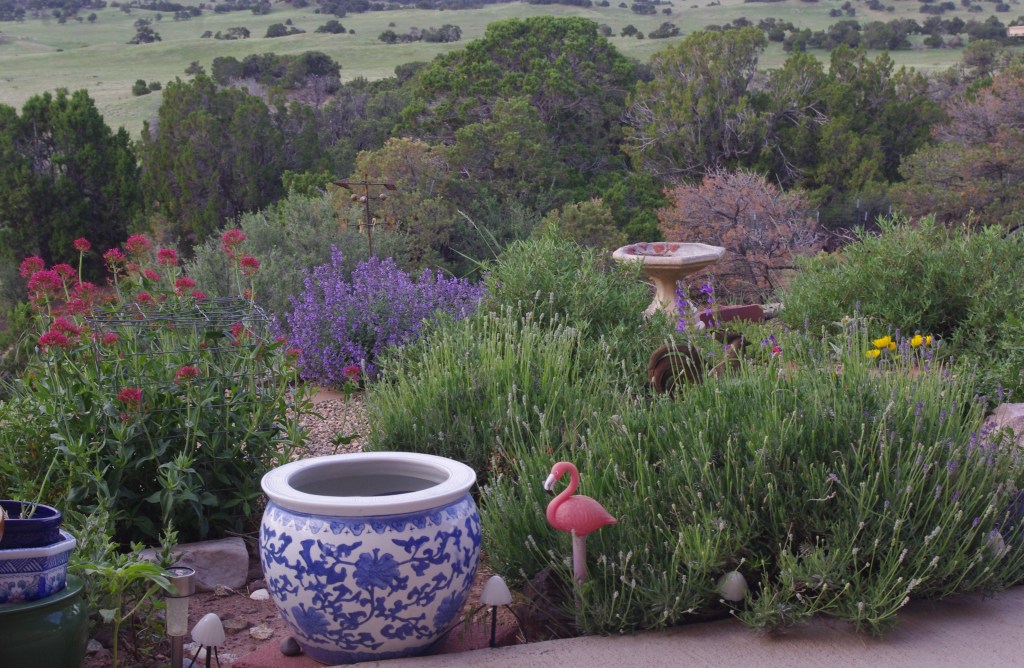
Lavender absolutely loves it up here! And that large Jupiter’s Beard on the left is thriving too.

I forget the name of these cute little yellow flowers, but they sure are tough! Then I have a couple of different penstemons in this grouping near one of my lavender plants. The Blue-mist Spirea bushes with start blooming in July.

This is a view of mid-garden with the steps. Yarrow dominates this area. It seems to be pleased with itself. My native Four-O’Clock is slowly creeping out from under Buddha and that big Catmint plant. It got hit hard by the big snow we had the end of May, that almost froze all the flower heads off! My green shamrock is in the foreground. Thanks Mike!
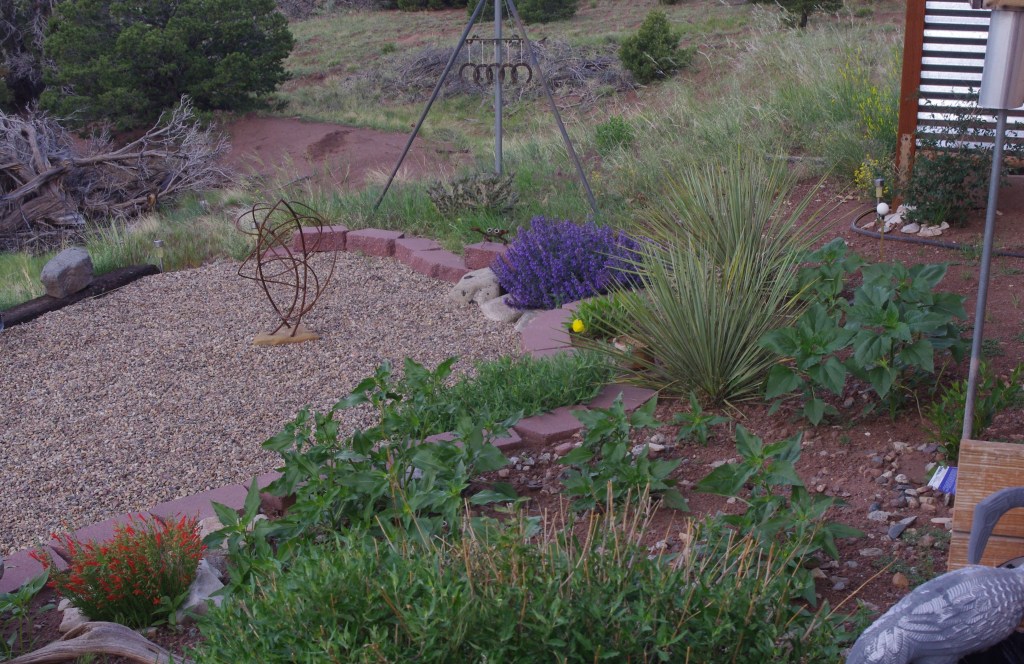
My west end is mostly new or native plants. So excited to see that yellow Evening Primrose start to bloom this morning! The native sunflowers are everywhere over there and I just planted a “Little Kim Lilac” bush over there. Sure hope it survives the wind! Check out a few of Mike’s creations, the metal sculpture and his horseshoe wind chime under the Bluebird’s box.

I should also include this central square of flowers, the first place I planted anything about four years ago. Can you find my metal coil dog? That’s one of Mike’s more recent creations.

Happy to be home!

After just two days up in the northern Colorado cities, Mike and I are always so happy to come home! Speaking as someone with a brain injury, cities increase my stress level immediately, even as we drive north through Pueblo, Colorado Springs and Denver. In summary, being there exhausts my brain energy so quickly. There is also the stress of staying in a different house with different people. All I know is that I need to sleep a lot after I get home to “catch up” on my mental comfort level and health. Of course, psychologists have known for years that:

“City living can chip away at your psychological immune system, which can be precarious for those with a family history of mental illness. According to psychologists , this environmental stress can increase their risk of developing a psychiatric condition, such as anxiety, depression, or bipolar disorder.”

As we drive south out of the metro parts of Colorado, we both breathe a gigantic sigh of relief. We love to return to the life that we love in one of the least populated and developed counties in Colorado. We find slow, quiet, and peaceful is great for our sanity! Our passive solar home always stays cool for free while we’re gone. I miss my garden and Mike misses his cat Rosie when we go on trips.

This is our reward for moving down here eight years ago now… Try to beat that view from your back porch! When I first met Mike he said he wasn’t moving again unless it was to somewhere where he wasn’t looking at the house across the street. Success at last!

I immediately go outside and check on my plants. Luckily nobody got eaten while we were gone 🙂

And yes, I do have some native plants coming up too, like this yucca, a transplanted Cholla cactus and some evening primrose. I sure hope the Cholla decides to bloom this July! It’s flowers are a bright magenta color.

Postscript: The funniest thing I witnessed on our drive through Denver was a trucking company named: “Follow me to Jesus, Inc.” No shit!

Sibling Relationships as our Parents Fade

We all know that death is a part of life, but as a middle boomer, I have been learning first hand about a few of the many emotional issues our parents demise can bring up among siblings. I believe a few of my personal struggles may reflect what other boomers are experiencing.

No, I am not talking about who gets what here, although that can certainly create major animosity between brothers and sisters as our parents pass away. What I am talking about here is experiencing the death of relationships with our siblings as our parents fade, and how these stressors may bring up previous traumas from our past.

Suddenly, after 40 or 50 years of growing apart, siblings may be forced to come together to decide quality of life and death issues for our parents. Differences between siblings can be countless after decades of living separate lives. Brothers and sisters may remain worlds apart. For example, my brother and sister could not possibly be more different.

Here are a few major sibling differences:

Very different health statuses and therefore view of quality of life issues

Differences in standards of living (homeless versus very well-off) & financial need

Differences in ethics and personal style

Very different personal relationships with our parents

Differences in the way we treat each other in difficult emotional times

When we add in parents who may be experiencing varying degrees of decreased mental capacity or dementia, we find an emotionally charged situation which often brings up old differences and new personality conflicts as family dynamics finally get settled. Because family members may be the ones whom we have relied on for emotional support in the past, they can be primary sources of relationship stress. It may take some time and work to understand all the stressors involved if siblings should choose to work through this process as our parents’ health fails. Otherwise this may be the best time to resolve decades of anger and frustration by finally ending a toxic relationship with your sister or brother.

Postscript: I just saw a film that dealt with this issue well, “June Again” a new Australian film.

“You are your ancestor’s wildest dreams!”

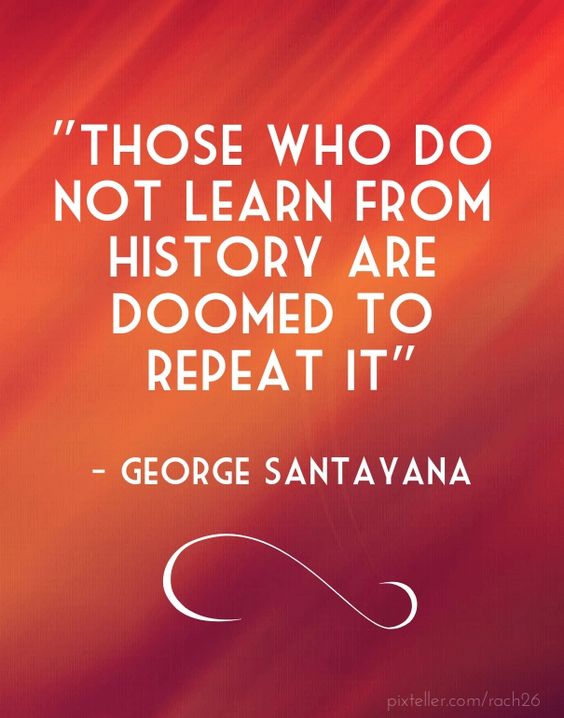
I have always loved history and also found most of us have little real sense of it. And without that strong sense of history, how can we appreciate our family’s or our nation’s progress? One of my graduate degrees is in history, where I learned a deeper appreciation of the simple quote attributed to writer and philosopher George Santayana,

Of course, knowing our history is no guarantee we will learn from it, or change because of it. If we take a hard look at our history with slavery, racism, women’s liberation or gun violence in America, we see some change but certainly nowhere near enough. But with no willingness to even look back and acknowledge what we were like in the past, no progress can be made.

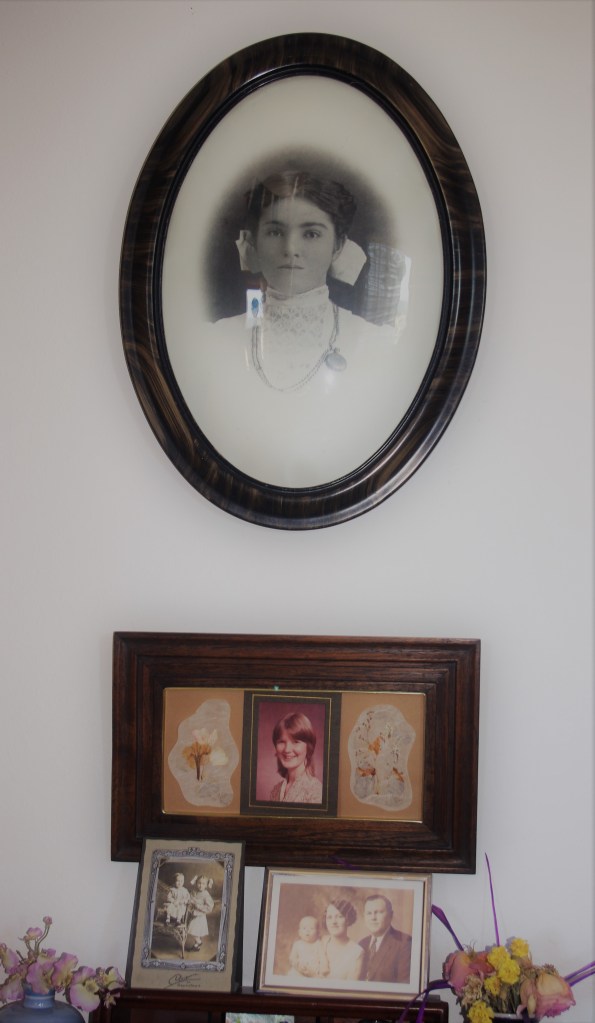
I also enjoy learning about my own family history, which is made so much easier because my mother spent a few years researching both sides of my family back to Germany, Ireland and Scotland. My family history reflects so much progress from our humble immigration to America, to Kansas farmers, business owners, politicians and educators. My grandfather on my Mom’s side, a skilled technician, went door-to-door trying to find any kind of work to support his family during the Great Depression. He ended up owning a major business and took out patents on his many inventions. My grandfather on my father’s side had no time to complete high school, because he needed to go to work to support his family, but Grandpa Carter taught his sons to go to college and even graduate school! And yes, everyone in my parents’ generation became educated, productive citizens.

That is why, when I heard our Ambassador Linda Thomas-Greenfield, Representative of the United States of America to the United Nations say this week to a class of college graduates: “You are your ancestor’s wildest dreams!” I felt so proud of my ancestors and myself!

We need to appreciate our progress as much as our shortcomings and knowing our history is the only way to do just that.

Garden Snow Art – May 22, 2022

OK, so I am not thrilled to find a foot of snow on my just-beginning-to-bloom garden this morning…

…but I do get a kick out of photographing the results of the snow, and besides, WE REALLY DO NEED THE MOISTURE!

Yucca makes a fine pincushion pattern in our sculpture garden!

And there is a little beauty to be found in the midst of a May blizzard. Besides we got over an inch of precipitation! Sure hope those baby blue bird chicks in our birdhouse survived…

Do you feel marginalized as you age? I do.

Perhaps you’ve heard about a new article in The Atlantic by Science journalist Ed Yong entitled:

“The Final Pandemic Betrayal.” Mr. Yong won the Pulitzer Prize in Explanatory Reporting for this “series of lucid, definitive pieces on the COVID-19 pandemic that anticipated the course of the disease, synthesized the complex challenges the country faced, illuminated the U.S. government’s failures and provided clear and accessible context for the scientific and human challenges it posed.

The subtitle of Mr. Yong’s latest article from April 2022 is:

“Millions of people are still mourning loved ones lost to COVID, their grief intensified, prolonged, and even denied by the politics of the pandemic.” I saw an interview with him this week that really hit home for me. At least nine million of us have lost someone we knew and cared for and yet it seems we just go on, ignoring the tremendous losses to so many. In just two years, COVID became the third most common cause of death in the U.S., which means that it is also the third leading cause of grief.

“Each American who has died of COVID has left an average of nine close relatives bereaved, creating a community of grievers larger than the population of all but 11 states. Under normal circumstances, 10% of bereaved people would be expected to develop prolonged grief, which is unusually intense, incapacitating, and persistent. But for COVID grievers, that proportion may be even higher, because the pandemic has ticked off so many risk factors.”

In his recent interview, Mr. Yong discussed what is for me the most important aspect of this horrible loss of life. The groups hardest hit were “marginalized” sections of our society. Who are they? The elderly, those chronically ill, the weakened, the brown, the black and low income groups who have less access to decent health care.

My experience in the past eight years, as I grow older and my own health declines, has been a movement from a “normal” person to one who definitely feels marginalized. First with the aging process we slowly become invisible in our culture, or worse, someone who should just get out of the way of the younger and more vital. Yes, it’s true some help me with doors and seem to feel some compassion for my difficult circumstances, but I have experienced a pulling away from others as I have become more disabled. I have found it almost impossible to make true friends in this rural area. It seems just about nobody believes I am worth their time and energy. I don’t think I would have believed it if I hadn’t experienced it myself.

In this way I have learned what “marginalized” means in this country. We have always put an emphasis on being healthy and able-bodied, and when I was also healthy I rarely noticed what happened to those who are not. Yes, I do have financial resources unlike so many Americans, but I do not live by bread alone. Thanks to those of you who have made an effort to welcome us here. And to the rest of you, I hope you don’t ever become elderly and need a friend.