appreciating nature
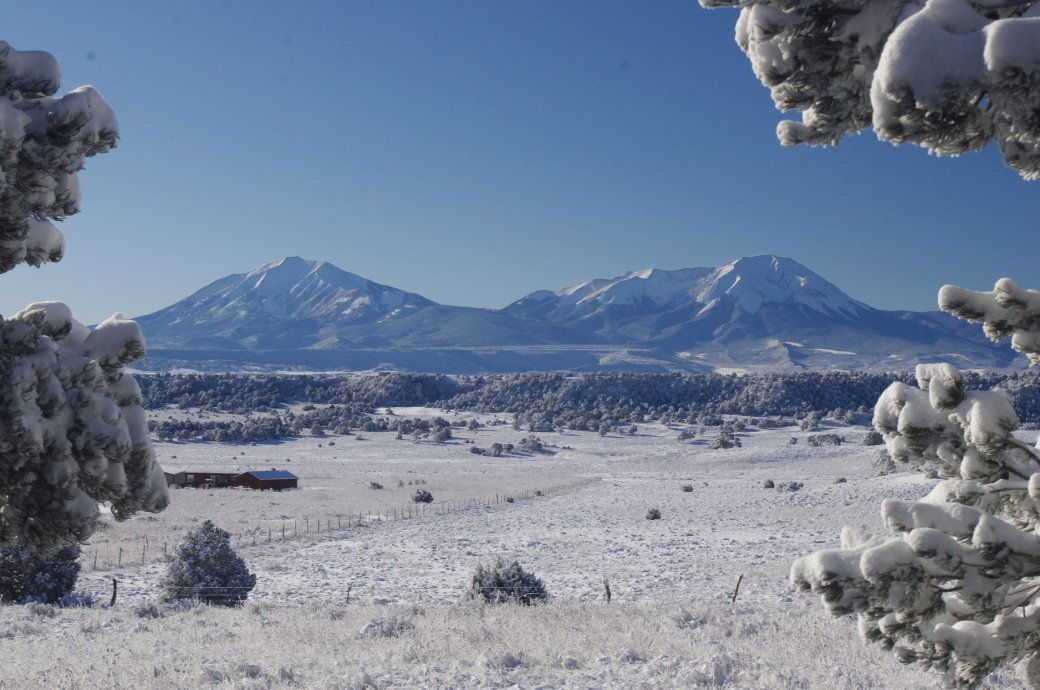
Capulin Volcano in Northern New Mexico

On a stunningly beautiful March day, with temperatures in the 70s, we decided to take a short drive down to Raton and points east yesterday.

Twenty miles east of Raton you will find Capulin Volcano National Monument. This volcano erupted into existence 60,000 years ago. Capulin’s conical form rises 1,300 feet above the plains and reaches 8,180 feet above sea level. A curvy paved road takes you up to the top where you can look down into a caldera or volcanic crater.

The best part? The incredible views looking west! If you look carefully you will see the Sangre de Cristo mountain range in the distance. Those are the mountains we see from our patio west of Walsenburg.

Check out Mount Capulin sometime and learn more about how volcanos form.
The Sandhill Cranes near Monte Vista Colorado!

Here’s another great reason to live here! Only about two hours west of here you will find thousands of Sandhill Cranes, who come through in mid-March on their way back north. A breath-taking vision!
Why we moved to the country to retire
For some reason this spring I keep flashing back to four years ago when we were still living in suburbia in Fort Collins and preparing to move down here to build our solar home…

Here’s an excerpt from my Memoir of Retirement:
I saw a stupid retirement TV commercial last night that really got me thinking. The question was:
Can you keep your lifestyle in retirement?
Say what? It suddenly struck me that this may be the most important difference between those of us facing retirement in the next few years. I for one have NO intention of keeping this lifestyle. If we did, what would be the point of retirement?
My dream retirement involves escaping this lifestyle! I feel that I have become ‘metro-fied,’ and I’m now more than ready for a peaceful escape from my present lifestyle.
I have lived in metropolitan areas for most of my adult life, for access to good jobs. What I have observed is ever increasing crowding, pollution, traffic and aggressive behavior.

Construction begins on our new solar home facing the Spanish Peaks!
What I now long for is a quieter more peaceful existence with just a few people per square mile, where we can enjoy a friendly, caring sense of community; a place where we can make new friends through our daily lives.
We know and accept that this will involve a major lifestyle change, and we are ready for that. No traffic sounds great to us in exchange for less shopping convenience. Valuing and having time for new relationships is what we seek, not more of the same overcrowding, air pollution and road rage.
As I sit in the constant traffic in Fort Collins or Denver these days, I can only think, “This is never going to get better!” People will continue moving here and traffic will keep increasing every year, and I do not want to spend one more precious moment of my life sitting in traffic.
We want out of this lifestyle, the sooner the better!
Postscript four years later: I WAS SO RIGHT ABOUT THIS!
Medical Cannabis, Seizures & Colorado Research
 One thing that continues to increase, since we moved to southern Colorado, is the number of families who move here to be able to properly medicate their children who suffer from severe seizures. Imagine having to make the choice between a good job and the health of your child. That is what our government is asking from these parents. Some move down here because it is so inexpensive to rent or buy a home here, compared to the cities up north.
I have to admire Alexis Bortell, a 12-year-old girl who is spearheading a campaign to legalize medical cannabis across our country. She and her family had no choice but to move from Texas to Colorado to find adequate treatment for her severe epilepsy. Now, her family and a handful of others are suing Attorney General Jeff Sessions and the Drug Enforcement Administration (DEA), demanding “cannabis for the treatment of their illnesses, diseases and medical conditions.” Ever since Alexis began her cannabis treatment, she has been seizure-free for 974 days.
Data from the Epilepsy Foundation:
Does cannabis help seizures?
Evidence from laboratory studies, anecdotal reports, and small clinical studies from a number of years ago suggest that cannabidiol, a non-psychoactive compound of cannabis, could potentially be helpful in controlling seizures. Conducting studies can be difficult as researchers have limited access to marijuana due to federal regulations and even more limited access to cannabidiol; there are also increased financial and time constraints.
Cannabidiol (CBD)
Open-label studies in the U.S. of Epidiolex (a drug derived from cannabidiol or CBD) are being performed. Epidiolex is a purified, 99% oil-based CBD extract from the cannabis plant and is produced by GW Pharmaceuticals to give known and consistent amounts in each dose. The U.S. Food and Drug Administration (FDA) has given some epilepsy centers permission to use this drug as “compassionate use” for a limited number of people at each center.
Recently, gold-standard studies (double-blind, placebo-controlled studies) have finished for difficult epilepsies such as Lennox-Gastaut syndrome (LGS) in children and adults and Dravet syndrome in children. Information from these studies has been presented at major scientific meetings and in press releases by GW Pharmaceuticals.
Results from 214 people who received Epidiolex (99% CBD) in an open-label study (without a placebo control) and who completed 12 weeks or more on the drug were published in Lancet Neurology.
Enter Sangre AgroTech
The most exciting development for Huerfano County, our “orphan” county with around 6,000 souls, has been in the tiny town of La Veta Colorado. WEED, Inc. announced this past July, that it recently acquired Sangre AT, LLC (dba “Sangre AgroTech”), with plans to open a Sangre Bioscience Center, investing over $1,000,000 into the Colorado Medicinal Cannabis Industry.
Sangre AgroTech then chose La Veta for their new research facility whose mission is: “To create a genomics-based Cannabis breeding program that will produce new, genetically-enhanced strains of Cannabis which express the desired plant characteristics for the treatment of disease…”
“At Sangre AgroTech, we are focused on the development and application of cannabis-derived compounds for the treatment of human disease. Targeting cannabis-derived molecules which stimulate the endocannabinoid system, we are developing the required scientifically-valid and evidence-based cannabis strains for the production of disease-specific medicines. Yes, medicines.”
Cannabis in Colorado History & Boomers’ Cannabis Use Patterns
 Colorado is the home of legal medical and recreational cannabis, and come to find out, we have history with this stuff. When Colorado became a state back in 1876, both hemp and cannabis could be grown legally, and they stayed that way for decades. By the late 1800s, cannabis oil was a common ingredient in medical tinctures. Asian-style hashish dens were common in larger cities like New York and San Francisco. Increasing popularity led to concerns that hashish would lead to mass addiction, and in 1906 the federal government imposed the first regulation on cannabis intended for consumption: A product simply had to be labeled if it contained the herb.
Between 1915 and 1917, Wyoming, Utah and Nevada all banned cannabis, and in March 1917, Colorado legislators made the use and cultivation of cannabis a misdemeanor. Those who broke the law were subject to a fine up to $10 and a month in jail, part of the growing national temperance movement that led to Prohibition in 1920.
On November 7, 2000, 54% of Colorado voters to approve the use of marijuana in the state for patients with written medical consent. Under this law, patients could possess up to 2 ounces of medical marijuana and cultivate no more than six plants.
Conditions recognized for medical use include: cachexia; cancer; chronic pain; chronic nervous system disorders; epilepsy and other disorders characterized by seizures; glaucoma; HIV or AIDS; multiple sclerosis and other disorders characterized by muscle spasticity; and nausea. Patients could not use cannabis in public places, or in any manner which might endanger others including operating a vehicle or machinery after medicating.
Since the enactment of Colorado Amendment 64 in November 2012, adults aged 21 or older can grow up to six marijuana plants privately in a locked space and legally possess all marijuana from the plants they grow, and possess up to one ounce of marijuana while traveling,
Since 2012, Colorado sales of cannabis have been staggering! Since legalization, Cannabis sales have topped 13 billion, with 4.5 billion just in 2017. Tax data shows close to 22 million collected just in 2017.
Boomers and Cannabis Use
 If you remember the 60s you weren’t there…
According to the most recent iteration of the 40-year-long “Monitoring the Future” study from the University of Michigan, 85 percent of Americans 50 plus have used illegal drugs, including marijuana, in their lifetimes.
Since 2006, marijuana use has increased significantly among adult Americans age 50 plus. A decade ago, roughly 4.5 percent of people ages 50 to 64, and 0.4 percent of seniors above age 65 had used marijuana in the past year. By 2013, those numbers had increased to 7.1 percent and 1.4 percent, respectively. In percentage terms, marijuana use among 50- to 64-year-olds increased by 57.8 percent, while among seniors ages 65 and up, it ballooned by 250 percent.
This study, based on over 45,000 responses to the National Survey on Drug Use and Health, isn’t the first to note that marijuana use is increasing rapidly among older adults. But it digs more deeply into the demographics of older Americans’ marijuana use, uncovering some interesting findings. For example European-Americans and African-Americans are much more likely to indulge in cannabis than Latinos. Low-income and married Americans are more likely to partake than separated or divorced, but single or widowed Americans use cannabis the most.
Many 50+ Americans are using cannabis to deal with mental health issues. Among those 50 and older, people who have suffered with depression or anxiety in the past year are much more likely to use cannabis medically. A number of studies have shown a link between marijuana use and mental disorders. Given the widespread prevalence of medical marijuana laws, some seniors may be turning to cannabis as an alternative treatment for the ailments of old age.
One study found that Medicare reimbursements for a number of common prescription medications dropped sharply after the introduction of medical marijuana laws.

