Observing two different dementia experiences

I just realized yesterday that in the past few years my sister and I have been witnessing two different dementia experiences up-close and personal. Since my father’s death in March 2020, both our mother and our brother have been slowly losing touch with reality. While my sister has taken care of our mother in a “quality” assisted living facility in Denver, Mike and I have been doing our best to assist my brother in a small rural town in southern Colorado. Another aspect of these different experiences is that my mother has retirement funds to spend on her care, while my brother receives all of his care through us, Medicare, and Medicaid.

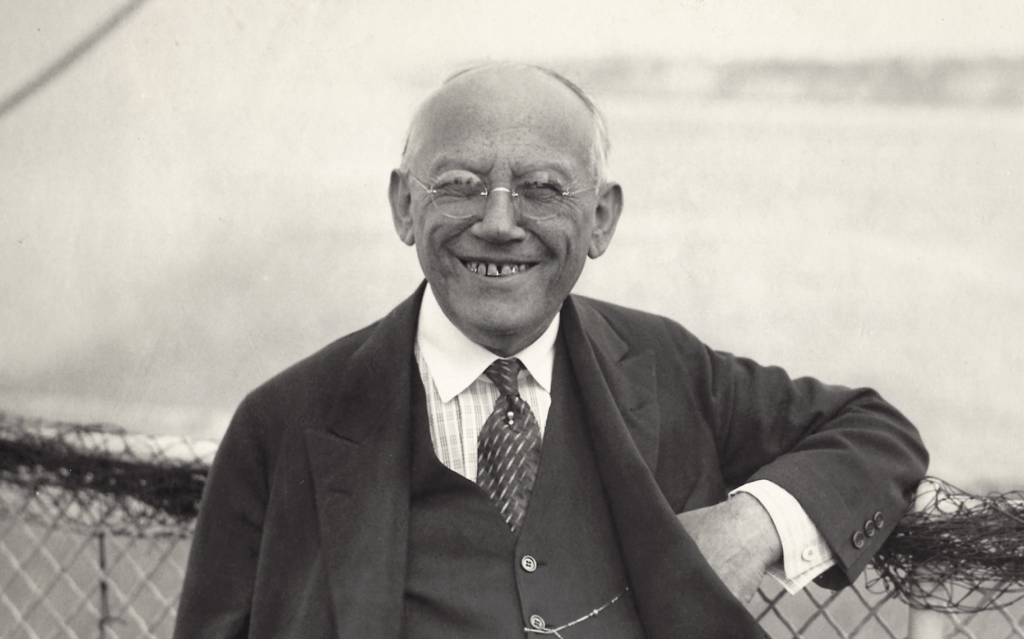
Our brother John, Christmas 2021

The experience I am most familiar with is that of my brother. He came here at the end 2020 from a lean-to he had been living in near Oak Creek north of Sedona for a number of years. He knew he could no longer live that life with no assistance if he needed it. He had a few health problems then, but he was generally doing well. Since then he has started on supplemental oxygen and various other drugs and supplements. Only in the past year of so has he begun complaining constantly of “total brain fog” and terrible memory lapses.

Our mother (on right) at my father’s 90th birthday party, February 2019

Since our Dad died in 2020, right before the “COVID years,” Mom was forced to live alone for a while. She entered assisted living two years ago as her memory continued to fail her. Hers seems to be more like classic Alzheimer’s disease with gradual memory loss. She no longer cares how she looks or what she wears, and only occasionally reflects on her many losses. However, she is still quite aware that her memory is failing her. This really is the long goodbye for us…

Luckily my sister and I have each other and our husbands to share our concerns and losses, but it is still quite a challenge to watch our family fall apart before our eyes. As my sister says, with her decades of experience in the fields of long term care and gerontology,

“Everyone tells you that aging is tough, but you don’t really get it until it happens to you…”

Rewilding, some positive nature news at last!

If you tire of hearing ever more negative news about how we humans continue to pollute and destroy the earth we depend on for life itself, try watching this five minute story from this week’s CBS Sunday Morning. Trust me, you will be glad you did!

Rewilding: Letting nature take over

Rewilding is a progressive approach to conservation. It’s about letting nature take care of itself, enabling natural processes to shape land and sea, repair damaged ecosystems and restore degraded landscapes. Through rewilding, wildlife’s natural rhythms create wilder, more biodiverse habitats.

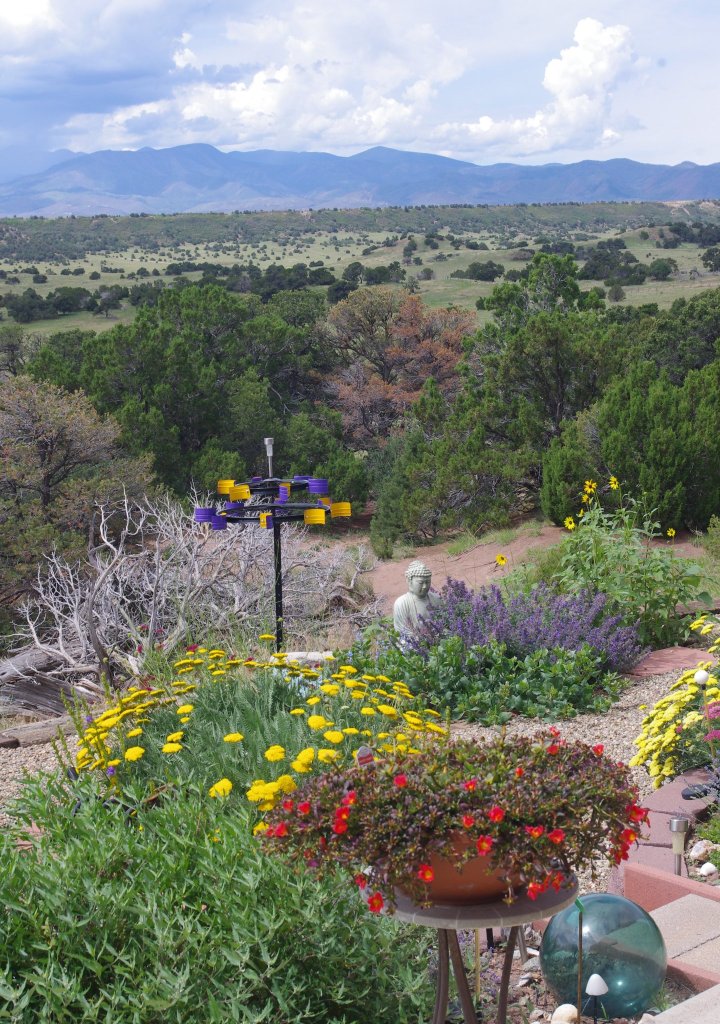
By growing native, drought-tolerate plants here, we have encouraged the return of wildlife, birds, bees, etc.

This idea/story offered me a sign of relief, showing me that sometimes nature wins in a great win-win way for people too. This is what my late father was always talking about, letting nature take over, because she did a great job up until now! This is also what we have tried to do on our own three acres in southern Colorado. I just do not comprehend those who buy land in the country and begin mowing the crap out of it immediately. We hated “yard work” when we lived in suburbia, and guess what, all the birds and bees and other wildlife there also could not tolerate it. They need biodiversity to thrive. Rewilding is a form of ecological restoration aimed at increasing biodiversity and restoring natural processes to the land.

Why is it so hard for man to simply leave nature alone to take care of itself? Why are we so convinced that we need to “improve” it? We as a species must learn the answer to this question before we “improve” ourselves into complete extinction.

Survival in my CO Foothills/Mountain Garden

First, let me say, gardening is so much fun and so rewarding! It makes me look forward to spring with such enthusiasm! But that is not to say that there aren’t some MAJOR disappointments as well.

My greatest problem here at around 7,000 feet just north of the Sangre de Cristo Mountains are the critters that come out at night and champ off the flowers on my plants that are just about to bloom for the first time in a YEAR!

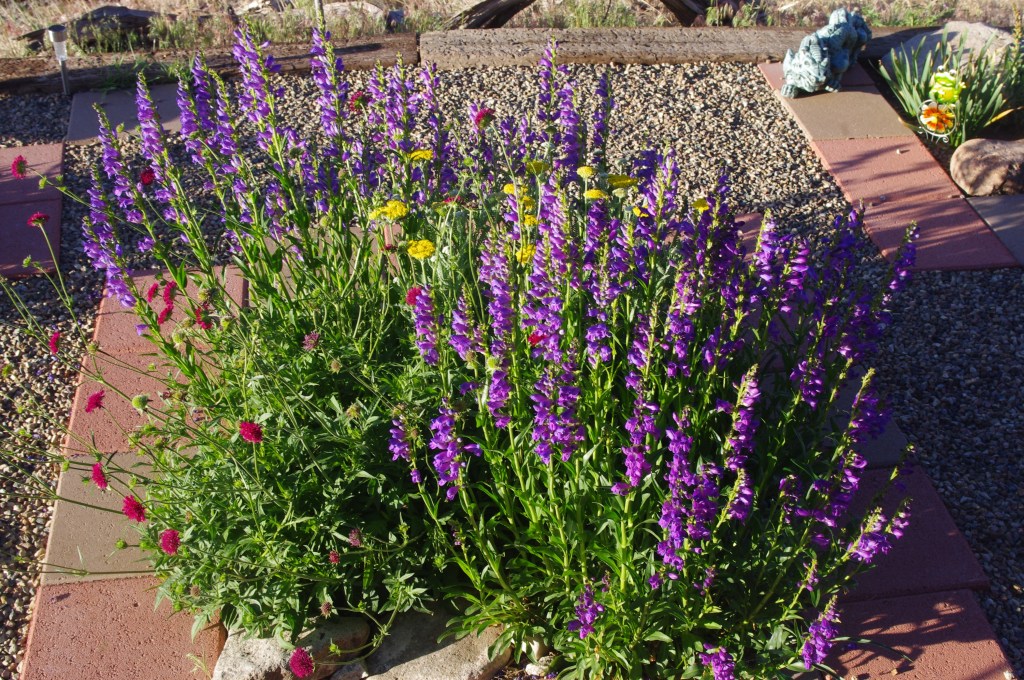
For example, my first few years I had the most beautiful Rocky Mountain Penstemons. These are from spring 2020.

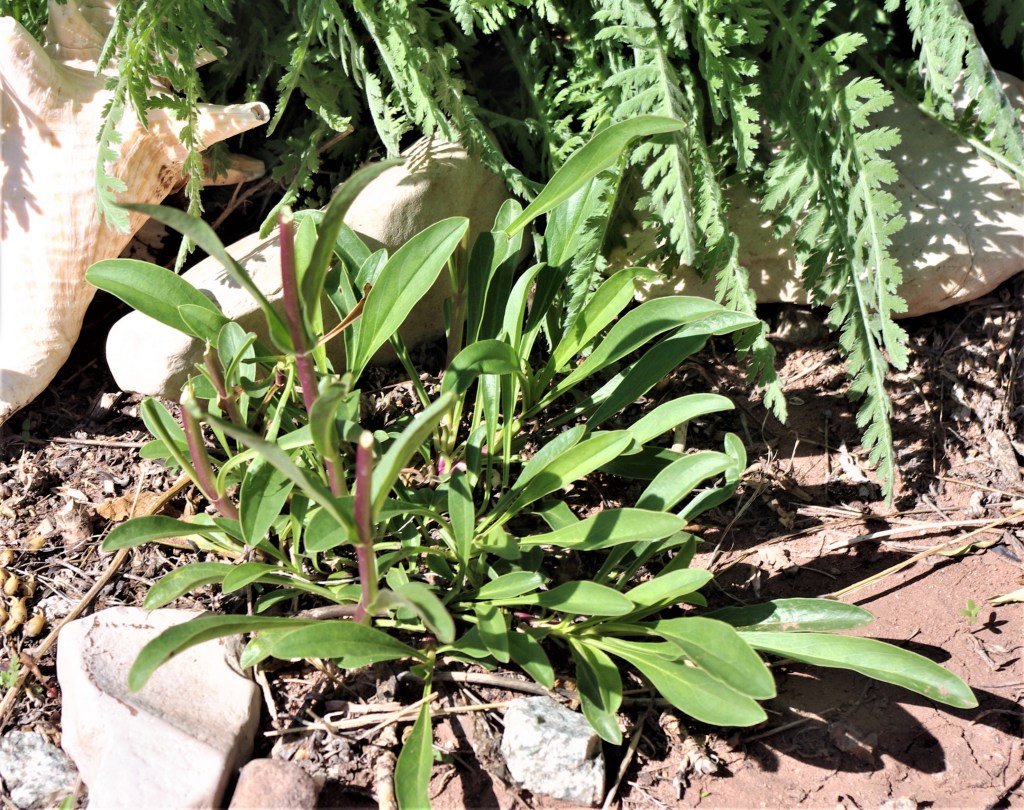
Since then, every time I see a new crop is thinking about blooming they get eaten off overnight. I know I can cover them, but I somehow get convinced that this year will be different and then it isn’t. They even ate some of my native penstemons last night! I’ve also had very bad luck with Evening Primrose out here.

Slowly but surely I’ve turned to the mostly shrub-type plants that never get eaten and seem to love life here.

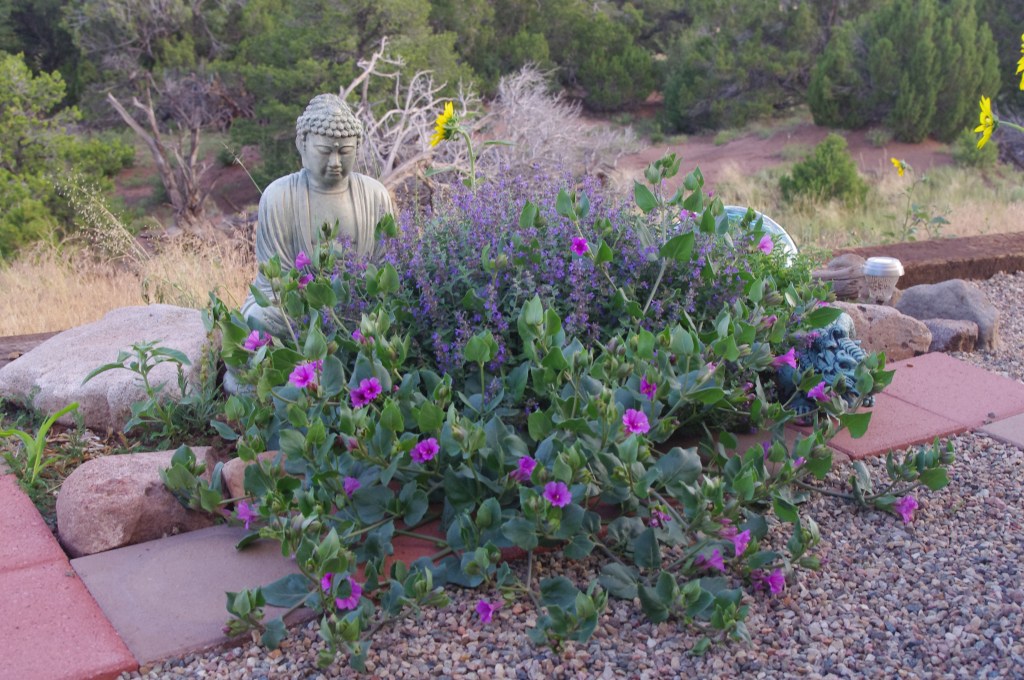
I’ve never had any problems with my Walker Catmint, here with a native Four O’Clock growing through it!

The Blue-Mist Spirea on the left has not yet bloomed, but the yarrows and lavender are quite happy!

I love when my Jupiter’s Beard comes in for the contrast to all of that purple out there. I seem to almost always choose the purple or yellow plants. I have learned that any plant that is woody and herbal, the animals don’t eat, like lavender.

And if I want to grow some annuals, I put them up far away from the critters!

Finding the Strength to Let Go of Self

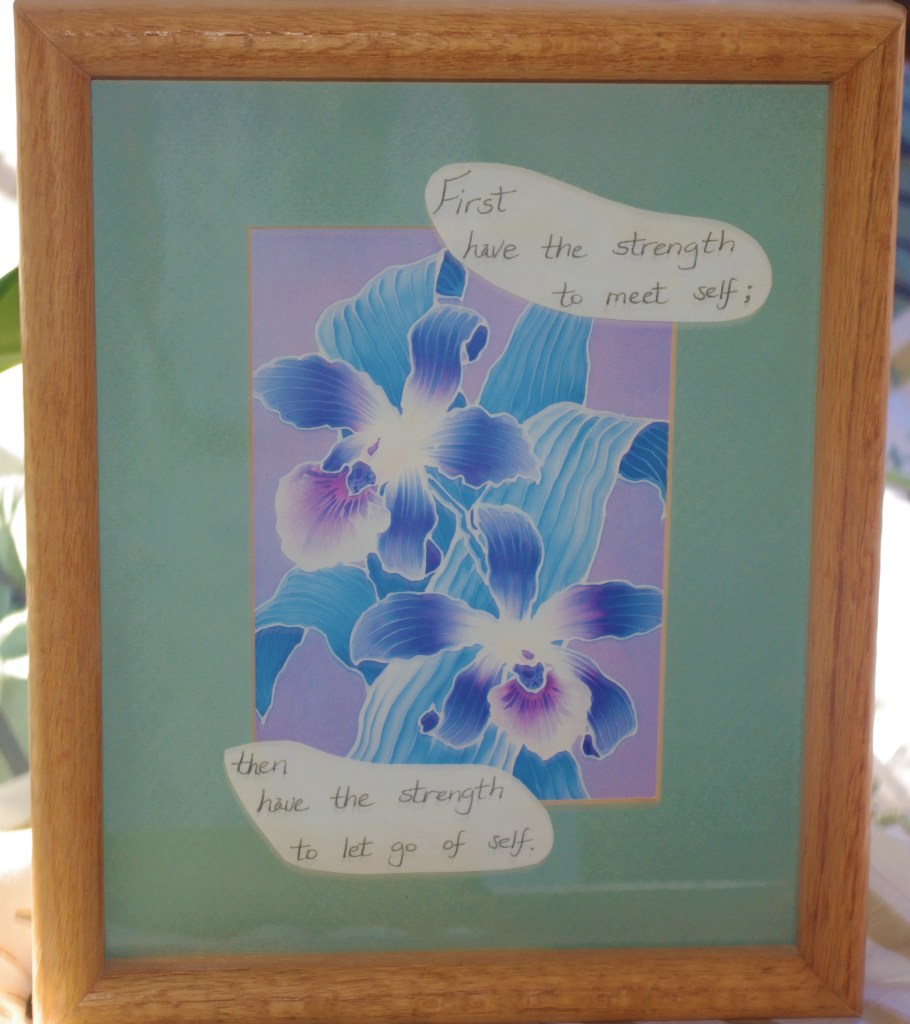
I believe our lives are a process of finding and confronting our true Self, and then slowly letting go of it as we age. Some might prefer the word ego in this scenario. I have had this message on my wall for decades:

What is the ego or sense of Self?

ego: a person’s sense of self-esteem or self-importance, the part of the mind that mediates between the conscious and the unconscious and is responsible for a sense of personal identity.

The way I relate to my sense of Self is to know that as a child and young adult my ‘job’ was to develop my sense of who I was inside, what did I think and value? How should I treat others? How did others see me? This naturally leads to a strong sense of self-consciousness, sometimes painfully so. Then came the time to figure out what I planned to do in the world. How did I hope to change my world? These are the purposes of young adulthood up until our forties or so.

Developing a strong sense of self or ego is a good and necessary part of being human. There is nothing wrong with having a strong ego, but it needs to be regulated. Problems arise when ego affects your decision making process, turning you into a victim, or when it makes you feel superior to others in order to justify your bad behavior. A toxic ego is one that does not learn from bad behavior, but instead blames others, often descending into negativity, resentment, and even violence.

For the past twenty years, my spiritual path has been that of the second part of life. I have been searching for the strength to let go of self. A part of this process is simply getting comfortable with self compassion and death. Although we might think we have a strong sense of self when we are younger, if we are very honest we may find much self-criticism inside. This is all a part of the ego. Like we really did have the power to change any part of our world…

Being close to nature is your best path to realizing your place in the history of time. Please note, there are no other animals or plants that believe they are changing the world. There are no other beings that fear death. They know what their part is, to be born, to live and then die. I have found a gradual process of getting used to the idea of death is the best path for me. At first is was so hard to be with so I would push it away and deny its power. Since I started facing some powerful signs that I won’t be around forever (lung disease and brain injuries) in the past few years, my acceptance has grown like my garden outside my door, bright and beautiful.

What were you born to do?

I heard an expression lately that struck me in a good way and reminded me of my upcoming birthday. Of all the ways there are to say it, I think asking, “What were you born to do?” gets down to the basics of our very existence here on earth. I was born 68 years ago into the mid-1950s, the third kid in a lower middle class family. My Dad was just finishing his PhD at the University of Iowa while my Mom worked nights to keep our family going. No, my family really didn’t need another child, but there I was.

On my first birthday, my Mom made me a cake and then my brother and sister cheered me on as I first learned about the intricacies of blowing out my one candle…

It took me quite a while to figure out what I was born to do and in my case it had little to do with how I earned my living. For as long as I can remember money was never that important to me. Fine qualities of character are what I look for in everyone I meet, and even more so today. Through decades of trusting the wrong people, I learned how to identify those worthy of my trust.

“Experience is the best teacher, and the worst experiences teach the best lessons.

Through a lifetime of experiences I have learned more and more about who I am and what I value. From these I can now clearly identify what I was born to do:

I was born to love unconditionally, but very selectively.

I was born to love the earth & sun, and conserve nature in all forms.

I was born to travel the world.

I was born to try to understand human nature and animal psychology.

I was born to love dance, beautiful movements, and especially in ice skating.

I was born to love intellectual stimulation, learning, research, books and the visual arts.

I am a natural born plant and flower lover!

So on this, my 68th year on earth, I now wish myself a heartfelt: