Country life south of Pueblo Colorado

 One aspect of Kya’s life I found easy to relate to, was how she observed or read about animal behavior to inform her about human behavior. This comes through clearly as she describes the behavior of the lawyers during her trial. Ever since I saw the short nature documentary film
Inspiration for uncertain older writers (like me!)
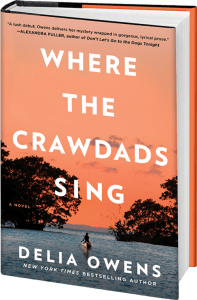
Have you heard yet the story of Delia Owens? I happened across her story on CBS Sunday Morning yesterday and felt new encouragement. She’s 70 and a loner from way back. Her new and first novel is Where the Crawdads Sing, although she has published non-fiction before (like me). This novel is tough to categorize; it’s a love story, a murder mystery, a courtroom drama, and an ode to the outdoors – all in one. It took her the better part of a decade to write, inspiration coming whenever it came.
I love the way she waits for wisdom even in her sleep:
“I sleep at night with a little pad of paper in my bed with a flashlight and a pen, and I wake up in the middle of the night and write something down,” she said. “Something that I think is brilliant! And then when I wake up in the morning I’ll look at it and half the time I can’t read what I wrote.” A thousand such moments became little scraps of gold, like this one:
“Sand keeps secrets much better than mud.” That one made it into her book.
I found her whole story so inspirational. I also constantly find ideas or quotes popping into my head, especially in the shower, the source of my greatest inspiration. I must have a million snippets of paper like that, and never use these in my books, and the freedom of writing fiction also excites me.
We’ll see if any of these ideas go anywhere, but in the meantime, I love the fantasy!
What I like about two movies I almost didn’t see: Bohemian Rhapsody & First Man
 After I watched the Oscars, I decided to see a couple movies that I had skipped over before. I skipped “Bohemian Rhapsody” because I figured it was a concert movie and I wasn’t completely sure who Queen was anyway. I know I can be pretty out of it sometimes… I skipped “First Man” because I have never been that interested in space flight. It sounded like a “male movie” to me. Mike convinced me to reserve these two at the public library, just in case we were missing something good. He was right. As most of you know, Bohemian Rhapsody is a 2018 biographical film about Freddie Mercury, lead singer of the British rock band Queen. When Rami Malek won the Oscar for best actor, they were exactly right! What an amazing performance! What an interesting character!
What I liked best about this film, besides watching tremendous acting and great music, was the way the makers included a truly sad part of our history as human beings. The way gays were treated back then, and especially if they contracted HIV/AIDS, is an embarrassment to all of us. I thought the writers dealt with this issue very well in this film.
 Then I watched “First Man” last night. The two things I took away from this film: exactly how courageous our first astronauts were, and the price they and their families paid for that courage. Who knew that Neil Armstrong had a two and a half year old daughter who died of a brain tumor in 1961? Although Neil Armstrong was obviously the hero of this story, I focused on his wife, played wonderfully by Claire Foy. Didn’t these guys get any kind of counseling for what they were going through? Their wives sometimes seemed like the real heroes, sitting at home with their children wondering if they still had a husband. And when their husbands did come home, how traumatized were they? Since back in the sixties men were raised to hide all emotions except anger, the wives bore the brunt of all of those confusing and repressed feelings. I was left wondering if either our astronauts or their families had any idea of what they were getting into when they signed up for this mission.
If any of this sounds interesting to you, see these two excellent films!
American Women and Their Long Struggle for Equality: Women’s History Month and the ERA
March is “Women’s History Month” in the USA, and like most attempts to honor and respect women, “Women’s History Month” took many years to become official in Congress.
In fact it took from 1981 to 1995!
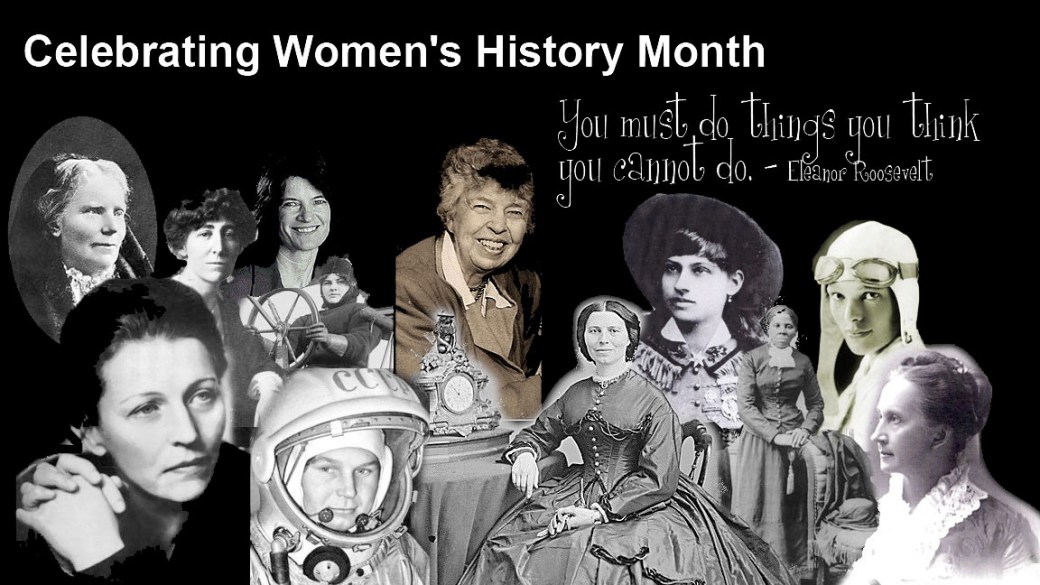
Before women had the whole month, the U.S. recognized Women’s History Week; before that, a single International Women’s Day. Dedicating the whole month of March in honor of women’s achievements may seem irrelevant today, but at the time of the conception of Women’s History Week, activists saw the designation as a way to revise a written and social American history that had largely ignored women’s contributions.
Women’s History Month had its origins as a national celebration in 1981 when Congress passed Pub. L. 97-28 which authorized and requested the President to proclaim the week beginning March 7, 1982 as “Women’s History Week.” Throughout the next five years, Congress continued to pass joint resolutions designating a week in March as “Women’s History Week.” In 1987 after being petitioned by the National Women’s History Project, Congress passed Pub. L. 100-9 which designated the month of March 1987 as “Women’s History Month.” Between 1988 and 1994, Congress passed additional resolutions requesting and authorizing the President to proclaim March of each year as Women’s History Month. Since 1995, Presidents Clinton, Bush and Obama have issued a series of annual proclamations designating the month of March as “Women’s History Month.”
What happened to the Equal Rights Amendment to the Constitution?
Yes, it is now OK to honor women, but still not OK to offer them equal rights under our constitution. The Equal Rights Amendment (ERA) is a proposed amendment designed to guarantee equal legal rights for all American citizens regardless of sex. It seeks to end the legal distinctions between men and women when it comes to divorce, property rights, employment, and other matters.
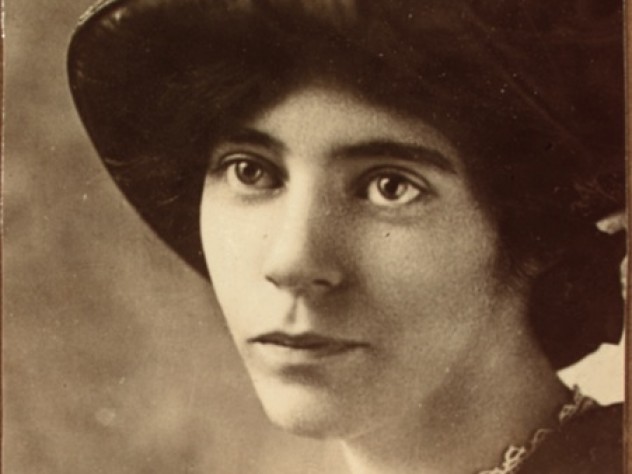
Alice Paul: Courtesy of the Historic National Woman’s Party, Sewall-Belmont House and Museum, Washington, D.C.
The ERA was originally written by Alice Paul and Crystal Eastman. and was introduced in Congress for the first time in 1921. It has prompted many conversations about the meaning of legal equality for women and men ever since.

“In the early 20th century, women who worked outside of the home were primarily low-income factory workers without recourse to oppose the inhumane treatment and serious discrimination they faced. In growing the suffrage movement, activists aligned themselves with the growing female labor force to promote the expansion of labor rights women’s suffrage would help to make a reality. By reaching out to some of the women most hurt by a lack of voice, the suffragist movement gained incredible power in its fights for the vote.
American women gained more than just the right to vote in 1920. After decades of fervent activism and organizing, suffrage finally gave women access to political involvement and the legislative process .The era following the 19th Amendment’s passage saw a dramatic increase in women’s participation in both the workforce. Though societal expectations certainly continued to limit women in many ways, this increase in workplace participation and access to political influence has helped them make amazing strides towards equality at work.” — SOURCE: https://www.equalrights.org/womens-equality-day-where-would-we-be-without-the-vote/
In the early history of the Equal Rights Amendment, middle-class women were largely supportive, while those speaking for the working class were often opposed, pointing out that employed women needed special protections regarding working conditions and employment hours. With the rise of the women’s movement in the United States during the 1960s, the ERA garnered increasing support, and, after being reintroduced by U.S. Representative Martha Griffiths (D-Michigan), in 1971, it was approved by the U.S. House of Representatives on October 12 of that year and on March 22, 1972, it was approved by the U.S. Senate, thus submitting the ERA to the state legislatures for ratification, as provided for in Article V of the U.S. Constitution.
Congress had originally set a ratification deadline of March 22, 1979, for the state legislatures to consider the ERA. Through 1977, the amendment received 35 of the necessary 38 state ratifications. With wide, bipartisan support including that of both major political parties, both houses of Congress, and Presidents Nixon, Ford and Carter, the ERA seemed destined for ratification until Phyllis Schafly mobilized her followers against it . These women argued that the ERA would disadvantage housewives, cause women to be drafted into the military and to lose protections such as alimony, and eliminate the tendency for mothers to obtain custody over their children in divorce cases. Labor feminists also opposed the ERA on the basis that it would eliminate protections for women in labor law. The 15 states that did not ratify the Equal Rights Amendment before the 1982 deadline included: Alabama, Arizona, Arkansas, Florida, Georgia, Illinois, Louisiana,Mississippi, Missouri, Nevada, North Carolina, Oklahoma, South Carolina, Utah, and Virginia.
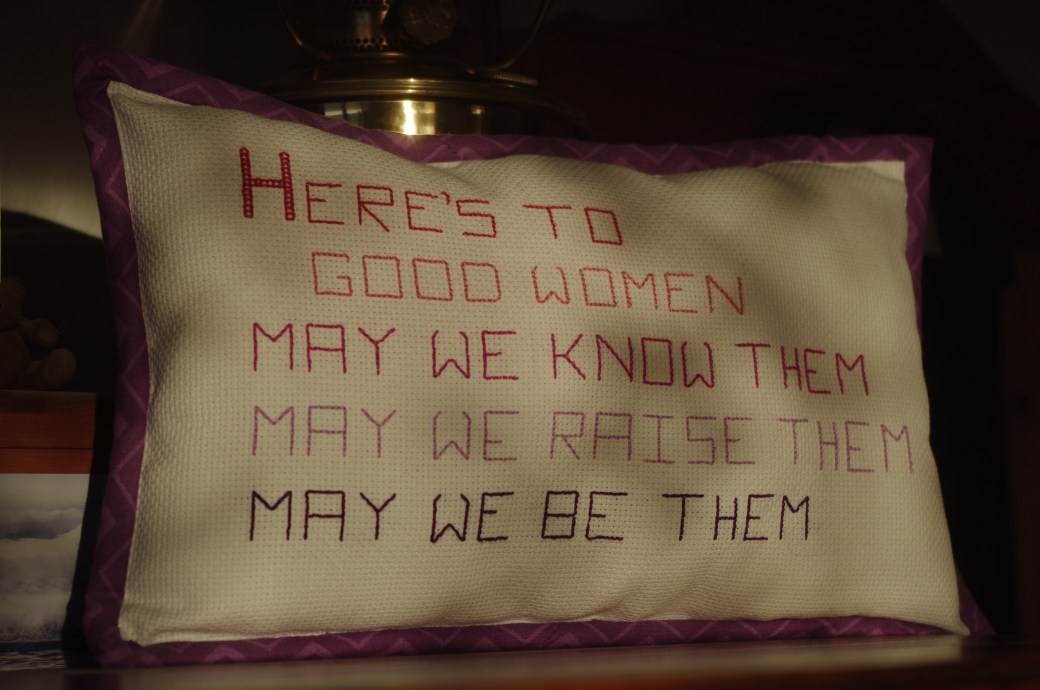
Pillow embroidered by my Mom as gifts to her daughters and granddaughters!
I have to say, I find it amazing that in a country like ours, our equal rights are not a given. This is just another example of how threatening women are to men’s power. After all, where would they be without us? I LOVED the results of the 2018 election.
I guess we need to take over Congress to make it work better!
How we steal the bright side from ourselves everyday: Try some cognitive reframing

The most fortunate are those who have a wonderful capacity to appreciate again and again, freshly and naively, the basic goods of life, with awe, pleasure, wonder and even ecstasy. — ABRAHAM MASLOW
Although I learned this psychological tool decades ago, I am always re-learning its usefulness in my own life. What is cognitive reframing? Here’s a definition from an article by social worker Amy Morin:
“Reframing is a technique used in therapy to help create a different way of looking at a situation, person, or relationship by changing its meaning. Also referred to as cognitive reframing, it’s a strategy therapists often use to help clients look at situations from a slightly different perspective.”
I have found that choosing a “different perspective” can also be the opposite of what I automatically go to in my own mind.
The point is that we can and do choose how we see ourselves and our lives everyday.
If we were raised with a critical or negative view of ourselves and how the world works, the way we will see our lives may be destined to be critical or negative, but that is not the only way to see ourselves. That is not the only reality behind our circumstances.
Here is an example from my own life:
In my present life I may tend to focus on all of the difficult challenges Mike and I have faced since we decided that we needed to leave Fort Collins behind for many good reasons. I may choose to focus on how much money we left on the table by selling our Fort Collins home before prices went way up up there, how expensive and stressful it was to build down here in a rural area, etc, making me critical of our past decisions. Or, I may choose to see exactly how fortunate I have been in spite of many tough misfortunes in the past few decades; to be here now, retired comfortably and happily, and most importantly together!
In addition there are the greater misfortunes of Mike’s horrible experience with CFS for decades, my inability to find another job in libraries at age 49, my traumatic head injury at age 53, and many more difficulties that just come up as we age. Considering all of these factors, we are more than fortunate. How can we be anything but filled with GRATITUDE that we made it to this soft place to fall in this beautiful place?
That is how reframing works, and it can be used in all parts of your life on a daily basis…

leading to overwhelming feelings of gratitude, a feeling we could all use more of!
Colorado Rocky Mountain High!
Boomers: Contrary to popular belief, not the American generation who had it made…
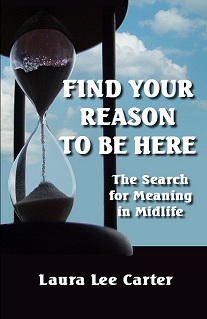 Ever since I heard from a fellow writer about a troll who goes around trashing boomers for ruining their life, I have been thinking about how the generation we are born into affects how we choose to live our lives and how we see ourselves. I have been studying this issue for years now, and wrote about the boomers’ place in history, how our lives compared to our parents, and how we are different psychologically, in my book Find Your Reason To Be Here: The Search for Meaning in Midlife, published in 2013.
“Our generation began with a literal BANG! when the USA used two nuclear bombs against Japan in 1945. Then in 1962, as children, we witnessed the Cuban Missile Crisis, a time when there existed roughly enough nuclear weapons on earth to erase human civilization one thousand times over. Our parents sat on the edge of their seats, wondering if the human race would simply disappear from this earth in nuclear holocaust. One cannot help but wonder what the long-term emotional consequences are of experiencing this type of worldwide threat as a small child. This is an important question that may be hard to pin down but cannot be ignored.” (page 7 in my book)
We were also the beginning of the “Age of Permanent Distraction” we see today:
“At times it seems we [boomers] were nothing but guinea pigs in a long line of mind-clutter experiments. As in no previous generation, our brains have been filled with far too much mindless television, in-your-face commercialism, and non-stop media coverage. We were the first generation to grow up with television. From the music of the early years, most notably rock ’n’ roll, transistor radios and then “boom boxes” allowed us to distract ourselves constantly by carrying around our music everywhere we went.” (page 9 in my book)
Contrary to some young ones who believe we had it made in our youth, with great jobs opportunities, spoiled rotten while we gobbled up natural resources as fast as we could with no regard for the future, our generation was found to be “the gloomiest generation” by the Pew Research Center in 2008.
Most boomers are under serious financial strain today, worrying more often than their parents did about money, and suffering a number of stress-related illnesses as a consequence. Many of us are also feeling financially stretched because we are supporting both our children and our aging parents. More than half of boomers still provide financial support to at least one adult child.

The death rate among Americans 45-54, increased dramatically between 1999 and 2013 compared to other developed countries.
“The increased deaths were concentrated among those with the least education and resulted largely from drug and alcohol “poisonings,” suicide, and chronic liver diseases and cirrhosis. This midlife mortality reversal had no parallel in any other industrialized society or in other demographic groups in the United States.”
Stress is perhaps the single most important psychological factor affecting boomer health today, contributing to higher midlife suicide rates than any other developed country. Poor self-esteem is another important stress-related factor that can and does lead to a number of chronic health problems. Poor self-esteem can cause us to indulge in addictive behaviors like excessive shopping, overeating, and gambling, and overuse of alcohol, tranquilizers, antidepressants, and sleep aids. People with low self-esteem also are less likely to maintain stable social relationships.
But I guess the statistic that concerns me the most about my generation is that most of us have little or no savings for retirement. No wonder so many of us are depressed. The future doesn’t look good for most of us.

