“Words” from a Broken Brain

For as long as I can remember, I have always loved words. Even before I learned English, I made up my own language to communicate with my cat and doll. Words meant so much to me. They seemed like magic. With the right words you might get others to understand your most important and secret feelings. With words you could begin to understand other peoples’ worlds. They were the key to everything!

As I grew I kept loving them more and more. Even though, or perhaps because, I was a book worm at heart, words were my own kind of magic. So I read everything I could, especially about other women’s lives. I wondered how they made it through the difficult world I saw outside my door. Words were my key to understanding my world. Then I learned how words could resolve misunderstandings and bring people closer together, another form of word magic. I always wanted to learn more.

Eventually I became a librarian with a whole building full of words. So many stories from all over the world, explaining why we do the things we do. I wanted to learn everything in those books! I began to wonder if I might write a book someday, but then I would find a book that expressed my ideas or feelings better than I could and say, “See, I hasn’t meant to be a writer.”

My own version of a midlife crisis at age 49 changed my mind. I felt like I had to write to understand and explain to others what I was experiencing. This phenomenal transition was too important for others to miss out on. That is when I became a writer. I started a blog that took off, with thousands of followers who seemed to understand what I was talking about. Words helped me to expand my world, all around the world! I had friends in Europe, Asia and Australia who understood the exceptional opportunity of changing everything in midlife.

Since then much has changed in my life. A traumatic brain injury in 2008 began to stand in the way of my wonderful relationship with words. I did get back to writing and still loved it, but then I learned, through a few concussions, that I needed to live on oxygen fulltime. And the concussions took their toll. Now I can only properly handle fewer and fewer words. A conversation with another can only go on for an hour or so before my brain gets tired and needs some silence to rest up for more time with others. Some days I have trouble remember the most basic words, like yesterday I had a hard time remembering the word for “dimples.”

For all of these reasons I will not be writing here much longer. My joy in writing is diminishing slowly. The concentration required seems to hurt my mind, especially being on the computer so long. After writing something like this I have to stare off into space for a while to recuperate.

But I do still love words and will continue that relationship for as long as I live. And I will also continue to admire when other writers get it so right. I believe this writer got it right in describing my favorite vision of life after death:

“There is a moment when your dreams and memories merge together to form a perfect world. That is heaven. Each heaven is unique. This is the world of you. The land is filled with all you hold dear, and the sky is your imagination.” – From the end of the movie “1883” written by Taylor Sheridan
Not age limits. Let’s use neuropsychological tests

Did you know that our country was one of the first in world history to create and do psychological testing on our candidates for military service in World War I? When you are fighting right next to others in trenches, mental stability is quite essential. Psychological and neurological testing is used in numerous ways today to qualify candidates for all kinds of jobs, why not for the most important jobs in the world?

Neuropsychological Testing is a test to measure how well a person’s brain is working. The abilities tested include reading, language usage, attention, learning, processing speed, reasoning, remembering, problem-solving, mood, and more.

With all the talk about age and abilities around our presidential candidates, etc. I would like to explain why age is not necessarily the issue here. Candidates like Donald Trump refer to terms like mild cognitive impairment (MCI) as if we had no way to impartially test for these problems without prejudice. There are excellent ways to test this. I know because I was tested recently.

I had one of these two hour tests last year, administered by a consulting neuropsychologist. Areas tested include attention and processing speed, verbal memory, visual memory, executive function, constructional praxis, apathy, depression, anxiety and sleep. My first observation was how exhausting it was for my brain. I had to sleep for a day afterwards to recover. But I already knew my worst problem was how quickly my brain wears out, and when it’s tired there no solution but rest. I also learned that as a person with mild cognitive impairment, I should not be working or running for any office.

I am certain the American public would benefit by testing such important personages as candidates for president and Congress in this way. What most do not understand and what I had to find out the hard way is that a person’s ability to serve is certainly not about age. It’s about cognitive strength or impairment. We have great tests for that. Let’s use them.

Observing two different dementia experiences

I just realized yesterday that in the past few years my sister and I have been witnessing two different dementia experiences up-close and personal. Since my father’s death in March 2020, both our mother and our brother have been slowly losing touch with reality. While my sister has taken care of our mother in a “quality” assisted living facility in Denver, Mike and I have been doing our best to assist my brother in a small rural town in southern Colorado. Another aspect of these different experiences is that my mother has retirement funds to spend on her care, while my brother receives all of his care through us, Medicare, and Medicaid.

Our brother John, Christmas 2021

The experience I am most familiar with is that of my brother. He came here at the end 2020 from a lean-to he had been living in near Oak Creek north of Sedona for a number of years. He knew he could no longer live that life with no assistance if he needed it. He had a few health problems then, but he was generally doing well. Since then he has started on supplemental oxygen and various other drugs and supplements. Only in the past year of so has he begun complaining constantly of “total brain fog” and terrible memory lapses.

Our mother (on right) at my father’s 90th birthday party, February 2019

Since our Dad died in 2020, right before the “COVID years,” Mom was forced to live alone for a while. She entered assisted living two years ago as her memory continued to fail her. Hers seems to be more like classic Alzheimer’s disease with gradual memory loss. She no longer cares how she looks or what she wears, and only occasionally reflects on her many losses. However, she is still quite aware that her memory is failing her. This really is the long goodbye for us…

Luckily my sister and I have each other and our husbands to share our concerns and losses, but it is still quite a challenge to watch our family fall apart before our eyes. As my sister says, with her decades of experience in the fields of long term care and gerontology,

“Everyone tells you that aging is tough, but you don’t really get it until it happens to you…”

“A Man Called Otto” my very personal review

My family has been falling apart…literally, in the past few years. We are a family of elders with no children or grandchildren around us. I am the youngest at age 68.

First my Dad died in 2020 leaving my Mom bereaved, in great need of companionship, and beginning to experience dementia and yet forced to live alone for a couple years, because of the COVID pandemic. In the meantime, my brother John finally left his lean-to tent near Oak Creek outside of Sedona AZ to move up near Mike and I. He needed more help to live. Since 2020 my sister and her husband have been taking care of our Mom in Denver while Mike and I have been helping John access affordable housing, medical care and food assistance here.

As John and Mom’s memory and mental status continued to fail, our Mom went into assisted living in Denver. Today my sister and I do what we can to keep everyone going in spite of our own health challenges. We also commiserate often over what is happening to our family. This can be quite depressing at times.

I spent most of my life trying to “go it alone.” After a traumatic betrayal in my early 20s I decided, “Who needs all those others who can be so disloyal, undependable and will only abandon me in the end?” When I was in counseling in my 30s my counselor assigned me the duty of inviting others to share a hike or a meal with me. I have spent most of my life alone.

This is why I can highly recommend the 2022 film “A Man Called Otto.” This story does not minimize the difficulties of life, especially as we enter our 60s and 70s. The writer acknowledges the “systems” we put in place to retain some sense of order in an otherwise lonely, messy and chaotic world. Yes, life can be so unfair at times. Yes, it is almost impossible to go it alone. Yes, suicide is always an option. Yes, some of us must be forced into caring for others, but that can also be our saving grace.

That is why I so joyfully welcomed Mike into my life at age 49. I changed. I finally found somebody worth my trust and was forced to acknowledge that life would not be worth living without the love and support of my best friend.

We Carters have never been a close family, but now we are finally bound together to face the end of us all. Mike has joined us in this process, as his own brother and sisters face their own demise. I guess this must be a common boomer process we face, especially if we don’t have children or grandchildren that care.

We all face the future as it comes, crying together when we need to, and laughing at it all when we can; knowing that all of humanity has come before us facing very similar situations and consequences. In the process, the love of others is such a plus.

A new stage of life: Becoming a caregiver!

There are many whom we love, but not all of us are willing to become a caregiver to them. Since I became a caregiver, that distinction interests me. I do understand the urge to avoid taking time out of your own life to be available to help a loved one, but I believe the main reason many of us do not choose to become caregivers is because of the sometimes confusing emotional demands of keeping a loved one going from day to day. Sure most would offer to pick up some groceries or provide other services to their Mom or Dad or sibling, but what about the activities of daily living? What about managing their prescriptions for them or helping them cleanse themselves?

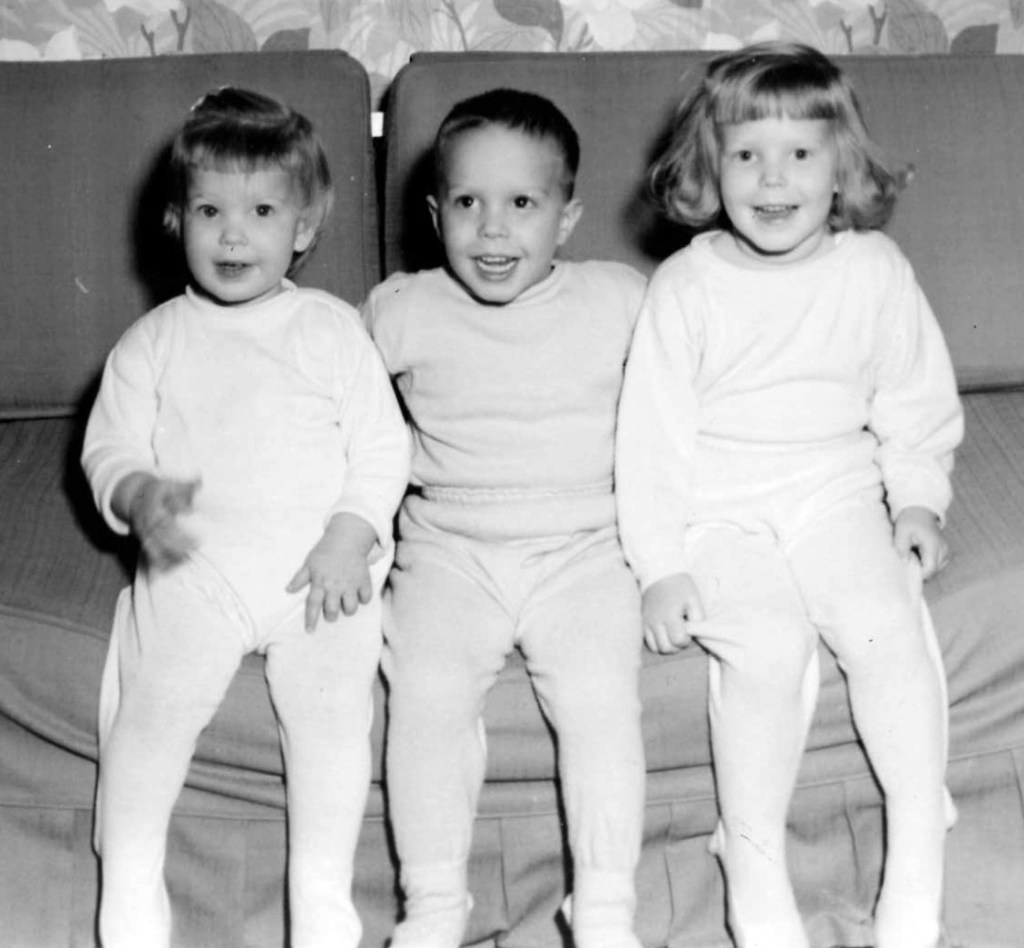
My sister Diane, John and me around 1957 or 1958…

After years of training in emotional caregiving, I am now called to use that training in service to my brother John. My greatest fear at first was to overstep his boundaries by offering more help than he wanted or needed. Just this past week I realized that he so appreciates anything I do for him as his energy and memory continue to fail him. For example, I learned that he can no longer manage his prescriptions and take his drugs on time. I didn’t notice that until he stopped taking his thyroid med and he had all the problems related to that including fatigue, brain fog and severe depression. I got him back on that med as soon as I realized what was going on.

It feels like a lot of responsibility to manage someone else’s life, but I love my brother and I want him to feel better. I can’t imagine not helping him at this point in time. He says he would never go into assisted living or some other care setting like that, so I will continue to help him as best I can.

Here are a few things I have learned about being a caregiver:

Caregivers value and appreciate help from others.

Caregivers take into account their own needs, the persons being cared for, and the other family members involved.

They respect other people’s opinions.

They appreciate the strengths and positive attributes in others and themselves.

They understand that caring for another person consists of letting that person make their own choices without ultimatums.

They wait to be asked for advice.

They are enthusiastic about their role as a caregiver.

They are empathetic and feel love towards the person they are caring for.

They don’t take other person’s words or actions personally.

This is not a job I ever expected to find myself in. I do know it requires patience, compassion, attentiveness, dependability and trustworthiness. I can do that. In fact I cannot imagine not doing it. I just appreciate even more that I’m here to help.

Cognitive Impairment & Dementia Past Age 60

I’ve been busy lately learning more about “mild cognitive impairment” (MCI) and dementia for myself, my mom and my brother. I was diagnosed in August with MCI by taking a two hour test from a Licensed Clinical Psychologist. This means that compared to others my age, I show some signs of cognitive impairment in a few different areas, mostly in short-term memory. These findings did not surprise me a bit considering my long history with TBI and concussions. In fact I wondered why I bothered with the tests afterwards, because they were so exhausting!

Then a few weeks ago my brother John started complaining of terrible brain fog. He could barely function some days, but it usually became less difficult as the day went on. He ended up sleeping a lot because he couldn’t do much else. I got so worried about him that I called our local hospice people. They were kind enough to come over and speak to John this week. They said he was doing OK and not ready for hospice assistance.

I saw an article in Science Daily recently that says:

“In the first nationally representative study of cognitive impairment prevalence in more than 20 years, Columbia University researchers have found almost 10% of U.S. adults ages 65 and older have dementia, while another 22% have mild cognitive impairment.” in the article:

“One in 10 older Americans has dementia” in Science News, October 24, 2022

Apparently John and I are not alone. In fact I have learned:

“Americans born between 1948 and 1965 are more likely than the generations that preceded them to have multiple health problems as they age. Many develop two or more health conditions up to 20 years sooner than folks from other generations…” according to the article “Cohort Trends in the Burden of Multiple Chronic Conditions Among Aging U.S. Adults” in the June 2022 issue of The Journals of Gerontology

Basically just about everyone in my direct family is dealing with some version of memory loss or MCI, and I am including my 14 year old dog Rasta. None of us are in great shape at the moment. We survive by reminding each other of appointments, etc. My Mom refused memory testing, but her ability to remember has been fading quickly since my Dad died in 2020.

One thing I did learn from my psychologist is that there is now a saliva test to detect the presence of the genetic APOE4 variant, which is associated with increased risk of late-onset (age >60-65) Alzheimer’s disease. 

Here’s a link: https://www.alzheimersorganization.org/product-page/apoe-genetic-test

Of course the next question is, do I really want to know?