Ever since I wrote this post about taking a worry vacation,I’ve been thinking more about why we worry. Of course there is a reality to why we worry. When I watch the tiny birds outside my window, I think about their worries. They need to be ever vigilant or some other animal might eat their food or even eat them!
In the history of our ancestors on this planet, it would seem the hyper-vigilant of the species must have survived longer than the lazy ones. But in this day, I have very little to worry about.
I realized yesterday that I live in a time and a place where I have less to worry about than just about anyone else in the history of planet earth. I’m warm, I’m safe, I’m well-fed and I’m happy. Yes, many of us have hit the sweet spot, and yet still we worry.
I wonder what percent of why we worry is based on completely faulty reasoning. Some say we worry to feel in control because our attention is turned to solving a certain problem. While we think we are solving the problem, we have the illusion that we have control over it. Worry can be reinforcing. We think due to the fact that we worried properly, we got the desired outcome.
The faultiness of this logic became far too obvious to me when I recently learned that I could not live without supplemental oxygen. It had never occurred to me that I would ever have trouble breathing. I had maintained a healthy lifestyle at 5,000 foot elevation and certainly never smoked. Then, after a few years living at 6,500 -7,000 feet, a doctor observed that I might be hypoxic. Very observant. But it still took a couple years and too many different medical tests to prove to me that I needed to live on full-time oxygen.
See how that theory about worrying properly worked out?Ah humanity! How we labor to convince ourselves that we’ve got this, and yet we still all have to die of something…
Since then I have tried to keep my heart open to change, because it’s coming whether we like it or not. These are my watchwords now:
“Even in seemingly dormant times, we are in transition. Losses and gains are in constant play. We are the change-agent, and we are changed. Even without toil, we transform. So wisdom advises us to open our hearts to transition; to honor fully what is passing, to learn from all that unfolds, and to welcome what arrives at our door each day with courage and curiosity.”
For the past five years, just over 40 million Americans moved each year, or about 13 percent of us. Most moves are local, either within the same county or within the same state. Within-county moves accounted for 65 percent of all moves in 2019, while moves between counties in the same state accounted for 17 percent, according to the federal government’s Current Population Survey (CPS) data.
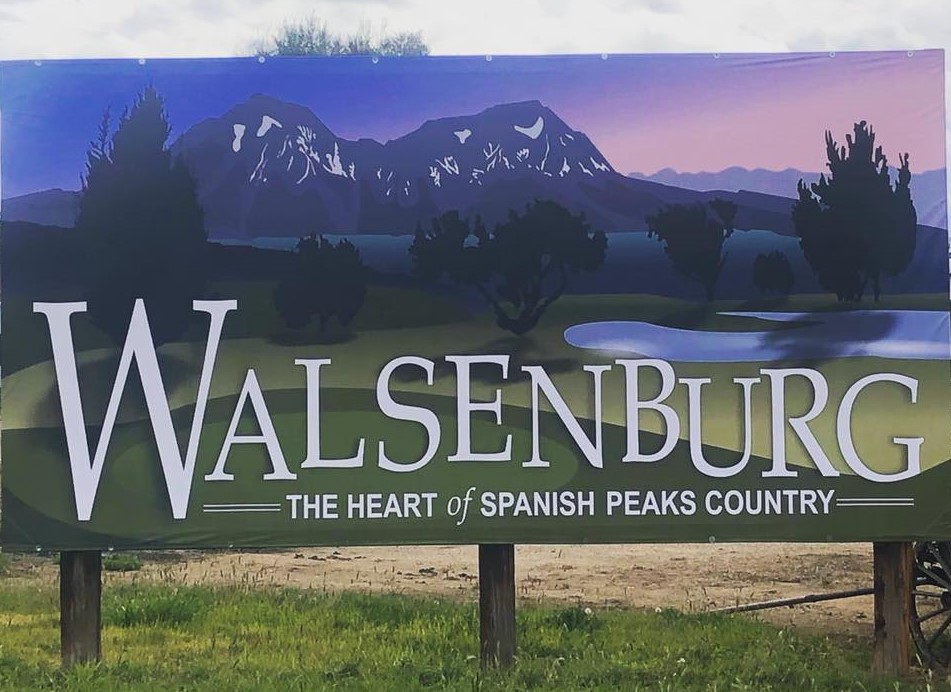
We moved from one of the northern most counties of Colorado (Larimer) to one 50 miles from the New Mexico border in 2014. Larimer County’s population has grown over 30,000 residents since then, while Huerfano County may have gained 200 residents. The only reason Huerfano has not lost residents since 2014, when it reached less than 6,400, is the beauty of the rural areas west of Walsenburg.
When we moved here from a nice suburb of Fort Collins, I experienced extreme culture shock, and most of the residents we talked to could not believe we had chosen to leave Fort Collins for here. I gravitated to hanging out in La Veta even though we lived in Walsenburg while having our solar home built in the foothills, halfway between La Veta and Walsenburg. I did not find Walsenburg residents particularly friendly to outsiders, and La Veta people seemed a little more welcoming. I later learned that most long-term residents here don’t like newcomers and don’t think they’ll stay, so they choose not to invest in friendships with them. I’m sure you see the self-perpetuating prophecy in this. La Veta was not super friendly either, but at least I did meet some nice people there.
Six years later, I continue to try and understand this area and its resistance to newcomers and new businesses. At first it really bothered me, especially when our next door neighbor offered friendship at first and then decided to hate us within six months for no apparent reason. After a few years I didn’t care as much because we were so happy in our solar perch with phenomenal views in every direction. As of today I only have one close, local friend and she plans to move back to San Diego soon.
We have had to adjust to many differences between city and rural life, but being able to order almost anything on the Internet has made all the difference! I would say if you are very independent of mind and truly celebrate natural silence and beauty you may end up loving it here. However, trade offs must be made. None of our restaurants are stellar and most are closed down now. No pizza deliveries here! You need to like cooking and have a few different avocations than city people, avocations like hiking, camping, gardening, photography and the arts.
As far as the differences between Walsenburg and La Veta go, Walsenburg has one of the highest crime rates per thousand in the U.S.
“The 2016 crime rate in Walsenburg, CO is 628 (City-Data.com crime index), which is 2.3 times higher than the U.S. average. It was higher than in 98.0% U.S. cities.”
Just about everyone I have met there has been robbed. I cannot find a crime rate for La Veta, but it’s very low. The main difference you will find in Huerfano County is that land prices east of La Veta average around $5,000/acre or less, and those in the higher mountains can be well above $50,000/acre.
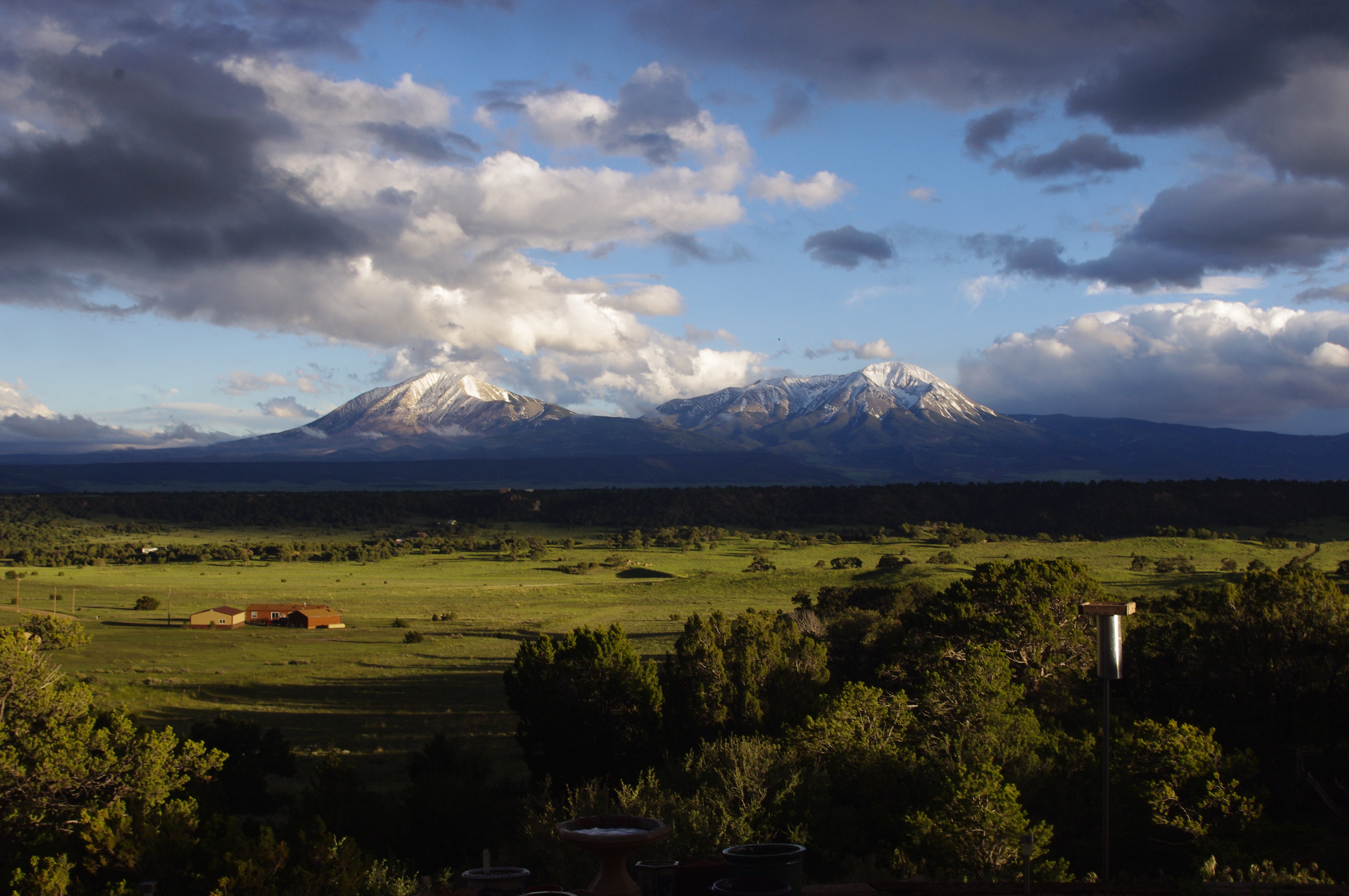
Springtimeview from our solar perch!
The apparent draw to this area, including ourselves, is that you can still find inexpensive rural land with tremendous views for reasonable prices. Just remember there are very few decent jobs here and most of this county is above 7,000 feet, which can challenge the breathing of many lowlanders.
Want to learn more about moving here? I kept a journal of this process:
Why we decided to move here after first checking out Ecuador (!)
The difficulties of renovating our old home and leaving our old life behind.
The culture shock of very small town living.
Building a passive solar home in a rural area,
and so many other challenges & adjustments to be made when you choose living rural.
To continue my train of thought from my last post, I choose to believe that we humans are uniquely supplied with a brain and conscience so that we might go beyond our reptilian or primal brain. Yes, we must maintain our innate and automatic self-preserving behavior patterns, which ensure our survival and that of our species. But I know we can be so much more!
A part of my learning at Naropa University in Boulder, was the study of higher levels of consciousness, most notably with Ken Wilber. There I learned of the research into what can happen in the human mind when we are able to shut off the constant thinking, wondering and worrying, reaching beyond this primal state of mind.
Buddhist monks have shown us that we can achieve an infinitely expanded true self through deep meditation. This is in accordance with Buddhist philosophy, which focuses on being liberated from one’s insignificant self consciousness to attain a higher state of being, thereby reaching an “infinitely expanded true self”.
The Buddha taught that consciousness is “like a stream of water” with different layers or levels. Mind consciousness is the first level, using up most of our energy. Mind consciousness is our “working” brain that makes judgments and plans; it is the part of our consciousness that worries and analyzes. The brain is only two percent of the body’s weight, but it consumes twenty percent of the body’s energy. So using mind consciousness is very expensive. Thinking, worrying, and planning take a lot of energy.
“We can economize this energy by training our mind consciousness in the habit of mindfulness. Mindfulness keeps us in the present moment and allows our mind consciousness to relax and let go of the energy of worrying about the past or predicting the future.” – Lion’s Roar
As strange as it may seem, my own trauma brain injury in 2008, helped me to access this higher level of consciousness more easily. Partially because I don’t have the energy to think and worry as much as I used to, I can simply slip into a state of mindfulness as I choose. Call it what you will, this is a great relief! I tire quickly with too much interaction or “thinking” and then I give up and just live in the present.
I have also found living close to nature to be quite mind liberating. City life kept me in a constant, often unconscious, state of anxiety and vigilance. It took me a few years of living away from cities and most other people to relax that vigilant mind state and just be here now. Sometimes I may still feel sudden city anxiety, but I quickly recognize it as not needed and let it go.
To learn more about all of this, I can highly recommend the Buddhist magazine Lion’s Roar and this particular article called: “The Four Layers of Consciousness”
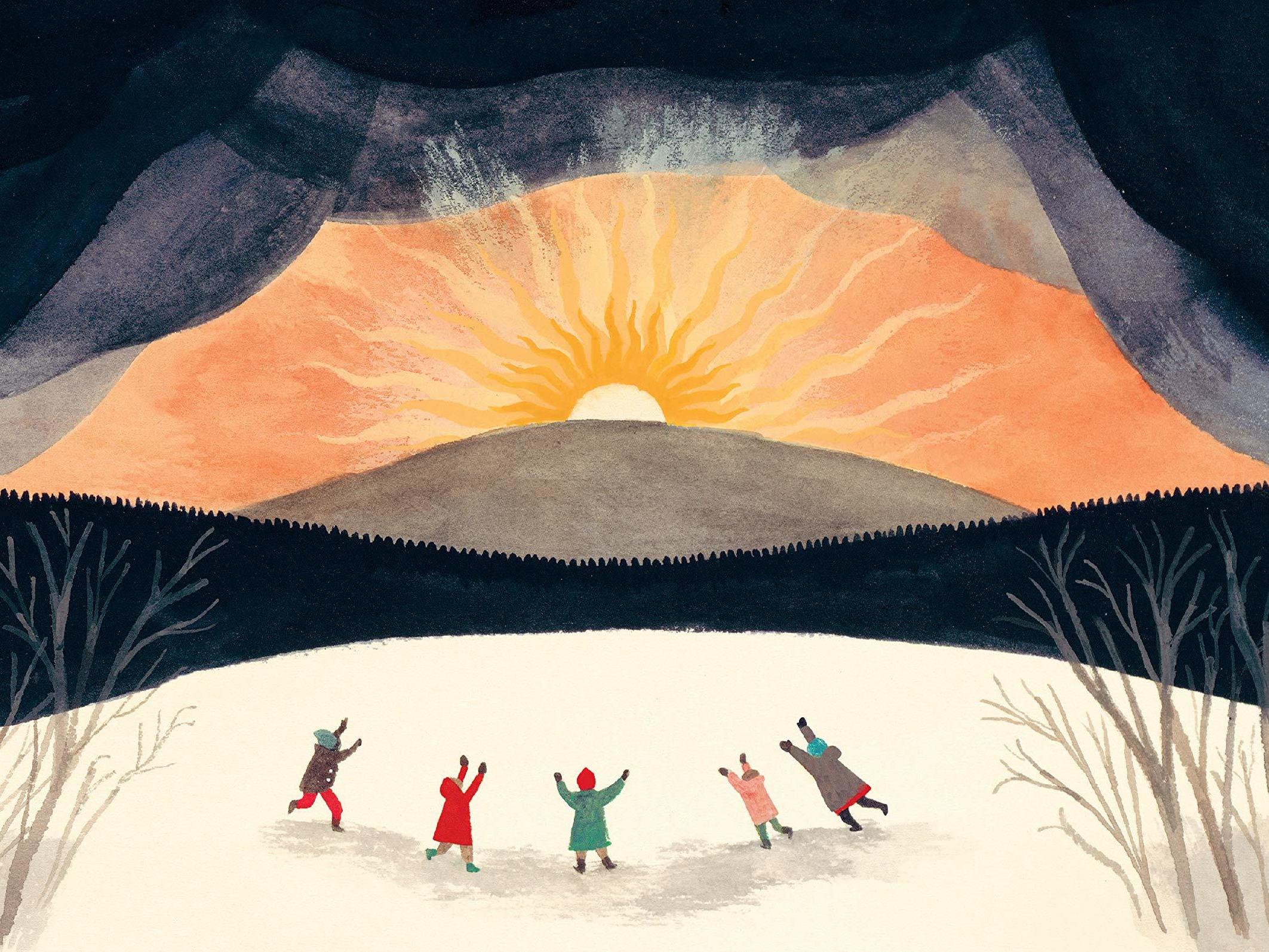
Tomorrow,Monday the 21st will be the darkest day of our year. This is the day with the fewest hours of daylight, marking the start of astronomical winter. After this solstice, days will begin getting longer and nights shorter as spring approaches.
The word solstice is derived from the Latin word sol (“sun”) and sistere (“to stand still”), because at the solstices, the Sun appears to stand still. The seasonal movement of the Sun’s daily path (as seen from Earth) pauses at a northern or southern limit before reversing direction.
The Winter Solstice in Human History
The winter solstice was a special moment in the annual cycle for most ancient cultures back to the neolithic. Astronomical events were often used to guide activities, such as the sowing of crops and the monitoring of winter food reserves. Many cultural mythologies and traditions are derived from this.
This is attested to by physical remains in the layouts of some ancient archaeological sites, such as Stonehenge in England and ceremonial structures in New Mexico’s Chaco Canyon. The primary axis of these monuments seem to have been carefully aligned on a sight-line pointing to the winter solstice sunrise and the winter solstice sunset at Stonehenge.
In the midst of gathering darkness, light becomes ever more valued…
The winter solstice was immensely important, because the Ancient ones were economically dependent on monitoring the progress of the seasons. Starvation was common during the first months of the winter, January to April (northern hemisphere) or July to October (southern hemisphere), also known as “the famine months.” In temperate climates, the midwinter festival was the last feast, before deep winter began. Most domestic animals were slaughtered because they could not be fed during the winter, so it was the only time of year when a plentiful supply of fresh meat was available. The majority of wine and beer made during the year was finally fermented and ready to drink at this time.
For me, this Winter Solstice has even more meaning, following one of the worst years in American history. This Solstice gives me hope that next year will be so much better in so many important ways! 🙂
My intuition told me to go back and look at some previous photos from six years ago, when we were building our passive solar home in the foothills of southern Colorado. Sure enough, December 17th six years ago was the day we put decking on our roof.
Unless you’ve built something yourself, you may not appreciate the idea of “drying in” your structure, but this is major, especially in the middle of winter in Colorado.
I remember when we drove up here, there were workmen all over the top of our house in very cold weather, working their asses off! Our contractor brought all his friends over to work on a Saturday to get this done. What was amazing was how comfortable they all seemed up on that roof! A snow storm came in later that day…
But the roof got covered and we were halfway to being dried in.
We got so excited about the smallest progress back then, after taking five months just to get approval from the county and our slab poured properly for passive solar heating! They forgot the insulation for the slab at first, but Mike got on them for that!
The windows came next! It was finally looking & feeling like a home!
But there were still a million more details to work out…
but we got her done and moved in on the first of August 2015.
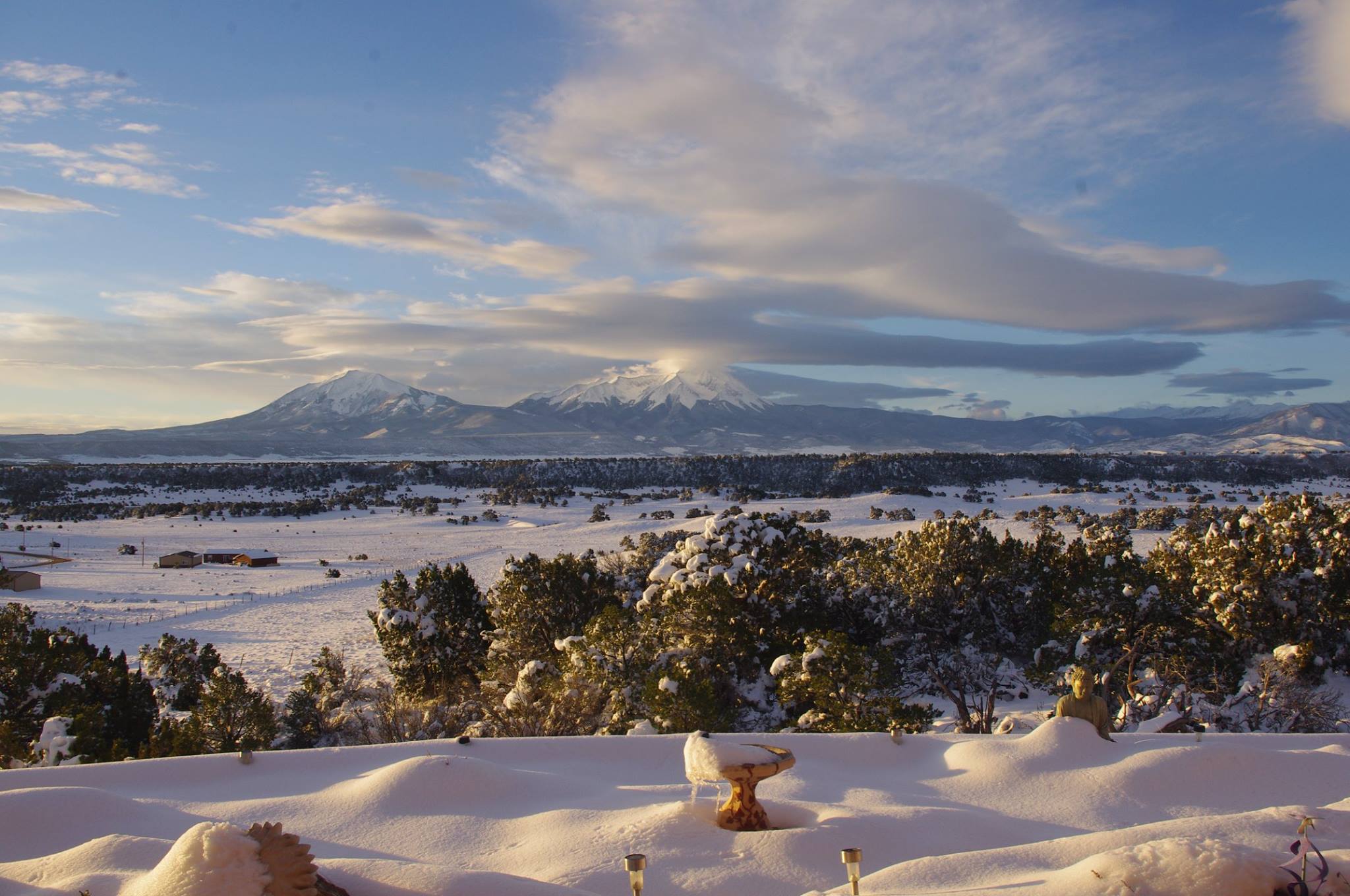
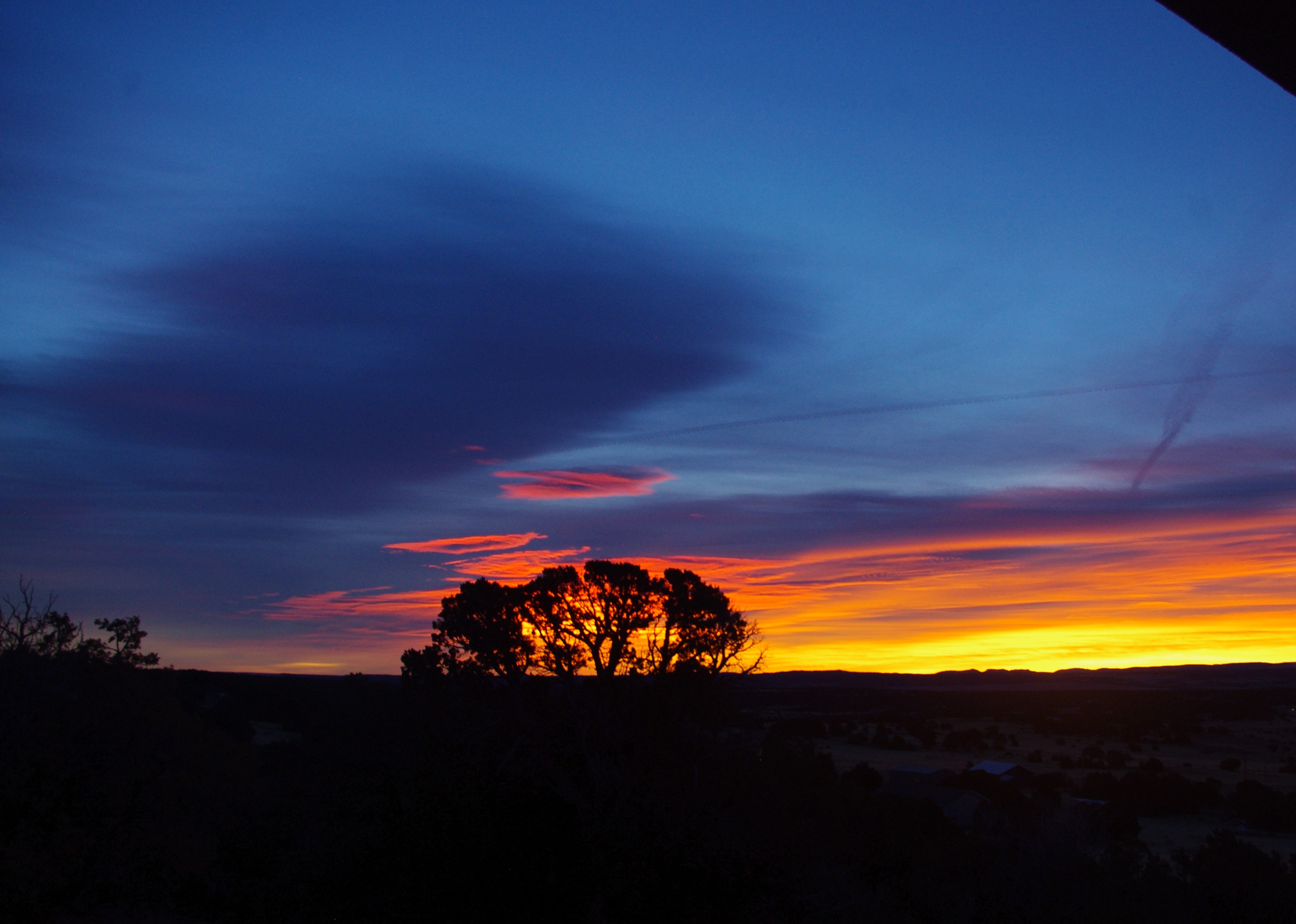
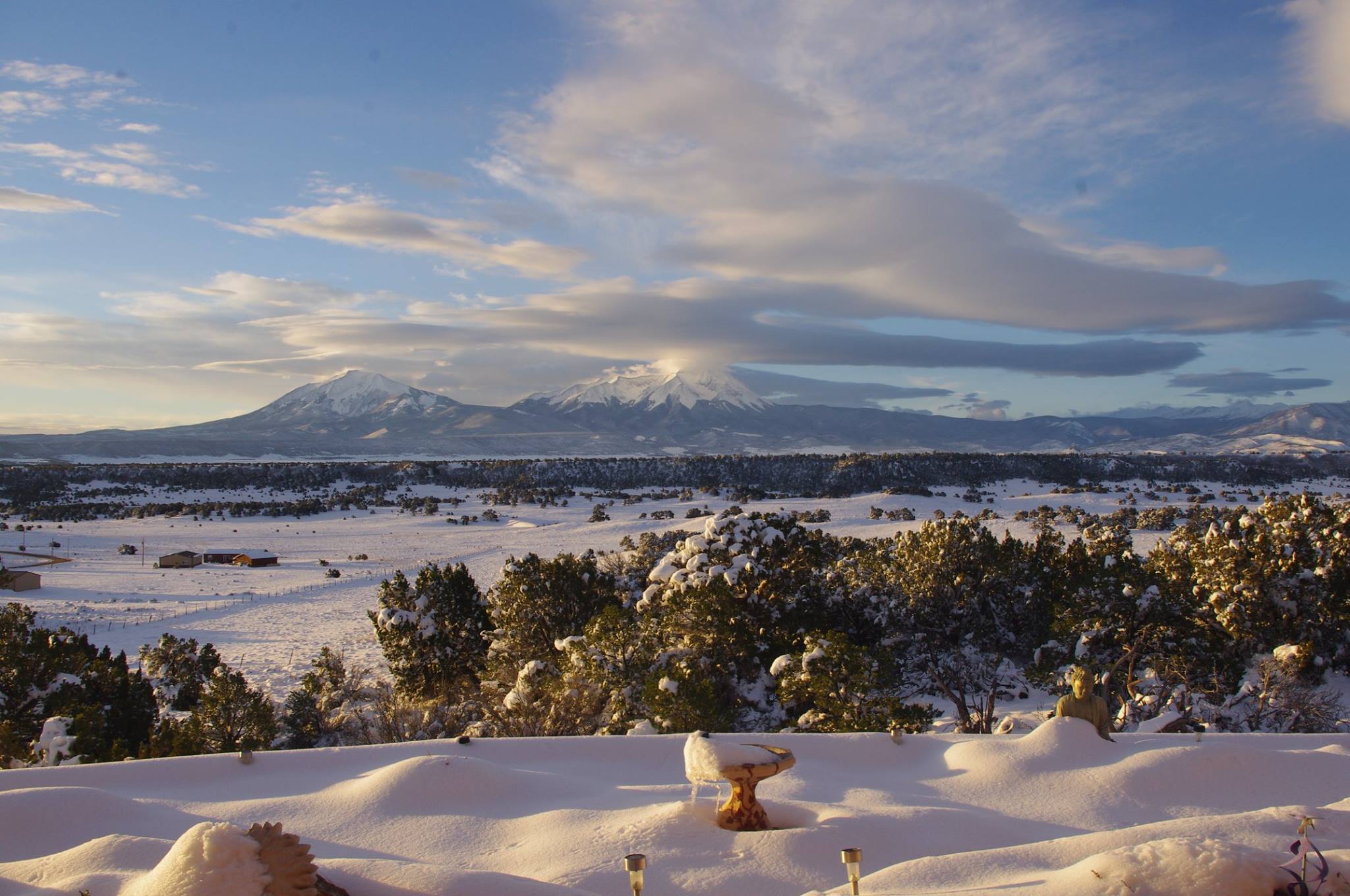
Then we rested while staring out at our spectacular view, for months, none stop!We cannot get enough of this even years later.The silence is magnificent!








 Adventures of the NEW??? Old Farts