The hidden purpose of my new memoir: Convincing your pardner to love rural!

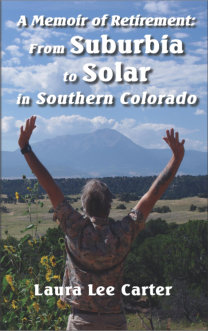
I decided to write a memoir of the process Mike and I went through around age 60, as we were going through it. I thought, we can’t be the only ones thinking about leaving city life behind for retirement, hoping to find a quiet, peaceful sustainable life in some beautiful rural area.

horsetooth in summer

Horsetooth Reservoir up above Fort Collins, Colorado!

As we put this plan into action and bought three acres west of Walsenburg to build our passive solar home at the beginning of 2014, I discovered that Mike was MUCH MORE CERTAIN than I was about this whole plan! He felt certain that he wanted to leave the city behind regardless of our old friendships back in Fort Collins, and the services and predictability of city life. This plan was suddenly coming together far faster than I could assimilate! I knew I loved visiting down south, but was I ready to give up everything I knew to move there?

320 w. 2nd St. Walsenburg July 2014

Walsenburg rental we lived in while building our home west of here

After we moved into our rental for the building process, I learned that many wives felt the same way initially about pulling up their roots and going completely rural. The men seemed to know what they wanted, but the women were more careful or hesitant to move to a rural area. Much like I felt at first that our new homestead was rather “isolated” other women I met felt the same. Luckily I totally trusted Mike’s sense of place and his unique abilities to make this home the best of my entire life.

But I just realized yesterday that my memoir is especially suited for wives or partners who want to move somewhere wild and rural, to show them the process I went through. I certainly changed my mind as the building went on…

At first I was so scared and uncertain of this choice we were making, mainly because we needed to sell our suburban home to afford the construction of our new solar home. There was really no way to go back on this deal if I ended up not liking it! It did feel really risky to me, but not to Mike.

morning sun on comanche drive

Our new home at sunrise!

I found that very quickly after we moved into our new home about one year after moving to Walsenburg, I loved it here. The silence, the natural beauty, the amazing sunrises and the big sky feeling… what’s not to love about that?

It just took me a while to adjust my vision and expectations and QUIT WORRYING SO MUCH ABOUT EVERYTHING!

So, for any of you who want to convince your pardner to move to a more rural part of the country. This book might really help!
Why we moved to the country to retire

For some reason this spring I keep flashing back to four years ago when we were still living in suburbia in Fort Collins and preparing to move down here to build our solar home…

memoir of retirement 2016

Here’s an excerpt from my Memoir of Retirement:

I saw a stupid retirement TV commercial last night that really got me thinking. The question was:

Can you keep your lifestyle in retirement?  

Say what? It suddenly struck me that this may be the most important difference between those of us facing retirement in the next few years. I for one have NO intention of keeping this lifestyle. If we did, what would be the point of retirement?

My dream retirement involves escaping this lifestyle! I feel that I have become ‘metro-fied,’ and I’m now more than ready for a peaceful escape from my present lifestyle.

I have lived in metropolitan areas for most of my adult life, for access to good jobs. What I have observed is ever increasing crowding, pollution, traffic and aggressive behavior.

beginning to build on the slab comanche drive

Construction begins on our new solar home facing the Spanish Peaks!

What I now long for is a quieter more peaceful existence with just a few people per square mile, where we can enjoy a friendly, caring sense of community; a place where we can make new friends through our daily lives.

We know and accept that this will involve a major lifestyle change, and we are ready for that. No traffic sounds great to us in exchange for less shopping convenience. Valuing and having time for new relationships is what we seek, not more of the same overcrowding, air pollution and road rage.

As I sit in the constant traffic in Fort Collins or Denver these days, I can only think, “This is never going to get better!” People will continue moving here and traffic will keep increasing every year, and I do not want to spend one more precious moment of my life sitting in traffic.

We want out of this lifestyle, the sooner the better!

Postscript four years later:  I WAS SO RIGHT ABOUT THIS!


Grief comes in many forms…

Grief the price of love

My last post about misfortune and friendships turned out to be somewhat controversial, at least to some. Putting my anger so obviously on display can be seen as weakness. After all, aren’t we supposed to get beyond that sort of thing as we age? Can’t we turn our anger into compassion for ourselves and others?

I like to think we can, but not immediately. A loving friend, who knows of what she speaks, observed yesterday that my response to my own failing health is so normal and so a part of “The 5 Stages of Grieving.” Yes, grieving is not just about losing a loved one. It can also be about losing a belief that sustains you. In my case I lost my illusion that my body is strong and healthy, and somehow immune to the millions of accidents and other misfortunes that life can throw at me.

It has been so confusing to me to be angry that I even caught this disgusting infection, while not blaming those who refuse to be around me because of it. I so understand their fear of contracting it. It’s the worst! But where do my feelings figure into this discussion?

My husband Mike is an interesting person to talk to about illness and friendships. He lost friends when he somehow contracted Myalgic encephalomyelitis / Chronic Fatigue Syndrome (CFS) at age 35 in the early 1990s. He had no idea what he had at first and either did most doctors. They would do lots of tests, and when they couldn’t figure out a proper diagnosis, they took to blaming him or his depression. His friends also had no idea how to react and some just decided to vaporize, but the hardcore ones remained for decades by his side. Of course he of all people understands fear of illness, but he also had no interest in looking up those who vaporized when he was very sick.

Mike has grieved for years over the loss of his high level of health before he suddenly became ill in his 30s. He has also developed an amazing level of compassion for those who struggle with illness, pain and frailty. He does not seem to judge anyone. He just understands.

grief and learning to swim

I will continue to deal with my own losses day by day. I do feel sorry for myself sometimes, and when I do I remember one of my favorite lines from an incredible therapist I saw for five years in my 30s:

“At least when you are feeling sorry for yourself, you are feeling something for yourself.”

Medical Cannabis, Seizures & Colorado Research

CBD oil what is itOne thing that continues to increase, since we moved to southern Colorado, is the number of families who move here to be able to properly medicate their children who suffer from severe seizures. Imagine having to make the choice between a good job and the health of your child. That is what our government is asking from these parents. Some move down here because it is so inexpensive to rent or buy a home here, compared to the cities up north.

I have to admire Alexis Bortell, a 12-year-old girl who is spearheading a campaign to legalize medical cannabis across our country. She and her family had no choice but to move from Texas to Colorado to find adequate treatment for her severe epilepsy. Now, her family and a handful of others are suing Attorney General Jeff Sessions and the Drug Enforcement Administration (DEA), demanding “cannabis for the treatment of their illnesses, diseases and medical conditions.” Ever since Alexis began her cannabis treatment, she has been seizure-free for 974 days.

Data from the Epilepsy Foundation:

Does cannabis help seizures?

Evidence from laboratory studies, anecdotal reports, and small clinical studies from a number of years ago suggest that cannabidiol, a non-psychoactive compound of cannabis, could potentially be helpful in controlling seizures. Conducting studies can be difficult as researchers have limited access to marijuana due to federal regulations and even more limited access to cannabidiol; there are also increased financial and time constraints.

Cannabidiol (CBD)

Open-label studies in the U.S. of Epidiolex (a drug derived from cannabidiol or CBD) are being performed. Epidiolex is a purified, 99% oil-based CBD extract from the cannabis plant and is produced by GW Pharmaceuticals to give known and consistent amounts in each dose. The U.S. Food and Drug Administration (FDA) has given some epilepsy centers permission to use this drug as “compassionate use” for a limited number of people at each center.

Recently, gold-standard studies (double-blind, placebo-controlled studies) have finished for difficult epilepsies such as Lennox-Gastaut syndrome (LGS) in children and adults and Dravet syndrome in children. Information from these studies has been presented at major scientific meetings and in press releases by GW Pharmaceuticals.

Results from 214 people who received Epidiolex (99% CBD) in an open-label study (without a placebo control) and who completed 12 weeks or more on the drug were published in Lancet Neurology.

Enter Sangre AgroTech

The most exciting development for Huerfano County, our “orphan” county with around 6,000 souls, has been in the tiny town of La Veta Colorado.  WEED, Inc. announced this past July, that it recently acquired Sangre AT, LLC (dba “Sangre AgroTech”), with plans to open a Sangre Bioscience Center, investing over $1,000,000 into the Colorado Medicinal Cannabis Industry.

Sangre AgroTech then chose La Veta for their new research facility whose mission is:   “To create a genomics-based Cannabis breeding program that will produce new, genetically-enhanced strains of Cannabis which express the desired plant characteristics for the treatment of disease…”

“At Sangre AgroTech, we are focused on the development and application of cannabis-derived compounds for the treatment of human disease. Targeting cannabis-derived molecules which stimulate the endocannabinoid system, we are developing the required scientifically-valid and evidence-based cannabis strains for the production of disease-specific medicines. Yes, medicines.” 

Cannabis in Colorado History & Boomers’ Cannabis Use Patterns

MJ weedColorado is the home of legal medical and recreational cannabis, and come to find out,  we have history with this stuff. When Colorado became a state back in 1876, both hemp and cannabis could be grown legally, and they stayed that way for decades. By the late 1800s, cannabis oil was a common ingredient in medical tinctures. Asian-style hashish dens were common in larger cities like New York and San Francisco. Increasing popularity led to concerns that hashish would lead to mass addiction, and in 1906 the federal government imposed the first regulation on cannabis intended for consumption: A product simply had to be labeled if it contained the herb.

Between 1915 and 1917, Wyoming, Utah and Nevada all banned cannabis, and in March 1917, Colorado legislators made the use and cultivation of cannabis a misdemeanor. Those who broke the law were subject to a fine up to $10 and a month in jail, part of the growing national temperance movement that led to Prohibition in 1920.

On November 7, 2000, 54% of Colorado voters to approve the use of marijuana in the state for patients with written medical consent. Under this law, patients could possess up to 2 ounces of medical marijuana and cultivate no more than six plants.

Conditions recognized for medical use include: cachexiacancerchronic pain; chronic nervous system disordersepilepsy and other disorders characterized by seizuresglaucomaHIV or AIDSmultiple sclerosis and other disorders characterized by muscle spasticity; and nausea. Patients could not use cannabis in public places, or in any manner which might endanger others including operating a vehicle or machinery after medicating.

Since the enactment of Colorado Amendment 64 in November 2012, adults aged 21 or older can grow up to six marijuana plants privately in a locked space and legally possess all marijuana from the plants they grow, and possess up to one ounce of marijuana while traveling,

Since 2012, Colorado sales of cannabis have been staggering! Since legalization, Cannabis sales have topped 13 billion, with 4.5 billion just in 2017. Tax data shows close to 22 million collected just in 2017.

Boomers and Cannabis Use

cannabis budIf you remember the 60s you weren’t there…

According to the most recent iteration of the 40-year-long “Monitoring the Future” study from the University of Michigan, 85 percent of Americans 50 plus have used illegal drugs, including marijuana, in their lifetimes.

Since 2006, marijuana use has increased significantly among adult Americans age 50 plus. A decade ago, roughly 4.5 percent of people ages 50 to 64, and 0.4 percent of seniors above age 65 had used marijuana in the past year. By 2013, those numbers had increased to 7.1 percent and 1.4 percent, respectively. In percentage terms, marijuana use among 50- to 64-year-olds increased by 57.8 percent, while among seniors ages 65 and up, it ballooned by 250 percent.

This study, based on over 45,000 responses to the National Survey on Drug Use and Health, isn’t the first to note that marijuana use is increasing rapidly among older adults. But it digs more deeply into the demographics of older Americans’ marijuana use, uncovering some interesting findings. For example European-Americans and African-Americans are much more likely to indulge in cannabis than Latinos. Low-income and married Americans are more likely to partake than separated or divorced, but single or widowed Americans use cannabis the most.

Many 50+ Americans are using cannabis to deal with mental health issues. Among those 50 and older, people who have suffered with depression or anxiety in the past year are much more likely to use cannabis medically. A number of studies have shown a link between marijuana use and mental disorders. Given the widespread prevalence of medical marijuana laws, some seniors may be turning to cannabis as an alternative treatment for the ailments of old age.

One study found that Medicare reimbursements for a number of common prescription medications dropped sharply after the introduction of medical marijuana laws. 

Medical or not, it’s clear that the rise in cannabis use among older adults is driven by the aging of the baby-boom generation, who dabbled extensively with cannabis in their youth and may be returning to it in old age for a variety of reasons.

Let’s face it. Most Boomers are different in their views of cannabis use compared to the generation before them, and since there are still plenty of boomers under 65, this trend toward increased use in old age is likely to continue into the future.

It is important to note that in some countries, like Israel, medical use of cannabis is considered standard treatment. Medical marijuana use has been permitted in Israel since the early 1990s for cancer patients and others with pain-related illnesses such as Parkinson’s, multiple sclerosis, Crohn’s Disease, and post-traumatic stress disorder. Patients can smoke cannabis, ingest it in liquid and caplet form, or apply it to the skin as a balm.

ALL KINDS of BOOMER LOVE for YOU!

clearer when in loveIsn’t Valentine’s Day crazy? Talk about a great gimmick to sell crap. I so dislike the way capitalism turns everything and everyone into a commodity to be manipulated, but this isn’t about that at all! This is about what a great idea it was to create a holiday totally based on LOVE. I think we should celebrate love every single day. After all, without love, where would we be?

So let’s start out with a post about LOVE from Carol Cassara: Love gives our lives meaning, whether we have a mate or not. That’s why I like to think of Valentine’s Day as covering love of all kinds, including maternal, filial, love we have for friends–the whole gamut.”

Sue from Australia says: At Valentine’s Day our thoughts turn to love and especially the love of a partner. But Sue Loncaric from Sizzling Towards 60 & Beyond wants to talk about a more important kind of love – Self-Love: The ability to appreciate who we are and love that person fiercely. Go see why we need to love and value yourself first, before expecting others to feel that way about you.

Happy V Day

After being divorced for several years, Jennifer, over at Unfold and Begin, knew it was time to wade back into the dating pool. She decided that online dating was the way to go. Here she shares her experience and guidance: Yes, It’s possible To Meet The Love Of Your Life Online.

For many, Valentine’s Day conjures up images of flowers, chocolate, hearts and often young love. But Meryl Baer of Six Decades and Counting instead chooses to peek into the lives of a married couple who have spent years of Valentine’s Days together the “Old Folks Way,” an oldie but goodie posted Valentine’s Day 2012.

Rebecca Olkowski of BabyBoomster.com says: Not everyone loves Valentine’s Day especially if you aren’t in a relationship. But, there is a solution. Rebecca suggests planning a Galentine’s Day with your girlfriends. Friends who are always there to support you.

old Charleston graveTom isn’t so sure he can fit his writings into our LOVE theme this week. He just knows he loves to visit Charleston in the winter. Tom Sightings, like many retirees, typically turns February into an extended snowbird trip to a warmer climate. This week in Sightings of Charleston he posts pictures of the historical city and asks for your feedback on a photo project he’s doing for his learning-in-retirement class.

And finally, Rita R. Robison, consumer journalist, wants to teach you a bit about Valentine’s Day economics, or what she calls “the cost of love.” U.S. consumers are expected to spend an average $143.56 on Valentine’s Day an increase from last year’s $136.57. Total spending is expected to reach $19.6 billion, up from $18.2 billion last year. The numbers are the second-highest in 15 years, topped only by the record $146.84 and $19.7 billion in 2016.

LOVE in LaLaLand

I just want to remind you all what real, mature, durable, sustainable boomer love is all about! I’m living it everyday and so I can assure you: All You Need is Love!