Not age limits. Let’s use neuropsychological tests

Did you know that our country was one of the first in world history to create and do psychological testing on our candidates for military service in World War I? When you are fighting right next to others in trenches, mental stability is quite essential. Psychological and neurological testing is used in numerous ways today to qualify candidates for all kinds of jobs, why not for the most important jobs in the world?

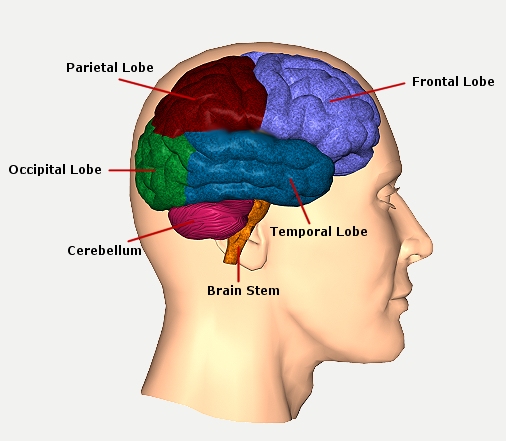
Neuropsychological Testing is a test to measure how well a person’s brain is working. The abilities tested include reading, language usage, attention, learning, processing speed, reasoning, remembering, problem-solving, mood, and more.

With all the talk about age and abilities around our presidential candidates, etc. I would like to explain why age is not necessarily the issue here. Candidates like Donald Trump refer to terms like mild cognitive impairment (MCI) as if we had no way to impartially test for these problems without prejudice. There are excellent ways to test this. I know because I was tested recently.

I had one of these two hour tests last year, administered by a consulting neuropsychologist. Areas tested include attention and processing speed, verbal memory, visual memory, executive function, constructional praxis, apathy, depression, anxiety and sleep. My first observation was how exhausting it was for my brain. I had to sleep for a day afterwards to recover. But I already knew my worst problem was how quickly my brain wears out, and when it’s tired there no solution but rest. I also learned that as a person with mild cognitive impairment, I should not be working or running for any office.

I am certain the American public would benefit by testing such important personages as candidates for president and Congress in this way. What most do not understand and what I had to find out the hard way is that a person’s ability to serve is certainly not about age. It’s about cognitive strength or impairment. We have great tests for that. Let’s use them.
August Colorado Foothills Garden Scenes

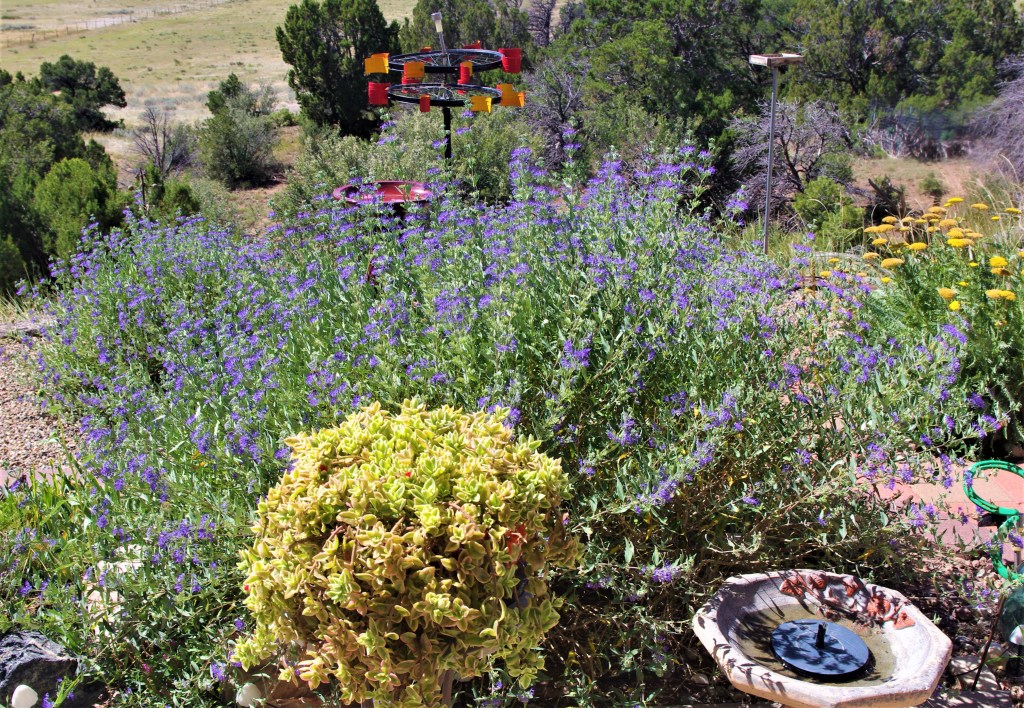
Although just north of here has received more than abundant rainfall this summer, we are very low on our Water Year measurement at only 11 inches so far, with less than two months to go. That has been pretty tough on my xeriscape garden & landscape.

But my Blue Mist Spirea bushes are bigger and brighter than ever!

And curiously, all the big sunflowers have sprouted on a hill below our home on the east side.

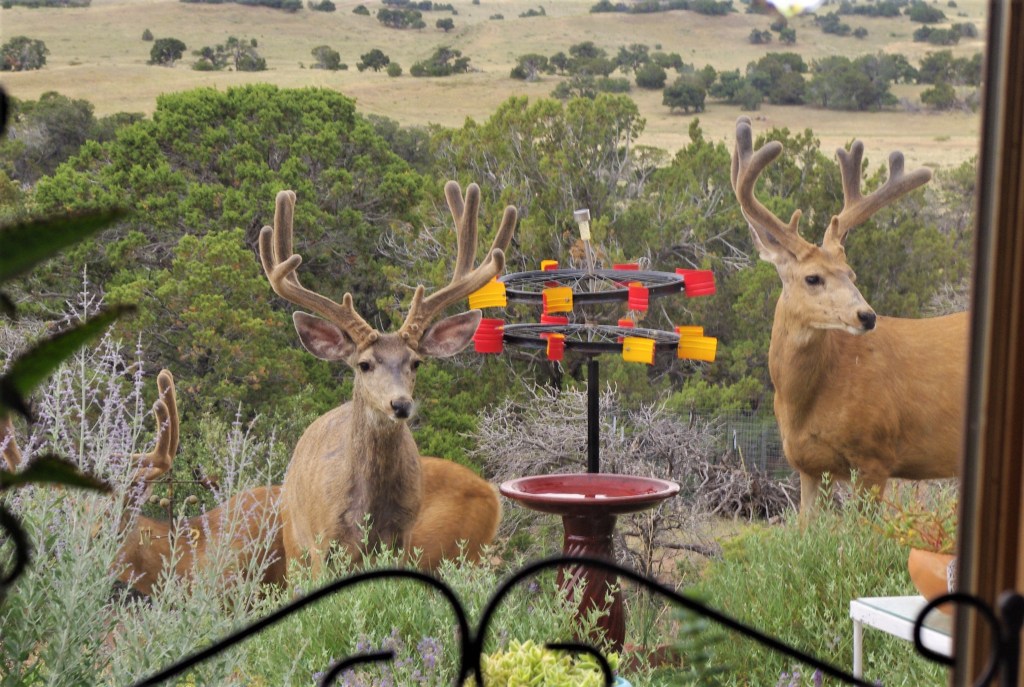
Our fountain & bird bathes continue to attract all kinds of birds, bunnies, chipmunks, bobcats, badgers…

and, of course, deer. It’s so fun to look outside at various times during the day and enjoy their antics.

This year is in stark contrast to the much wetter August of 2021, when we had had twice as much precipitation by this time in the water year! GO SEE PHOTOS HERE:

Finding the Strength to Let Go of Self

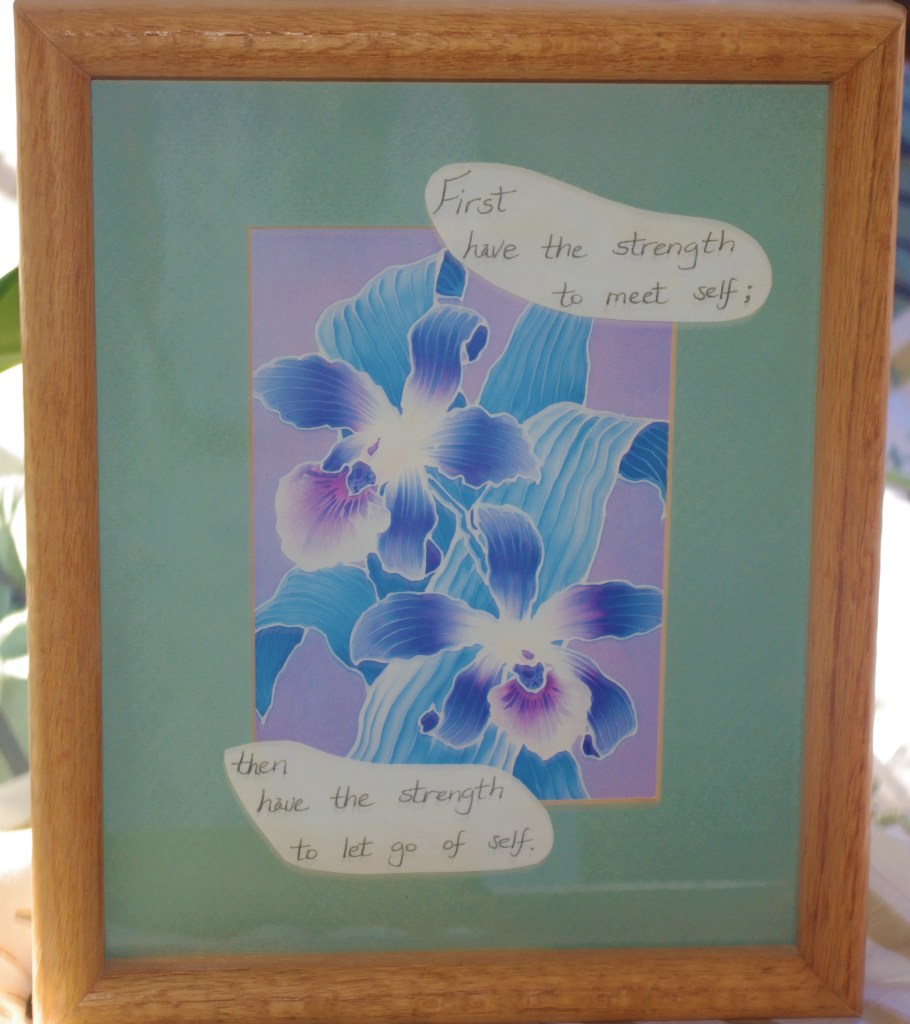
I believe our lives are a process of finding and confronting our true Self, and then slowly letting go of it as we age. Some might prefer the word ego in this scenario. I have had this message on my wall for decades:

What is the ego or sense of Self?

ego: a person’s sense of self-esteem or self-importance, the part of the mind that mediates between the conscious and the unconscious and is responsible for a sense of personal identity.

The way I relate to my sense of Self is to know that as a child and young adult my ‘job’ was to develop my sense of who I was inside, what did I think and value? How should I treat others? How did others see me? This naturally leads to a strong sense of self-consciousness, sometimes painfully so. Then came the time to figure out what I planned to do in the world. How did I hope to change my world? These are the purposes of young adulthood up until our forties or so.

Developing a strong sense of self or ego is a good and necessary part of being human. There is nothing wrong with having a strong ego, but it needs to be regulated. Problems arise when ego affects your decision making process, turning you into a victim, or when it makes you feel superior to others in order to justify your bad behavior. A toxic ego is one that does not learn from bad behavior, but instead blames others, often descending into negativity, resentment, and even violence.

For the past twenty years, my spiritual path has been that of the second part of life. I have been searching for the strength to let go of self. A part of this process is simply getting comfortable with self compassion and death. Although we might think we have a strong sense of self when we are younger, if we are very honest we may find much self-criticism inside. This is all a part of the ego. Like we really did have the power to change any part of our world…

Being close to nature is your best path to realizing your place in the history of time. Please note, there are no other animals or plants that believe they are changing the world. There are no other beings that fear death. They know what their part is, to be born, to live and then die. I have found a gradual process of getting used to the idea of death is the best path for me. At first is was so hard to be with so I would push it away and deny its power. Since I started facing some powerful signs that I won’t be around forever (lung disease and brain injuries) in the past few years, my acceptance has grown like my garden outside my door, bright and beautiful.

A Different Kind of Mind

Somehow I never pictured myself breathless and brain damaged at age 67. ‘Disabled’ did not occur to me ever, until things started happening to me. It took me an amazing length of time to believe that I was having trouble breathing. In fact, I didn’t discovery it myself. A very observant MD in Colorado City turned to me once when we were there for Mike’s health and said, “Are your lips turning blue? Let’s do a walking test.” For those unaware, a walking test is a simple walk around a doctor’s office where they test your O2 level before and after your block-long walk. I flunked, dipping far below 90 and yet I still insisted this could not be happening to me. Recently we went through the same test with my brother John, and yes, he denied it, and now he’s enjoying his supplemental O2.

My point is, unless you are literary hit over the head with a new disability (like a head injury?) it is very hard to accept that you may have a big new problem. I struggled against using oxygen at home for quite a while. I simply could not believe it, plus we Carters are known for extreme stubbornness. Now I can only go a couple minutes without it.

The head injuries started in my fifties and who knows, perhaps they were connected with shortness of breath. I know my most recent concussion were related to being out of breath. I went to look for something, forgot my oxygen, and ended up passed out for the floor. Unfortunately Mike was gone for a few days so when I came to I had to crawl over to my bed and get up there to lay down. I never forgot my oxygen again!

The aspect of disability I find both surprising and annoying is when others find it natural or even necessary to feel sorry for me. Some old friends have even stopped communicating with me. Talk about feeling written off! When I heard there is a new TV show called “Not Dead Yet” I thought, that’s me!

What I would like to share with all of you who think I’m done or doomed (aren’t we all?) is that, yes, my brain has changed, but sometimes it feels like it might be for the better.

I know I may have sometimes sounded pathologically optimistic here, but these days I rather enjoy my present state of mind. When I’m sitting staring out at our incredible views of the Sangre de Cristo mountain range, which I do a lot of, there is a certain non-reality that is a bit like being high without drugs. That I like. I also believe that in some strange way I may have become less judgmental and more intelligent by exchanging certain parts of my brain for a less precise and exacting attitude. Call it more flexible or easygoing, but I find that soothing. Perhaps my brain got tired of holding grudges.

Of course living with Mike has helped me a lot. I am definitely the worrywart in this partnership. We Carters are first-class worriers, expertly trained by a number of previous generations. I will never forget a few years ago when I was sitting in the living room listing my well-established list of worries for Mike. He had heard this list too many times, and I guess he was tired of it, so this time he sat back in his easy chair and said, “Who cares! Is worrying about these things going to change anything?” That made a lot of sense to my bruised and shaken brain…

“I’ve spent too many years at war with myself…”

Every time I listen to Sting sing “Consider me gone” I get stuck on these words. Why do we spend so much time picking on ourselves? As a psychologist I assume we learn how to do this from our overly self-critical parents, and then carry on the practice by habit. Some say these patterns get stuck in our brains and are almost impossible to fight against or change.

I know I have been far too self-effacing for as long as I can remember and then, of course, others along the way helped me become even more critical. Now, in my 60s, I’m still working at fighting this pattern in various ways. It helps so much to have a close friend or life partner who points out how hard we can be on ourselves. I remember back in my late 40s I gained a lot of new insight when I read Gloria Steinem’s book “Outrageous Acts & Everyday Rebellions” but this is a process that will last forever I’m afraid.

The three Carter kids at Grandma’s house at Christmas

Just recently I was rearranging things and came across a small photo of myself at around age three, looking pretty sassy in my new Easter clothes. Now I focus for a few minutes everyday on that little girl, on loving her all the way through and sending good thoughts for the many ways she might feel really good about herself for the rest of her life. I feel so much compassion for the battles she has fought in her war against herself and visualize how much easier her life could have been if she had learned self-love at an early age. I seems it has always been easier to be critical rather than compassionate towards myself.

I watched a marvelous 2005 movie recently called, “Mrs. Palfrey at the Claremont.” It’s about a retired older woman, played wonderfully by Joan Plowright, who befriends a young man, played by Rupert Friend, (YUM!) by chance on the streets of London. It’s has a lot of insights into aging and how we treat our elders with a number of great lines, but the one that keeps coming back to me is:

“It’s very important to praise people a lot early on, otherwise they might die of disappointment.

Ice Dancing is the Perfect Sport (for me!)

If any of you were able to watch the finals of the Free Skate competition this weekend in Finland, you were very lucky! The winning Canadian couple, Piper Gilles and Paul Poirier, absolutely took my breathe away when they skated their final program to the music from Evita. This was the epitome of artistic beauty completed with amazing ice skating skills. I had it on Peacock so I could watch it over and over again. Such perfection!

I’ll let you in on a secret few know about me. I have absolutely loved ice skating for as long as I can remember. My brother John and I began skating in junior high school. Colorado College had their own ice rink and we got to skate there for free, because my Dad worked at the college. I would go skating as often as I could in high school with my friend Linda Cook, spending hours perfecting our balance, coordination, figures, spins, jumps and hockey stops. In high school during boring classes (like chemistry!), I would dream up skating routines, escaping into dreamy dance routines, music, etc. It was a major focus for my teenage brain and body.

Why? Because I loved the freedom and versatility of skating. After I got good at it I loved to work on skating figures on my edges. The fine tuning required to lean into an edge just the right amount without overdoing it fascinated me. It seemed like the perfect sport, requiring great strength, control and artistry.

Only later I learned about ice dancing. Recently I signed up for Peacock streaming just so I can enjoy all of the international ice skating competitions at length. I especially love that I can watch the skating without all the interruptions of commentators. How rude to talk during these amazing performances! I like the individual events too, but the concentrated coordination of the pairs and ice dancers blow me away.

Now I know I am a true romantic. When I watch them I sometimes feel like I have escaped to the land of sprites and fairies. It is almost unbelievable how the ice dancers swoop and swirl like snow flakes across the ice. If only I could have been an ice dancer!