The Legacy of American Lawns & “Lawn Nazis”

I got a few interesting responses to my last post about re-wilding areas destroyed by farming or other forms of human landscape “improvements.” The 4th episode of PBS “Human Footprint” this week caused me to think further about our American addiction to lawns and lawn care.
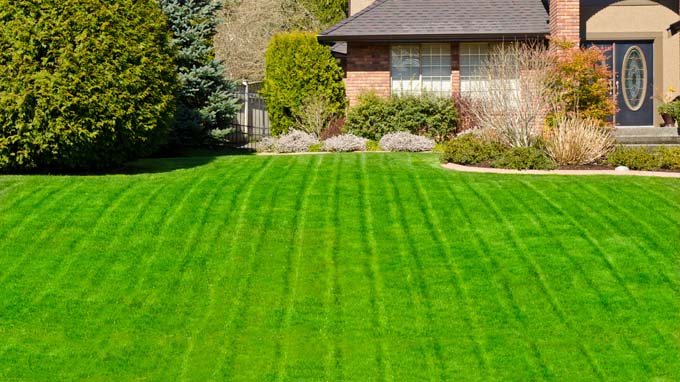
Did you know one 400 acre golf course uses 358,000 gallons of water every day? We have more than 40 million acres of turf in the United States that use over 80 millions pounds of fertilizer per year.

Grass is the most resource intensive plant in our country today.

In a country where we so highly value productivity, lawns are the ultimate in unproductive.

The story goes that we can apparently blame the Brits originally. The old idea of owning your own manor and “estate” added to our own brand of individualism in the USA caused many of us to want to own a home on maybe a quarter acre in suburbia. Our home was our castle, and the surrounding space was our territory to improve and maintain. Although some grasses have American-sounding names like Kentucky bluegrass, most of the turf-grass species we plant in the United States are native to Europe.

We also have a strong tradition from our earliest days of feeling like we had “too much land” (after we stole it from the native Americans). If we farmed it, or ranched it, or timbered it for five years than that land was ours. This set the precedent that we should not just sit on land, we should “improve it.” Every place humans inhabit is made artificial in some way, and in our country that usually involves lawns.

The Lawn is the Ultimate Male Status Symbol, showing how deeply grass is rooted in the American psyche.

Thinking about these American traditions reminded me of how proud my Grandpa Carter was of his small home and yard outside of Kansas City, Kansas. He took so much pride in keeping it perfect with his walking mower and lots of watering. And my own Dad the botanist, a lifelong advocate of leaving things natural, still worked hard to keep a nice lawn around his home.

The younger generations may not be so convinced that lawns are a good thing.

To quote that PBS special: “Grass is a signal. Just having it says that we are part of a community.”

And yet, as Nancy Hill pointed out after reading my last piece, those who don’t choose to maintain traditional yards in suburbia may be ostrasized by HOAs and other nasty neighbors. Covenants can be legally enforced. I had never before heard of the term “Lawn Nazis.” In a country that prides itself in offering “freedom of choice,” when it comes to the land around our own homes, we can be forbidden to plant native plants or go natural.

Find A Healing Environment For Retirement

In my last post I wrote about healing relationships, relationships that truly saved my life. But I have not yet shared one of the most important transitions I have gone through in the past eight years. I hear so much these days about Boomers who are trying to find the best place to retire. Of course, that will be different for each of us, but for me, retiring as close to nature as possible has transformed me. And the irony is that I was not certain at all whether I wanted to come here in the first place.

Eight years ago at this time, Mike and I was crazy busy preparing to sell our beautiful home in the Fort Collins suburbs so we could build a passive solar home on three acres west of Walsenburg, Colorado. Mike was always convinced that this was his ideal retirement plan. I was not so sure. Still surprised that I would even be able to retire by age 60, our options still hadn’t struck me. Then, after we moved into a rundown old miner’s home in town while we built our new home 13 miles west of there, I became really worried. I could not figure out where I was for a while. You try moving from a big cosmopolitan city to a tired old town of less than 3,000 souls, then you tell me if you don’t feel a whole lot of culture shock.

Our first year down here was difficult. So many disappointments and worker slow downs in construction, not to mention health concerns. But we did prevail and moved into our brand new home a little over one year later…

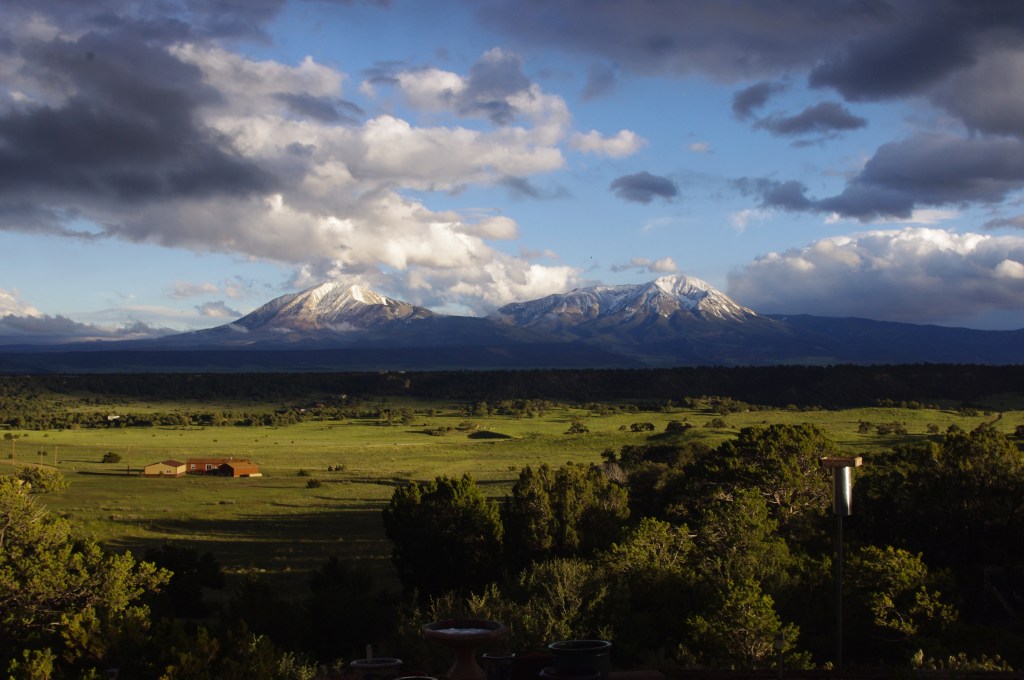
Oh, did I mention the view of the Spanish Peaks and the Sangre de Cristo Range from our new home?

When we first moved in, nothing seemed real. I felt like I had moved into a fancy foothills resort and the management would be coming soon to kick us out. After living in cities and suburbia for most of my life, this felt a bit like make-believe. To finally live in a naturally warm, energy-saving home that we had designed specifically for our needs and up to our standards with a view like that? Wow! But the best was yet to come.

The escape from the frenetic energy of cities was the best! I don’t know that I can properly describe exactly how peaceful this place felt after living with all of that crowding and traffic my whole life. The silence was astounding! I loved to go out in the morning, sit down and just soak it all in; the sunrises, the bird songs, the trees, the mountains. How did I end up here?

In the years since, my love of this place has grown and grown along with my sky garden, dedicated to my brother. How was I ever so lucky? With many new health challenges including head injuries and the need for permanent supplemental oxygen, I still feel so content to watch the sunrise each morning and look out over that tremendous view, knowing that I have finally found the place I belong.

In June 2014 we packed up or got rid of most of our worldly goods, sold our home in Fort Collins, and took off for an ancient rental in Walsenburg, Colorado. It was then we named ourselves the “NEW Old Farts” because we were barely 60 years old. I have been sharing our retirement story here on this blog since October 2014; the year long passive solar construction wins and losses, the big move in and our gradual adjustment to life in rural Colorado. We have fallen in love with living in tune with the sun and seasons, waking up each day amazed to find ourselves in such a beautiful, quiet, natural place. Good luck choosing the perfect place to make your own retirement dreams come true!

Please contact me at MidlifeCrisisQueen@gmail.com to purchase copies of any of my books. Thanks!

Outdoor or Indoor Kitty?

To give you some idea of the questions that we wonder about living here, away from all cities or even towns, recently we were discussing whether our cat should be let out to roam a bit, or is it too dangerous with the wild animals around here?

charley-and-rasta-on-mikes-lap

Charley the cat has been an indoor kitty since we got him last August. He was just a kitten then and had no idea where he was. Since then he has grown bored with our great indoors. He wants out!

Friends around here have both encouraged and warned us about letting animals out to roam. Especially dogs seem to disappear if you don’t keep close track of them.

IMGP4761

Rasta never goes out without us close by. He was raised a city dog, and has no idea that other animals might come by to eat him. Einstein is his middle name, LOL!

But Charley is a whole different animal. He’s young and strong and a natural hunter. He loves exploring the sunflower groves outside our home, and he’s a great mouser. He needs to go out, it seems.

So this morning we let him out for a while. He loved it! I guess we’ll keep a close eye on him, and let him out a bit in the morning when most animals aren’t prowling for a meal. We’d hate to lose him.

Getting used to something so right…

I was singing along with that old Paul Simon song, “Can’t get used to something so right…” this morning, and realized sometimes I have that problem myself.

After over two years in the brand new world (for me) of rural southern Colorado, I would say I’m just beginning to settle in.

This adventure started back in mid-June of 2014, and I can assure you I wasn’t sure at all about this place. It all seemed so backward, slow and poor to me after living in Loveland and Fort Collins for years. People kept asking me why we moved here, and I wasn’t so sure myself. Luckily my husband is an “eyes-on-the prize” kind of man. He knew exactly why he was here!

My first year here was not good. Between feeling like a fish out of water myself, and the extremely challenging feat of building a custom solar home out in the foothills, my best description is STRESS CITY! 

But once we moved out of Walsenburg and settled into our new home, life improved dramatically. After so much stress and our second move in a year, we spent weeks doing very little, simply enjoying our marvelous new environment…

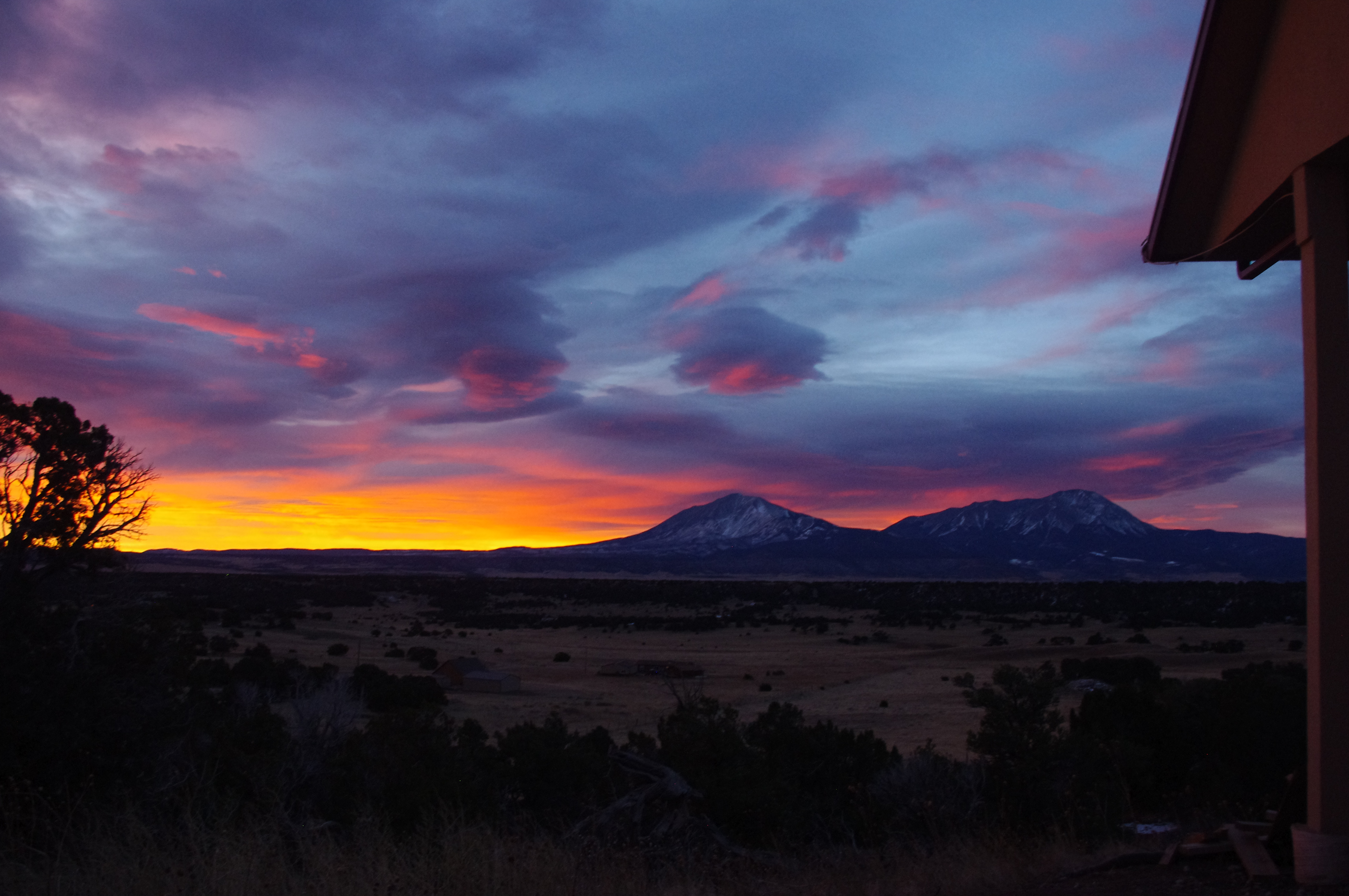
AMAZING sunrise over the Spanish Peaks January 2018

OK, we spent most of our first winter here doing that!

One thing you need to know about this part of the country, things really do slow down here in the winter. I can remember days last winter when I went into La Veta, and it looked like a ghost town.

In the spring things liven up quite a bit. The tourists start coming down here and clogging up Main Street in Walsenburg. This past spring I started taking a yoga class and walking around La Veta in the mornings. I also started making a few friends and feeling more like I belong here.

Just yesterday I realized how right this place feels to me now. I love living in the country, I have a wonderful husband and home, I have new friends who care, and I rarely have to deal with all the things I hated in the city.

Life is good and getting better. Mission accomplished!

Want to learn more about the experience of moving from the city to the country to live a quiet, relaxed life? Check it out here!

How Living Close To Nature Can Change You

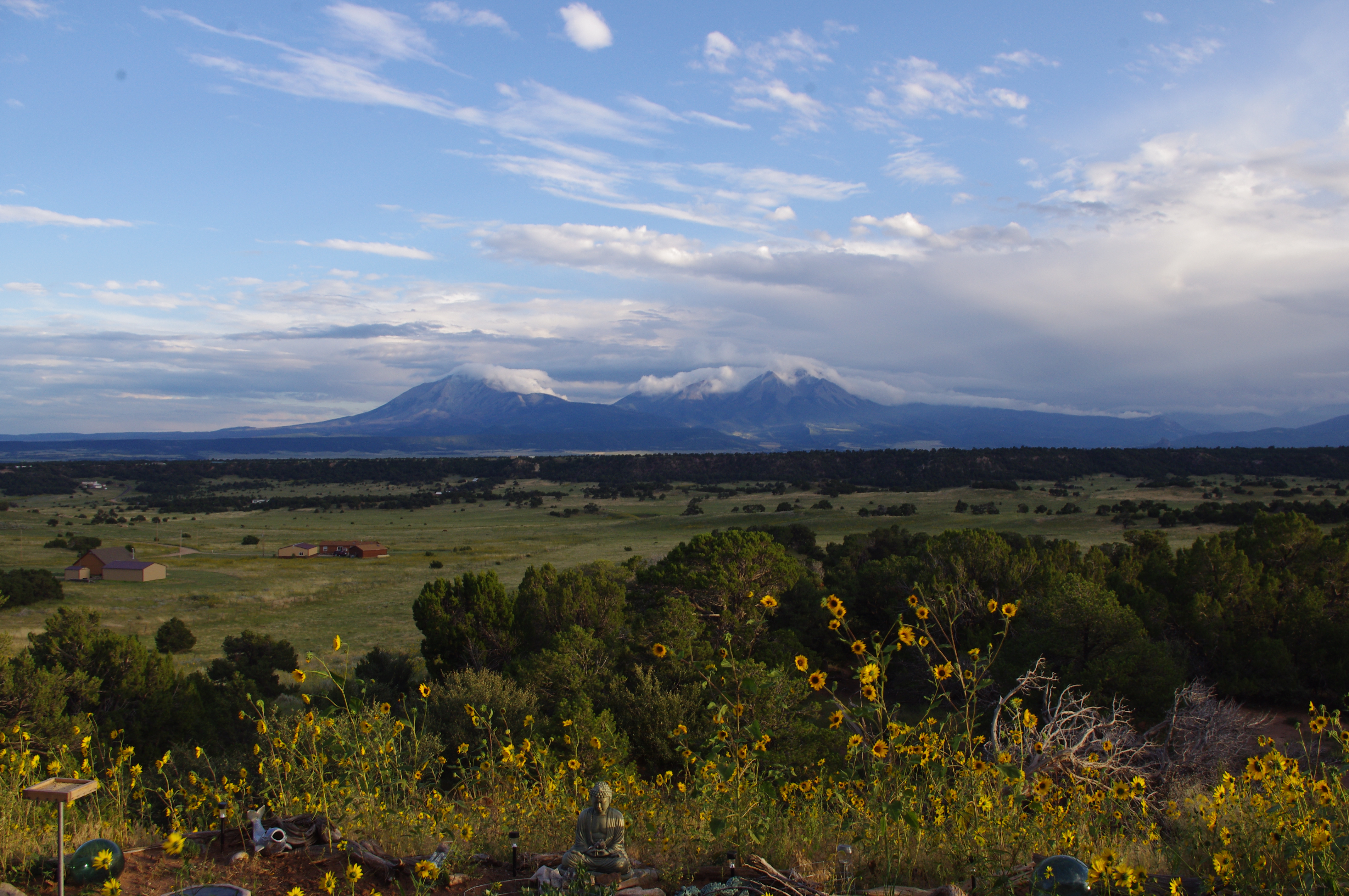
NICE view of sunflowers in garden and Spanish Peaks summer 2017

In 2014 we moved from Fort Collins, with the 6th largest county population in Colorado (333,577), to the least populated, Huerfano at about 6,500 souls. Huerfano county is the home of the Spanish Peaks, seen above…

The Huerfano means orphan in Spanish, and so many of us here are orphans, because we are elders. We lived in the town of Walsenburg (pop. 3,000) for our first year here, while building a custom passive solar home to the west. As we complete our first full year of living in the foothills, close to nature, I find those who live in cities to be busy, always busy. What is that doing to their soul?

I feel I have learned so much on this topic by living close to nature for the past year. Getting far from any city has been a reawakening for me, and living here permanently is a wonder. I love to experience those unique emotional experiences which defy our habitual way of thinking. Living here has been all about defying my previous limited state of mind. I called myself “metrofied” before I moved here, but I had no idea how horribly stuck I was in “city mind.”

IMGP7674

It is so soothing to observe how cities change us, and then leave, transitioning to a slower, calmer way of being. In my first year here I became aware of the constant anxiety level I maintained by living in cities. Then I slowly let it go. When I feel anxious now, I quickly see there is truly no reason for this feeling. Now, only when I get impatient or angry do I realize that I used to feel that way so much of the time back in Fort Collins, where the traffic was horrendous, and everyone was some form of tense.

The true change for me is the awareness that I can now live in the present. I have been seeking this experience for most of my life. Instead of worrying about the past or demanding more in my future, I can just be here now, loving my life. The down side to this new way of being? Great difficulties going back into cities! I don’t want to waste one more moment of my limited lifespan sitting in traffic and breathing city air.

I am filled with gratitude that I can now live in nature forever…

“You must live in the present, launch yourself on every wave, find your eternity in each moment.”  —   Henry David Thoreau

Laura and rasta close up

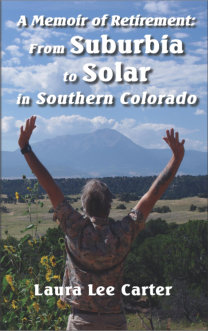
Want to learn more about moving from a good-sized city to the outback? Then check out my book: A Memoir of Retirement: From Suburbia to Solar in Southern Colorado 

Share this information with your friends, and please feel free to contact me directly to order your own signed copies of any of my books!  Cheers, Laura Lee  (email me: MidlifeCrisisQueen@gmail.com)

Be sure to follow us on Twitter

High in the Sangre de Cristo Mountains: Foothills versus Mountain Living in Southern Colorado

Yesterday was so interesting! We visited some new friends who have lived up above 8,000 feet in the Sangre de Cristo Mountains west of here for the past few years. Loved hearing their stories about living up high.

I know many have romantic visions of life up in those beautiful mountains, but remember this too:

Manuel's snow tractor

The approach to their house is a windy, dirt road off of a major highway, a road they and their few neighbors must maintain, unlike the county road we live off of, 15 miles west of Walsenburg. Once they came home a few years ago and there was 6 feet of snow on this road. They couldn’t go home!

We heard stories about when the deep snows come, and the big state highway snowplows plow their road closed! That’s why they need to maintain snow-moving equipment themselves….imagine that!

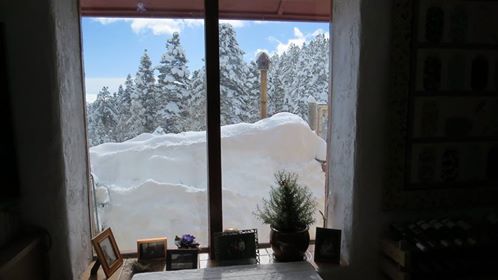
snow over the windows

I asked them how deep the snow gets up there, and they decided one picture was worth a thousand words!

WOW! We have had a few snows of a foot or so, but nothing like this! They told us stories of  a few snowstorms where they shoveled for eight hours straight. If they didn’t have heavy equipment they wouldn’t be able to get out for weeks!

Their property includes an old straw-bale cabin on a mine site plus 100 acres. Their water comes from a spring nearby, and what delicious water it is! They heat with a large wood stove, which requires a great amount of log splitting to prepare for the winter cold. They have electric service, mainly because the costs of returning renewal energy back to the grid here requires outrageous fees and insurance requirements, and going off grid presents other problems with reliability and initial  installation costs. We are stuck here until better energy storage solutions are developed worldwide.

The natural beauty of their landscape is beyond words and, did I mention, they have no water or heating bills… They maintain a number of wildlife cameras and see so many different animals around their home. Bears are so commonplace that they have named a few of them! It’s a wonderful place that requires a lot of work to maintain.

Postscript: This home was lost in the Spring Creek Fire , July 2019.

We recently built a passive solar home right at 7,000 feet and are told by our new friends that we are really saving a lot of money in the winter by absorbing the sun’s heat directly into our insulated slab, which helps to hold the daily sun’s heat within our home overnight.

solar water tubesWe hope to add a few of these solar thermal water tubes to our home soon to increase our thermal mass and help to moderate temperature swings both in the winter and summer. Beyond solar, we depend on Cadet forced-air electric wall heaters on thermostats for all of our winter heating needs. They usual turn themselves on during the night and turn off soon after the sun comes up most days. In the summer, the positioning and excellent insulation in our new home keeps us cooler than most without the need for air conditioning. We have ceiling fans in every room.

We have rarely been “snowed in” this past winter, but we did purchase a Subaru and love how well it works on steep snowy roads. Overall, we’re glad we chose a lower elevation, especially since our home survived the Spring Creek Fire in 2018!

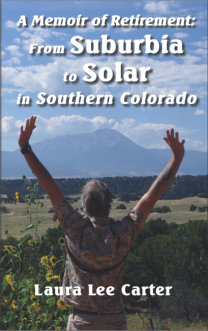
memoir of retirement 2016We are newcomers to rural Colorado, so after two years I compiled a book about the total experience of moving here to build passive solar  in the foothills:  A Memoir of Retirement: From Suburbia to Solar in Southern Colorado Please feel free to contact me directly for copies of any of my books! MidlifeCrisisQueen@gmail.com