Sunrise Meditations, Number 1

IMGP7585

United we stand. Divided we fall. 

Hatefulness is not the way…

It cannot be more clear to me that our enemies are winning in this race to see how best to destroy our country. Russia and probably China (and who knows who else) would like to see us fall into division and disarray. They love to watch this president sow seeds of anger, hate and doubt. In his mind, everyone is responsible except for him, just like a child.

I have never seen such hatefulness in my country in my 63 years here. Hate begets hate. Violence begets violence, and anyone who knows anything about human behavior knows that blaming is a thoughtless and childish way of ignoring the part we each play in this destruction of our country.

There is no way Trump will be maturing anytime soon, so what are the rest of us to do about this cancer of divisiveness? Arguments have been made on both sides about “going high,” “going low” or standing up to the stupidity and lies we see daily. I have no answer except to say:

We all want the same things. I am certain of that. We do not want to end over two hundred years of American history, by descending into hatred and chaos.

Each of us must be honest, see what is happening here and choose a higher road than that of our president. If we don’t, hate and stupidity wins and we all lose.

Autumn in the shadow of the Sangre de Cristo Mountains

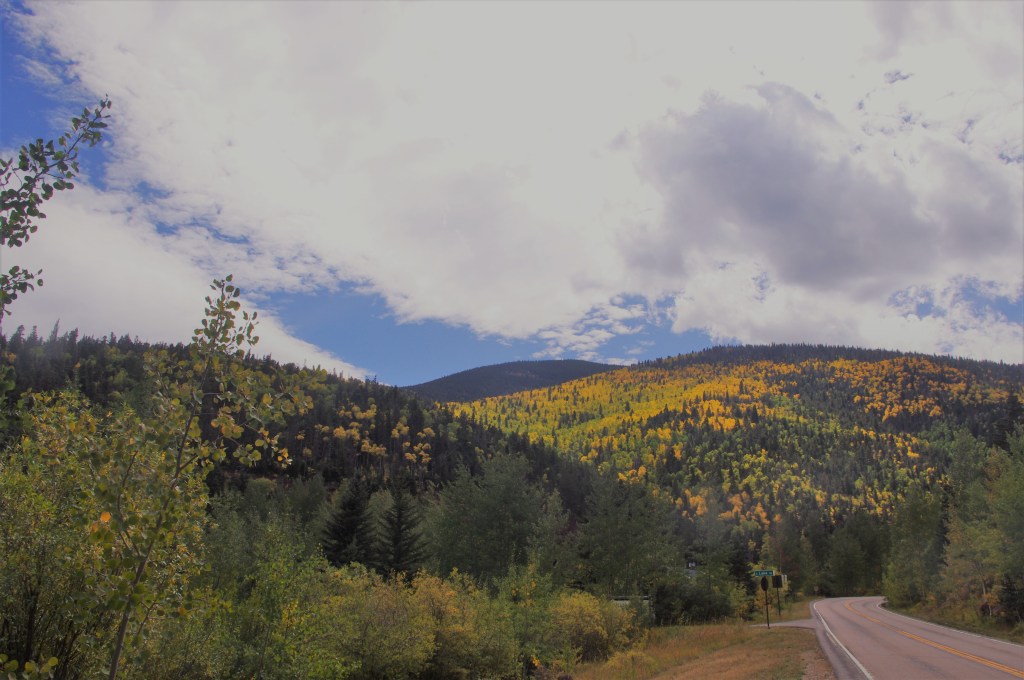
We are having a warm lovely fall here in southern Colorado! We had our first snow in the Sangre de Cristos south of us a couple weeks ago, and then some weather in the 60s settled in to warm our winter-fearing souls.

The 60s are my favorite temperature, just right for sitting outside and observing the  many birds and quadrupeds that happen by our home. We have seen herds of deer and a couple coyotes walking by recently…

and the Road Runners come right up to our glass doors.

Unfortunately that first hard freeze did a number on my first crop of lavender.

We have had such a strange summer season this year. The winter and spring, which are usually super wet, were quite dry through June, when the Spring Creek Fire hit this area, destroying over 108,000 acres and over 140 homes and other structures.

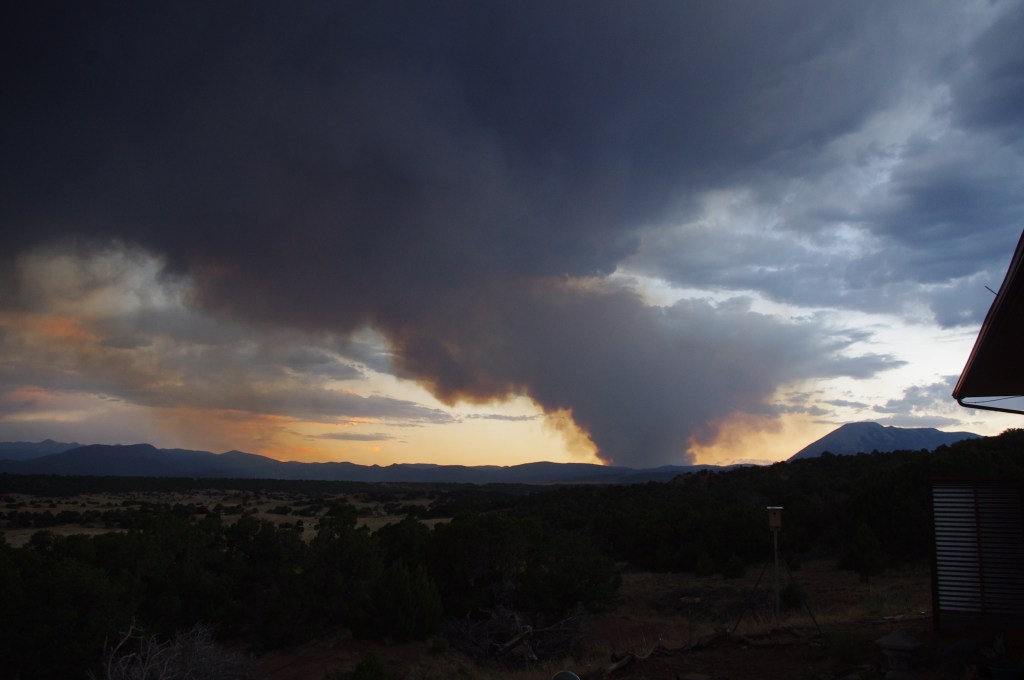
This was my first view of the fire as it emerged south of Mount Mestas on June 27th.

Fortunately in July the rains finally came, saving our area from complete devastation, but still for the 2017 – 2018 water year we received less than half of average precipitation.

My brand new foothills garden did not like these ever changing conditions. It died way back in June, but made a phenomenal comeback with the 3.35 inches of rain we received in July! My garden is perpetually a work in progress. We are now waiting to get a bunch of red pavers to place in the lower level around the bird bath.

It gives me great joy to wander around outside and think about how Mike and my brother John worked so hard to help me realize this lifelong dream!

LOTTERY LOVE in the USA!

WOW! I just heard one fun fact: Americans will spend $73 BILLION this year on lottery tickets! Coloradoans spend right around $100 per year, while the overall average spending in the USA is $223 per person. REALLY?

For a GREAT article on this topic go here. The numbers will astound you!

Next I wondered who spends the most on the lottery by income. There I found that some households earning less than $13,000 a year spend a shocking 9% of their money on lottery tickets. The lowest-income households in the U.S. on average spend $412 annually on lottery tickets, which is nearly four times the $105 a year spent by the highest-earning households, according to a recent study by Bankrate.com. And almost 3 in 10 Americans in the lowest income bracket play the lottery once a week, compared with nearly 2 in 10 who earn more than that.

“Lotteries have become an alternative mechanism of social mobility—a way of achieving financial success in an economy that’s increasingly bereft of those opportunities,” said Jonathan Cohen, a Ph.D. candidate at the University of Virginia who’s completing his dissertation on American lotteries. “There’s an understandable belief that the economy is rigged and your best chance of making it out and getting rich is through the lottery, not through your job or savings.” 

At least in Colorado the lottery has invested more than $3 billion into protecting Colorado’s wilderness and wildlife by creating trails, parks, and also public school construction. That’s the only reason why I occasionally buy a ticket. No illusions of grandeur here  🙂

Do beliefs about climate change depend on how old you are, your education level or “groupthink”?

I will never forget a discussion I had over ten years ago with a woman in her eighties at the Senior Center in Fort Collins. She said climate change was bull and I said just wait. Then I realized and said to her, “Of course you’re not as concerned about climate change. You won’t be around to see what happens, but what about your children and grandchildren?” I’m certain that woman is dead now.

UN report on climate change 2018

SOURCES FOR THE NEW UNITED NATION REPORT ON GLOBAL WARMING

UN Climate change report-october 2018-Today I did the research on this topic. Please go check out this survey that describes concerns about climate change in the United States between 2015 and 2018, by age group. During this period, over 51 percent of adults between 18 and 34 years of age agreed that global climate change will pose a serious threat. Of those over 55, less than one third felt climate change was a serious concern in their future.  Now let’s ask the thousands of victims of Hurricane Michael. Why was this the first storm to hit this area in decades and why did it’s intensity increase when it headed out over the land?

Further research suggests:

“Climate change believers are generally younger, more educated, have more money, and are non-white (which means skeptics are generally older, less educated, and white). But all these factors are only weakly associated with climate change beliefs… Instead, political affiliation – Democrat, Independent, or Republican – strongly predicted climate change belief, such that Democrats are more likely to believe in climate change than Republicans…

This might suggest that groupthink, the psychological effect of similar thinking to maintain conformity to a group, guides climate change attitudes, not just ideology alone.” “Understanding Climate Change Skeptics” in Nature Education

Who voted for Donald Trump? A Cohort Study

After our 2016 election, I became determined to understand why Americans found a billionaire, real estate mogul, reality show candidate so attractive as our next president. This did not compute for me. What about this 70-year-old, obviously sexist and racist candidate spoke to so many Americans? In the midst of listening to the popular music of the 1960s this week I finally got it. This music reminded me of what was happening in our country in the mid- to late 1960s, something I hadn’t thought about in years.

First of all, let me explain what a cohort study is. Wikipedia defines it as:

“A cohort study is a particular form of longitudinal study that samples a cohort (a group of people who share a defining characteristic, typically those who experienced a common event in a selected period)…”

My best example is a study I learned about when I was pursuing a Master’s degree in history. It theorized and then proved that many of the children from Germany in WWI lost their fathers and consequently found themselves seeking a strong, authoritarian father figure as they grew up. This they found in Adolf Hitler. They found meaning and purpose in the rise of Hitler’s Nazi Party.

Back to the Trump cohort. I began to think about the recent history of our country, and the revolution we experienced in the 60s, a real revolt against the Vietnam War, racist and sexist attitudes, and powerful men who thought they could tell us what to do without our permission. Note the impeachment of Richard Nixon who resigned in 1974.

“Opposition to United States involvement in the Vietnam War began with demonstrations in 1964 against the escalating role of the U.S. military in the Vietnam War and grew into a broad social movement over the ensuing several years. This movement informed and helped shape the vigorous and polarizing debate, primarily in the United States, during the second half of the 1960s and early 1970s on how to end the war. By 1967, according to Gallup Polls, an increasing majority of Americans considered U.S. military involvement in Vietnam to be a mistake.”

I began to see how the 1960s peace movement tended to include educated college students and their elders: “Opposition grew with participation by the African-American civil rights, women’s liberation, and Chicano movements, and sectors of organized labor. Additional involvement came from many other groups, including educators, clergy, academics, journalists, lawyers, physicians, and war veterans.”  Source: Wikipedia

This revolution left out most poor and uneducated Americans who didn’t go to college or revolt. The men were sent to Vietnam. Trump was also apparently left out. He attended the New York Military Academy and the Wharton School during the Vietnam War protests.

“After graduating from college in the spring of 1968, Trump was eligible to be drafted and sent to Vietnam. Instead he received a diagnosis that would change his path: bone spurs in his heels. This diagnosis resulted in a coveted 1-Y medical deferment that fall, exempting him from military service as the United States was undertaking huge troop deployments to Southeast Asia, inducting about 300,000 men into the military that year. The deferment was one of five Mr. Trump received during Vietnam. The others were for education.” The New York Times

In 1968 Trump began his career working for his father in real estate, blissfully unaware of a war half a world away that killed over 58,000 Americans and caused permanent physical and mental disabilities in thousands more.

Vietnam vets account for at least one quarter of homeless Americans today.

My theory, and I find statistics do back this up, is that those who went to Vietnam or went straight into jobs in trades like coal mining and factory jobs, felt left out and let down by an ever expanding economy and higher education rates. They may have felt like losers for not getting better careers, because of their lack of education and connections. Statistics show how financial insecurity played a role in attracting Trump voters, but education levels mattered more than income levels. 

“I love the poorly educated,” Trump famously said after winning the Nevada Caucuses in February, 2016. Apparently, for many of those voters, Trump offered them a chance to not feel like a loser for the first time in a long time.

He relates to those who missed out on the 60s revolution and higher education, training that teaches us to respect scientific data when it warns us of warming oceans and catastrophic hurricanes.

“Clinton gained over 8 percentage points on Obama’s 2012 performance in the 50 best educated counties, but lost over 11 points in the 50 least educated counties.” Seven Surprising Graphics About Trump Voters

I find this cohort explanation satisfactory to explain that both the older, wealthy Americans who fear losing their wealth, and the uneducated who have felt like losers in this ever-expanding global economy, not to mention the purely fascist, racist segment, elected this president.