Dealing with Trauma as a Highly Sensitive Person with Head Injuries: A Personal Note

I have been thinking about trauma in my own history these past few weeks and I now see I have suffered a number of traumatic experiences that I did not originally recognize as such. I think this can be attributed to two personal factors. One is that I have always been a “highly sensitive person” and the second is my numerous head injuries in the past 15 years.

I assume most of you have heard of the term highly sensitive, but these are the traits I relate to personally:

  • Overly sensitive to emotional and physical violence
  • Naturally experiencing the emotions of those around me
  • Often feel overstimulated
  • Often need to withdraw because of overstimulation
  • Startle very easily
  • Enjoy a rich inner life
  • Feel deeply moved by beauty
  • Deeply emotional and compassionate
  • Unable to deal with even moderate amounts of criticism
  • Usually feel different and alone
  • Easily overthink and worry way too much
  • Very intuitive
  • Often feel tired and emotionally overwhelmed

I guess you can see why someone like me can be more easily traumatized. Then when I experienced a traumatic brain injury in 2008, my ability to deal with others, especially when they are angry or even just mean to me was multiplied by one hundred percent. And with this most recent serious concussion I find I am so easily drained after simple exchanges with others, and I can only socialize for an hour or two with anyone.

Luckily I found a life partner who is also quite sensitive and therefore understands exactly how much I can take from others. And yet, even with him I need to withdraw regularly into my quiet little world where nobody can reach me. I simply feel safest alone in very quiet places. I guess I am a true introvert now.
Understanding the power of trauma in your life

I found myself wondering recently why a traumatic breakup with a lover over forty years ago still has such a powerful impact on my brain, so I did some research on recent findings on how psychological trauma can affect us. I was especially interested in how we can get “stuck” emotionally when traumatized.

I have always found it fascinating how one traumatic event can change everything. Ever since I did my counseling psychology internship in a rehab hospital back in the 1990s, trauma has been one my favorite areas of research.

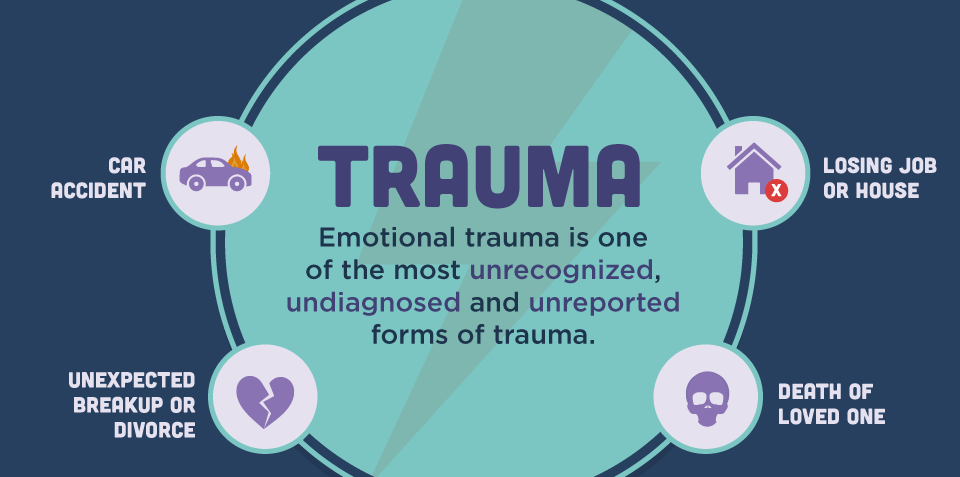
There are a number of important misunderstandings about human trauma. The first is that a “trauma” has to be something tragic, violent or catastrophic, like being injured in combat, a natural disaster or terrible accident. This is simply not true. Our brains are all very different and may interpret any incident in our lives as traumatic, even if the event does not register as highly significant at the time.

Our psychological backgrounds and emotional sensitivity levels are so unique that a traumatic breakup or an abusive relationship can cause one person to regress or get stuck emotionally, while that same event might have little impact on someone living through a similar experience.

Trauma is not an event that happens to you, it’s how you process that event. If you are emotionally injured as a child or young adult, the outcomes can be greater than as an adult. If you receive support or help while going through a traumatic event and its aftermath, the trauma is less likely to have such long term effects. But if you experience the trauma alone and with no support, the effects can be much more long-term and traumatic, especially if that event feels like it threatens your very existence.

Depending on the severity of the trauma, your entire way of being may be formed around one traumatic event. This is because, on a neurobiological level, the trauma is not properly processed. It can rewire your brain in such a way that ultimately influences your thought patterns and behavioral responses as you get older.

Traumatic events can overwhelm you body and mind, leaving a lasting mark on your mood, relationships, and sense of self long after the trauma has ended. When trauma impairs your ability to develop full emotional maturity, this is known as arrested psychological development. Trauma can freeze your emotional response at the age that you experienced it. When we are traumatized at an early age, the memory of the trauma is stored both in our brain and body. As a result, if healing does not occur, the traumatic incident can impede healthy development.

The good news is that if we understand how traumatic this event has been in our lives and then seek proper help from a licensed therapist, most can integrate their traumatic experiences and become unstuck emotionally. For many this will mean developing more mature emotional responses and relying less on unhelpful, child-like coping methods.

Take it from me. Spending the time to fully process anything you consider traumatic in your past, can only benefit your emotional future!

The most important healing tip I’ve learned from my own brain injuries (TBI & concussions)

I just saw an interesting piece on the importance of sleep on the NBC morning news show, which reminded me of the most important thing I have learned from experiencing a traumatic brain injury and a few serious concussions. That is the amazing healing powers of sleep!

I’ve always been a pretty good sleeper and enjoyed every minute of it, but now I see that sleep, whenever you feel like you need it, is your best brain restoring behavior. When we are younger we may try to get away with less sleep than we need, but, as we age, deep REM sleep is essential to brain health and memory retention.

After my traumatic brain injury fourteen years ago, I had no choice but to sleep quite a bit for months afterwards. I also had fractured ribs and breathing problems. That kept my activities to a minimum. But my brain did slowly heal itself over a few years. It literally re-wired itself to work well again.

It was only after a recent serious concussion in April 2021 that I knew that I must take it really easy on my brain and rest whenever I felt fatigued. Then I read Dr. Jill Bolte Taylor’s amazing book “My Stroke of Insight: A Brain Scientistʼs Personal Journey” where she explained how she slowly healed from a terrible stroke. There she re-emphasized the need to sleep as soon as you feel any need for it. In this way I have slowly regained clarity and stability over the past year and a half.

We must all stop fighting sleep and ENJOY IT! It has such a healing effect on your brain and every other part of your body. If you don’t believe me, believe the Dalai Lama:

Acceptance releases everything to be what it already is… Bye-bye Bodie :(

Did I ever mention how stubborn I am? Most who have known me well would certainly agree!

Most recently it took me a very long time to accept that I really did need to be on oxygen 24 hours per day. And there’s those annoying concussions I have suffered in the past few years mostly because I refused to wear my oxygen, or simply forgot I didn’t have it on. So here I am lost-in-space too much of the time… It isn’t as bad as it sounds, because I now accept all of it.

Bodie, our problem child…

But I had to be convinced that Mike and I could not handle a new puppy at this late date. And it wasn’t just us, our other pets, Rasta at age 14 and Rosie, Mike’s cat, completely rebelled at the experience of one wild and crazy puppy dominating everything while running around our home non-stop.

Mike was just going along with me when I suggested this new addition to our family, because he loves to make me happy. He is the most loving and tolerant person I have ever met, but after five days of pee and poop everywhere and absolutely no peace in our home, we both knew the puppy needed to go back to his pack in Raton. We were so lucky that Bodie’s original owner was also caring and tolerant. She just wanted everyone to be happy too. She already had five dogs, so what the heck! We all saw that this pup needs a household full of kids and/or other dogs who LOVE TO PLAY… FULLTIME!!!

I have always been fairly impulsive, and apparently my brain injuries have made that worse. I guess this lesson falls squarely under the heading of “Live and Learn.” My old dog Rasta took a full day to believe that a puppy wasn’t going to pounce on him at any moment, and our cat has finally emerged from the bedroom. We love having our peace and quiet back.

All’s well that ends well… and now we know.

Living in the simplicity of the present

I’ve been thinking a lot lately about how I have been changed by the experience of leaving city life behind. The greatest change has been my new ability to at least occasionally be in the present. I see now that before I moved here, I was constantly stressed out, and in distraction mode.

“Distractions are both more tempting and more destructive than we realize. It’s tempting to fill in every little minute of the day with productivity or distractions. Don’t. Leave some emptiness.”  – Zen Habits

It seems to me that cities are set up for constant outside noise and distraction. Any time you feel uncomfortable in any way, you can call up someone to go see, order some new kind of food, go out shopping or go see a movie. People in cities spend most of their time sitting in traffic or driving somewhere else. Cities are distraction machines, and the Internet is the ultimate, easily available escapism.

Being in the present means you are not planning ahead. You are sitting still, willing to be here now to observe and absorb your present surroundings with no thoughts of yesterday or tomorrow, no need to distract yourself. I find many of the observations of ZenHabits.com useful in my new mindset:

“If you’re filling your life with distractions, its probably because you’re afraid of what life would feel like without those distractions…”

To be honest, I never really had the time to gain full awareness of all of this until I moved away from modern American life. I knew I was anxious and not as relaxed as I wanted to be in the city, and now I see why. Cities raise our anxiety levels. I know because it took me at least a year away from a city to see how anxious I have been most of my life, and then find ways to allow myself to truly relax.

I have been a worry shopper my whole life. Once I solved one problem I moved on to the next one. Out here there is so little to worry about, leaving me much more time to focus on what is important to me. Now that’s a great new challenge! And what is important to me now is a few important relationships, and appreciating the natural world and its wonders.

We can sit and dream about so many things, but we would be wasting our lives. This present reality is all we get. Let’s learn to love it.