Rewilding, some positive nature news at last!

If you tire of hearing ever more negative news about how we humans continue to pollute and destroy the earth we depend on for life itself, try watching this five minute story from this week’s CBS Sunday Morning. Trust me, you will be glad you did!

Rewilding: Letting nature take over

Rewilding is a progressive approach to conservation. It’s about letting nature take care of itself, enabling natural processes to shape land and sea, repair damaged ecosystems and restore degraded landscapes. Through rewilding, wildlife’s natural rhythms create wilder, more biodiverse habitats.

By growing native, drought-tolerate plants here, we have encouraged the return of wildlife, birds, bees, etc.

This idea/story offered me a sign of relief, showing me that sometimes nature wins in a great win-win way for people too. This is what my late father was always talking about, letting nature take over, because she did a great job up until now! This is also what we have tried to do on our own three acres in southern Colorado. I just do not comprehend those who buy land in the country and begin mowing the crap out of it immediately. We hated “yard work” when we lived in suburbia, and guess what, all the birds and bees and other wildlife there also could not tolerate it. They need biodiversity to thrive. Rewilding is a form of ecological restoration aimed at increasing biodiversity and restoring natural processes to the land.

Why is it so hard for man to simply leave nature alone to take care of itself? Why are we so convinced that we need to “improve” it? We as a species must learn the answer to this question before we “improve” ourselves into complete extinction.

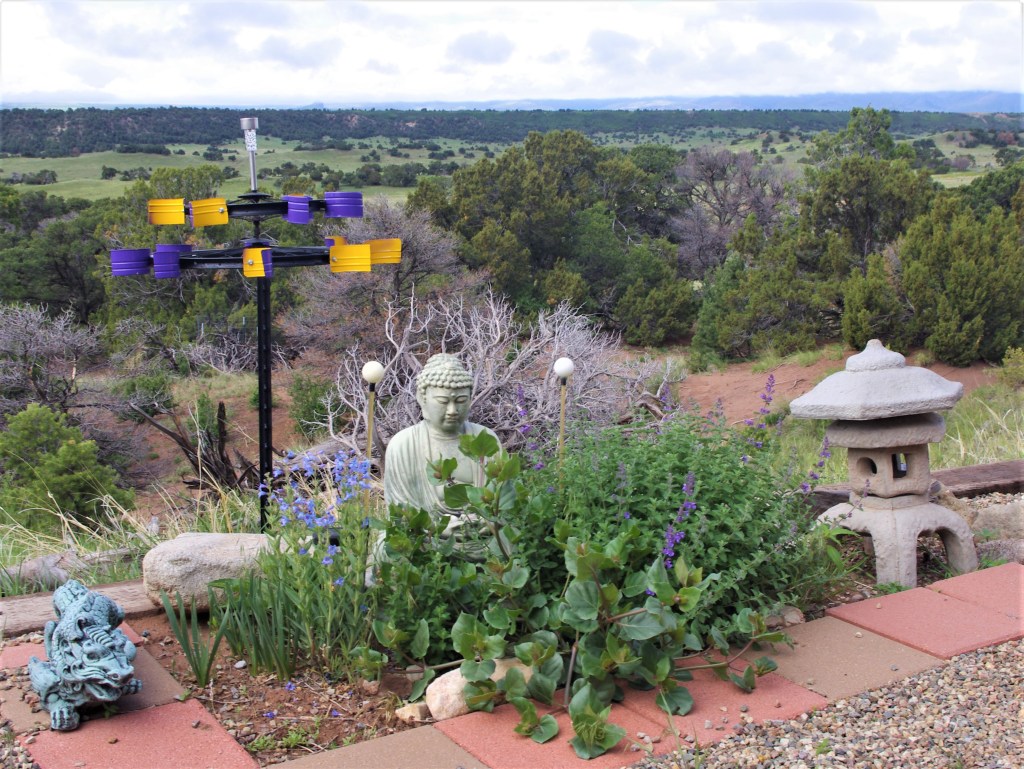
My Early June Garden After a Rainy May

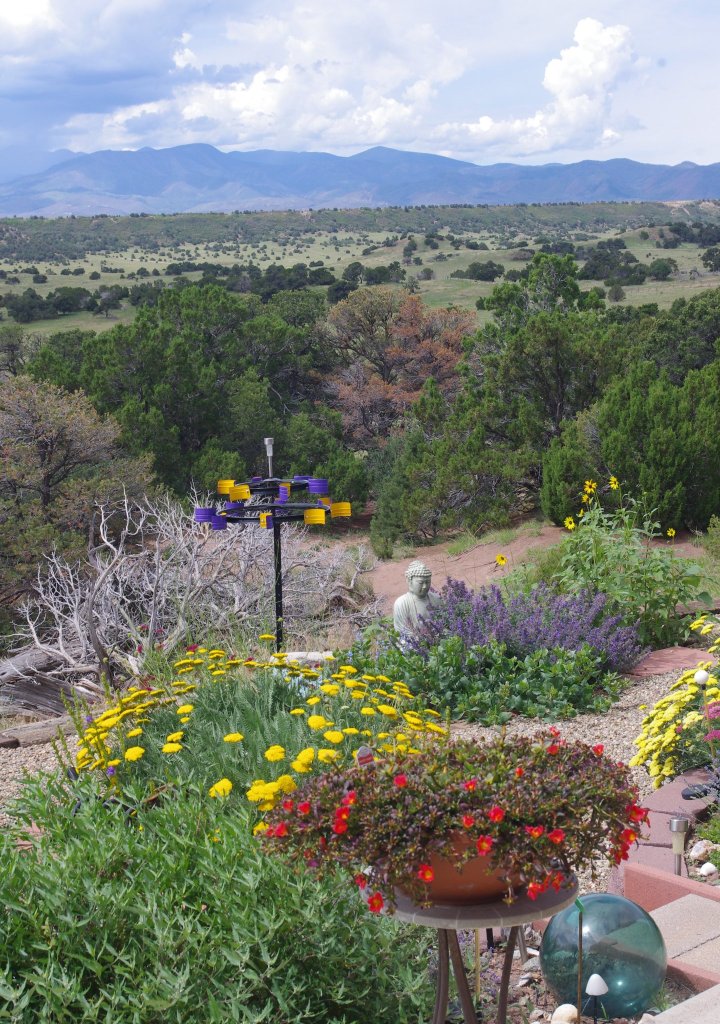
Although we haven’t had the kind of moisture that Denver and Colorado Springs have had this past May (with over five inches!), we have had over two inches here with cloudy rainy days for quite a while now. Today is a good example. Here are some pictures of my plants and bloomers in my foothills garden in southern Colorado today.

Starting on the west end, we have some very happy yucca, cacti and evening primrose plants, although the flowers and fruit of the yucca were rudely eaten off by some kind of varmint. Note the cute little honeysuckle bush in the upper left. It always blooms too early in the year!

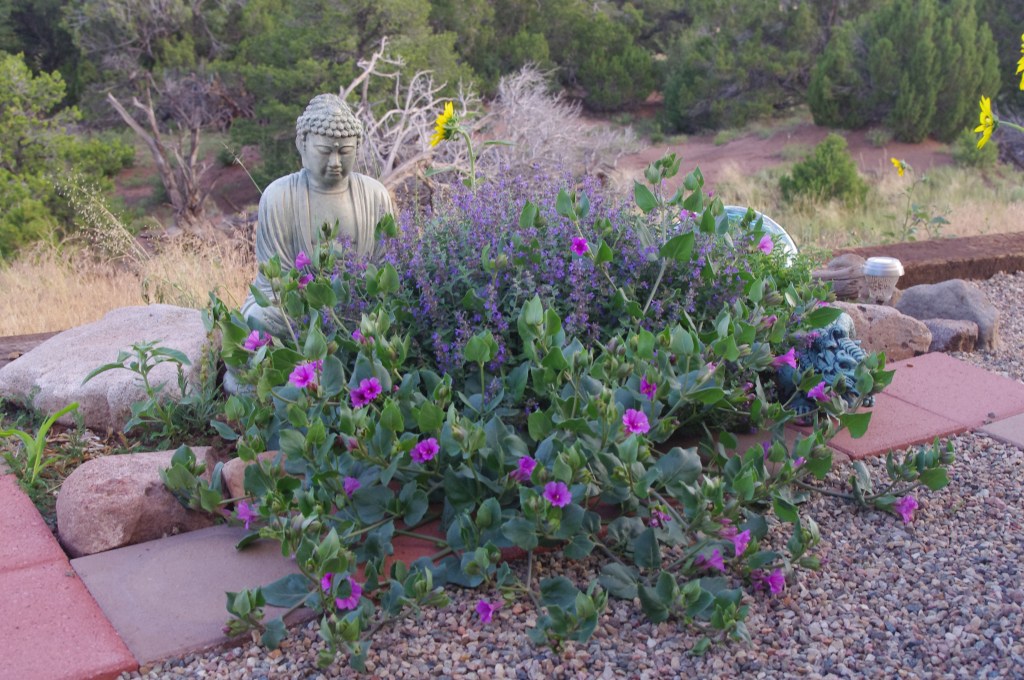
Next we have the plants that bloom around my Buddha. On the left is a native Penstemon volunteer still blooming, some catmint coming in on the right and a native Four O-Clock fighting its way through in the middle. That will have magenta flowers eventually… Love it!

What I’m most proud of is my yellow Columbine, because I’ve never had one bloom in my garden thus far. Although it is the Colorado state flower, it usually gets bitten off before blooming.

On the east end I have some lovely irises blooming with the West Spanish Peak behind them!

Overall I’m so pleased with what I have so far, because I know that those May and June showers will bring some great blossoms later on! I’ll keep you posted…

Survival in my CO Foothills/Mountain Garden

First, let me say, gardening is so much fun and so rewarding! It makes me look forward to spring with such enthusiasm! But that is not to say that there aren’t some MAJOR disappointments as well.

My greatest problem here at around 7,000 feet just north of the Sangre de Cristo Mountains are the critters that come out at night and champ off the flowers on my plants that are just about to bloom for the first time in a YEAR!

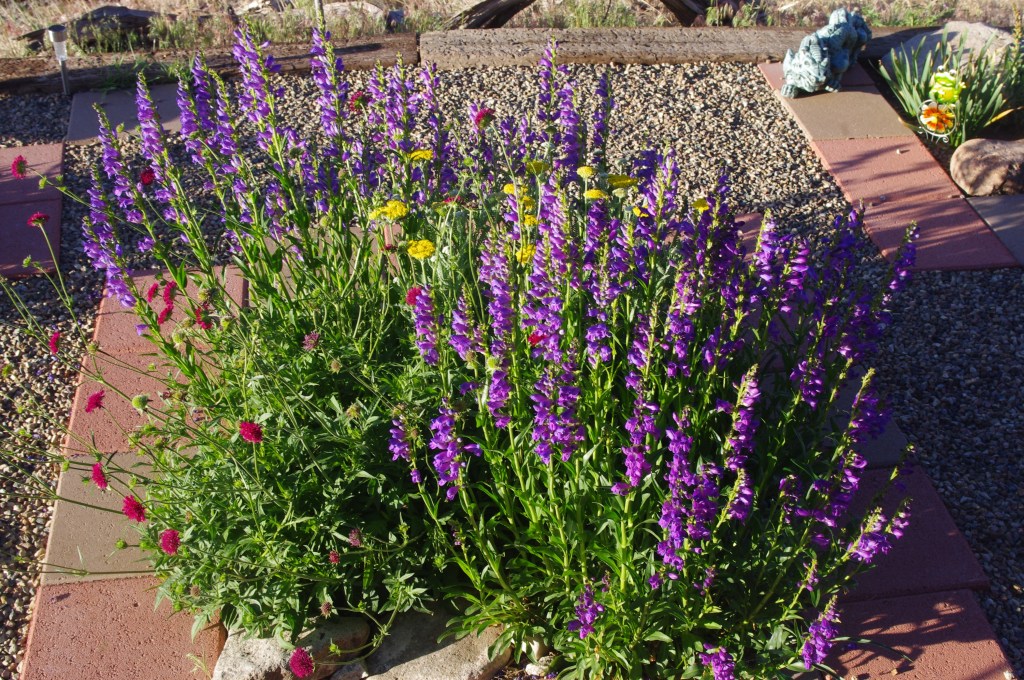
For example, my first few years I had the most beautiful Rocky Mountain Penstemons. These are from spring 2020.

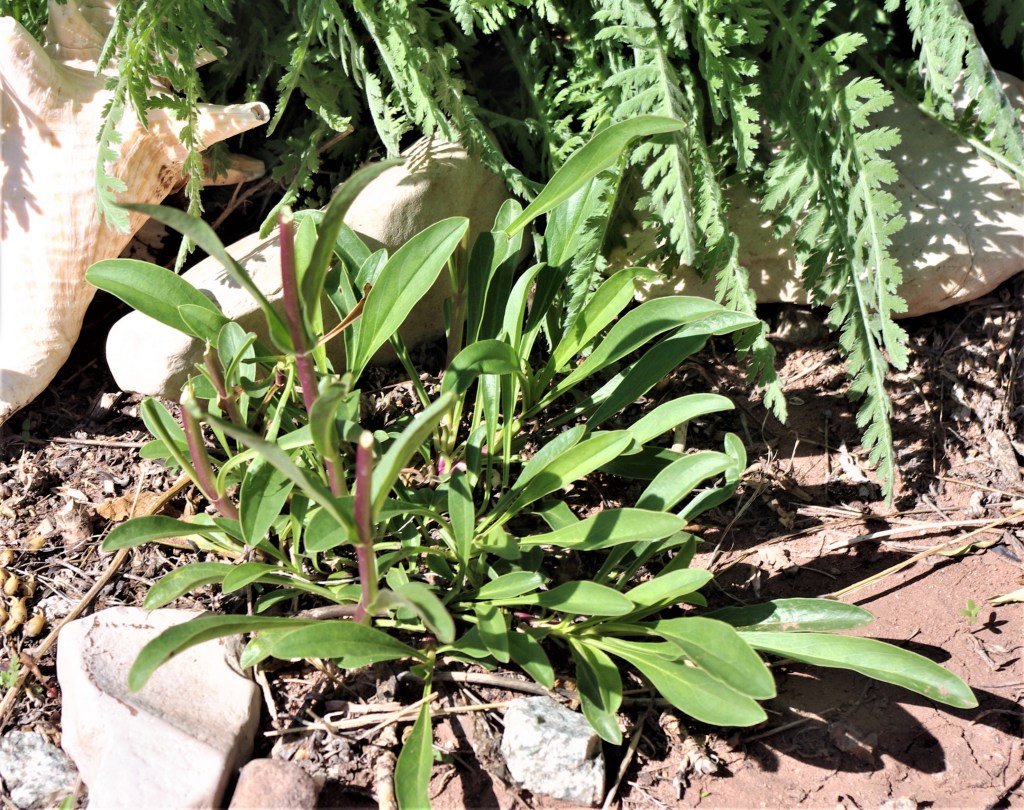
Since then, every time I see a new crop is thinking about blooming they get eaten off overnight. I know I can cover them, but I somehow get convinced that this year will be different and then it isn’t. They even ate some of my native penstemons last night! I’ve also had very bad luck with Evening Primrose out here.

Slowly but surely I’ve turned to the mostly shrub-type plants that never get eaten and seem to love life here.

I’ve never had any problems with my Walker Catmint, here with a native Four O’Clock growing through it!

The Blue-Mist Spirea on the left has not yet bloomed, but the yarrows and lavender are quite happy!

I love when my Jupiter’s Beard comes in for the contrast to all of that purple out there. I seem to almost always choose the purple or yellow plants. I have learned that any plant that is woody and herbal, the animals don’t eat, like lavender.

And if I want to grow some annuals, I put them up far away from the critters!

Finding the Strength to Let Go of Self

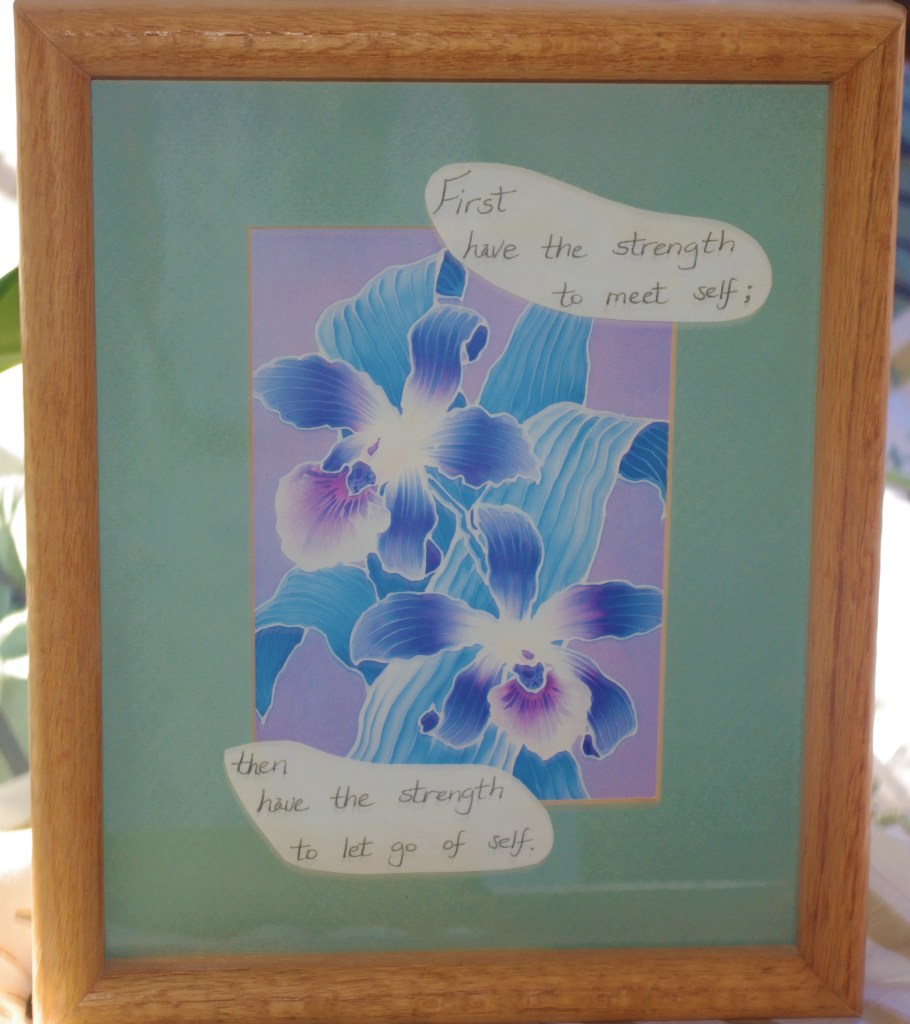
I believe our lives are a process of finding and confronting our true Self, and then slowly letting go of it as we age. Some might prefer the word ego in this scenario. I have had this message on my wall for decades:

What is the ego or sense of Self?

ego: a person’s sense of self-esteem or self-importance, the part of the mind that mediates between the conscious and the unconscious and is responsible for a sense of personal identity.

The way I relate to my sense of Self is to know that as a child and young adult my ‘job’ was to develop my sense of who I was inside, what did I think and value? How should I treat others? How did others see me? This naturally leads to a strong sense of self-consciousness, sometimes painfully so. Then came the time to figure out what I planned to do in the world. How did I hope to change my world? These are the purposes of young adulthood up until our forties or so.

Developing a strong sense of self or ego is a good and necessary part of being human. There is nothing wrong with having a strong ego, but it needs to be regulated. Problems arise when ego affects your decision making process, turning you into a victim, or when it makes you feel superior to others in order to justify your bad behavior. A toxic ego is one that does not learn from bad behavior, but instead blames others, often descending into negativity, resentment, and even violence.

For the past twenty years, my spiritual path has been that of the second part of life. I have been searching for the strength to let go of self. A part of this process is simply getting comfortable with self compassion and death. Although we might think we have a strong sense of self when we are younger, if we are very honest we may find much self-criticism inside. This is all a part of the ego. Like we really did have the power to change any part of our world…

Being close to nature is your best path to realizing your place in the history of time. Please note, there are no other animals or plants that believe they are changing the world. There are no other beings that fear death. They know what their part is, to be born, to live and then die. I have found a gradual process of getting used to the idea of death is the best path for me. At first is was so hard to be with so I would push it away and deny its power. Since I started facing some powerful signs that I won’t be around forever (lung disease and brain injuries) in the past few years, my acceptance has grown like my garden outside my door, bright and beautiful.

What were you born to do?

I heard an expression lately that struck me in a good way and reminded me of my upcoming birthday. Of all the ways there are to say it, I think asking, “What were you born to do?” gets down to the basics of our very existence here on earth. I was born 68 years ago into the mid-1950s, the third kid in a lower middle class family. My Dad was just finishing his PhD at the University of Iowa while my Mom worked nights to keep our family going. No, my family really didn’t need another child, but there I was.

On my first birthday, my Mom made me a cake and then my brother and sister cheered me on as I first learned about the intricacies of blowing out my one candle…

It took me quite a while to figure out what I was born to do and in my case it had little to do with how I earned my living. For as long as I can remember money was never that important to me. Fine qualities of character are what I look for in everyone I meet, and even more so today. Through decades of trusting the wrong people, I learned how to identify those worthy of my trust.

“Experience is the best teacher, and the worst experiences teach the best lessons.

Through a lifetime of experiences I have learned more and more about who I am and what I value. From these I can now clearly identify what I was born to do:

I was born to love unconditionally, but very selectively.

I was born to love the earth & sun, and conserve nature in all forms.

I was born to travel the world.

I was born to try to understand human nature and animal psychology.

I was born to love dance, beautiful movements, and especially in ice skating.

I was born to love intellectual stimulation, learning, research, books and the visual arts.

I am a natural born plant and flower lover!

So on this, my 68th year on earth, I now wish myself a heartfelt:

March is Brain Injury Awareness Month

There isn’t a lot I can do to “change the world” these days, but one area that I have too much experience with is serious brain injuries and how they can change your world. So this month I will try to educate everyone a bit about what I have learned on this topic.

A traumatic brain injury (TBI) is one where you lose consciousness for a period of time and often have a bleed in your brain afterwards. It is a sudden injury that causes damage to the brain and may happen when there is a blow, bump, or jolt to the head. This is a closed head injury. A TBI can also happen when an object penetrates the skull. This is a penetrating injury. In my case I fell head first off of my bike while riding downhill. I was unconscious off and on for hours afterwards along with fractured ribs, a thigh injury, a wrist injury, and spent 24 hours in the ER and the hospital neuro-unit under observation. At the time I could not stand up without passing out.

How long does it take to fully recover from a TBI?

Depending on the severity of the injury, recovery time for a TBI may vary from a few weeks to six or more months. Each person reacts differently to injury and illness. Thus, recovery time will vary between individuals. The length of recovery time for TBI depends on how long a patient is unconscious and what parts of the brain are injured.

Are patients ever the same after a TBI?

Moderate to severe TBI can cause permanent physical or mental disability. Because polytrauma is common with moderate to severe TBI, many patients face additional disabilities as a result of other injuries. Even patients who appear to recover fully may have some long-term symptoms that never go away.

My experience:

I would say it took a few years for me to feel “normal” again after my TBI in 2008. My main form of rehabilitation was writing books, reading a lot and maintaining my blogs.

Unfortunately, I have been prone to falls and further head injuries since then. I fell again with serious concussions in 2015, 2019 and 2021. My most recent concussion was most serious and caused permanent balance, memory and vertigo problems. I now use research, writing and game shows like Jeopardy to spur my memory and keep me sharp. I also love old movies, soft music, and nature shows on PBS. They really soothe my brain.

Does TBI affect IQ?

In the end, a brain injury does not make a person less intelligent. It does, however, make certain mental activities, such as learning, require more time and effort. This is because the brain works less efficiently after a brain injury.

My biggest pet peeve around my present condition is that others may look at me and assume I’m not quite all there. I am definitely as smart as I used to be, it just takes me longer to arrive at the answers. I do have trouble getting around because of my oxygen machine, but that doesn’t mean that I am someone to feel sorry for. I do not feel sorry for myself.

I think I have a great life here with Mike and my puppy Rasta, and this fantastic view of those beautiful Sangre de Cristo Peaks.