Love: The Only Why

So here we are facing Valentine’s Day again, a Hallmark holiday whose origins, much like Halloween, are rooted in pagan partying. This lovers’ holiday traces its roots to raucous annual Roman festivals where men stripped naked, grabbed goat or dog skin whips, and spanked young maidens in hopes of increasing their fertility, so says classics professor Noel Lenski at University of Colorado, Boulder. What do pagan parties have to do with love? Nothing.

After being abused in most of my early relationships and spending most of my adult life without any idea what love feels like, I spent some serious time after my divorce around age 49, studying love and how I had missed out on it so completely.

How had I lost my ability to trust anyone else? Did I want to spend the rest of my life that way? Time was up for me. It was time to decide. Would I ever believe in love again?

I was quite lucky. After decades of struggle, study, and contemplation I finally met someone who was worthy of my love. Of course I didn’t know that at first. In my case I felt certain of his love whenever I was around him, but completely uncertain when I wasn’t. It took me a long time to truly trust him with my heart, but he has always been patient and loving around my trust issues.

For us it was a life and death struggle in a world full of complete nonsense. He had a chronic illness which had challenged his will to live for decades. I had lost my will to live after so many decades of disappointment with the human race. He wanted to find new reasons to live, and he wanted to help me find new sources of joy.

snowy west peak with comanche home in foreground

We decided to make life great again TOGETHER…

From this I have learned that when you struggle together against great odds, you can build a powerful, trusting relationship, and you will never be the same after sharing struggles like this. Fifteen years later we still face many daily challenges, and we know we will face them together until the end.

How to believe in love again, by Laura Lee Carter, M.A. Transpersonal Counseling Psychology
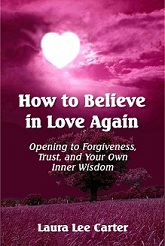
how-to-believe-in-love-again-between-tiny-and-blog-size

Most of us start out believing that love can transform our lonely lives into something better. When that doesn’t work out as hoped for or planned, do we dare dream again? After 25 years, I lost my job back in 2004.  I was 49, divorced with no kids. With five months warning, I watched the career I had counted on for decades for my bread and butter disappear before my very eyes.

Totally focused on “What’s next?”, the rational, practical side of my brain told me to go get another job doing exactly what I had always done, but my inner wisdom begged to differ.  It kept prodding me to open my own non-Internet-based matchmaking service. Eventually I agreed. I figured, what did I have to lose? I needed a date and a job.

Little did I know that this new business would unconsciously nudge me towards an even more profound use of my intuition and inner wisdom to guide me towards a rejuvenated approach to love and life…

Insights into Boomer Health Care Costs

I have spent the past week learning something I did not want to know about boomers, and what we will be dying of in the future. This all started when I contracted a Clostridium difficile or Cdiff infection back in October. C. diff is a common bacterium that can cause symptoms ranging from diarrhea to life-threatening inflammation of the colon. It can be very difficult to cure with standard antibiotic treatment, and the spores are easily transmitted on all surfaces.

fluAccording to the CDC, Clostridium difficile causes over half a million infections in the United States each year, and over 29,000 die within 30 days of initial diagnosis.  More than 80 percent of the deaths associated with C. difficile occurred among Americans aged 65 years or older. C. difficile causes an inflammation of the colon and deadly diarrhea.

I have followed the standard protocol of antibiotic treatments for the past few months, but my infection continued to return. Because the generic vancomycin I have been taking off and on for months seemed less effective, I recently requested a stronger, more targeted antibiotic, fidaxomicin also known as Dificid. Come to find out, this drug is Tier 4 to my insurance company, so they will not help me purchase it, and at over $5,000 per treatment, there are no guarantees it will be more effective in curing my illness.

I’m beginning to see, the worse your illness, the less likely your insurance will pay for needed treatments. Now I see why C. diff is killing so many Americans.

The only truly effective treatment for C. diff is a fecal microbial transplant. This treatment is over 90% effective, but guess what? This treatment is still considered experimental and is therefore not covered by insurance in our country.

So there you have it. The only two treatments that might actually help me at this point, are not covered by insurance and are therefore so outrageously expensive that no one but those billionaires who hang out with our president could afford them! I did find a British clinic in the Bahamas that offers FMT at a halfway reasonable rate, and if we get desperate, that is what we’ll do.

Good to know our health care system is working so well for Americans over 60. Sure there are lots of great drugs and treatments for infections and cancer, and most of us will never be able to afford them. We may also need to go to other countries to get treatments we can afford, and those that actually work!

Time to go renew my passport I guess…

The average cancer drug price for approximately 1 year of therapy was less than $10,000 before 2000. In 2012, 12 of the 13 new drugs approved for cancer indications were priced above $100,000 per year of therapy.

Happy Gut, Happy Life!

I wish to share something I’ve been learning a lot about lately. I have been experiencing a bad and surprisingly virulent intestinal infection in the past few months. Through this I have learned BIG TIME that nearly everything about our health, for example, how we feel both physically and emotionally, hinges on the state of our microbiome or intestinal organisms. Since I started having intestinal distress, it has become quite clear to me that dysfunction in my gut causes much confusion in my brain.

gut brainMost have no idea that our intestinal organisms, or microbiome, participates in a wide variety of bodily systems, including immunity, detoxification, inflammation, neurotransmitter and vitamin production, nutrient absorption, feelings of hunger or fullness, and how we utilize carbohydrates and fat. All of these processes factor into whether you experience chronic health problems like allergies, asthma, ADHD, cancer, type 2 diabetes, or dementia.

Your microbiome also affects your mood, your libido,  your perceptions of the world and especially your clarity of thought. A dysfunctional microbiome can be at the root of headaches, anxiety, inability to concentrate, and even a negative outlook on life. Neurologists are now finding that no other system in the body is more sensitive to changes in gut bacteria than the central nervous system. The good news? They are now seeing dramatic turnarounds in brain-related conditions with simple dietary modifications or with techniques to reestablish a healthy microbiome.

Scientists are learning that this intimate relationship between the gut and the brain goes both ways, which means that just as your brain can send pain to your gut, your gut can relay its own state of calm or alarm to the brain.

vagus nerveThe vagus nerve, the longest of 12 cranial nerves, is the primary channel between millions of nerve cells in our intestinal nervous system and our central nervous system. The vagus extends from the brain stem to the abdomen, directing many bodily processes that don’t require thought, like heart rate and digestion. Bacteria in your gut directly affect the function of the cells along the vagus nerve, in other words, our gut’s nerve cells and microbes release neurotransmitters that speak to the brain in its own language.

We have so many neurons in our gut that many scientists are now calling this our “second brain.” This brain not only regulates muscle function, immune cells, but also manufactures an estimated 80 to 90 percent of the serotonin, our “feel-good” neurotransmitter. This means your gut’s brain makes more serotonin than the brain in your head.

This is why many neurologists and psychiatrists are now realizing antidepressants can be less effective in treating depression than proper dietary changes.

To this I can only say Live and Learn! It’s funny how we don’t learn about these interesting bodily connections until we notice them in ourselves! Take care of your gut and it will take care of you.

Clostridium difficile & Proton-Pump Inhibitors

c. difficile bacteriaOne thing many of you do not know about me, is that as a freelance writer I published a number of technical articles in medical journals. One area I’m strong in is medical research. So when I discovered that I had contracted a Clostridium difficile infection this fall, I was determined to understand how this happened.

According to the Mayo Clinic:

“Clostridium difficile (klos-TRID-e-um dif-uh-SEEL), often called C. difficile or C. diff, is a bacterium that can cause symptoms ranging from diarrhea to life-threatening inflammation of the colon.

Illness from C. difficile most commonly affects older adults in hospitals or in long-term care facilities and typically occurs after use of antibiotic medications. However, studies show increasing rates of C. difficile infection among people traditionally not considered high risk, such as younger and healthy individuals without a history of antibiotic use or exposure to health care facilities.

Each year in the United States, about a half million people get sick from C. difficile, and in recent years, C. difficile infections have become more frequent, severe and difficult to treat.”

Now I know why these infections “have become more frequent, severe and difficult to treat” in apparently healthy younger adults. So many of us are on proton-pump inhibitors long-term. This can be a good thing for treatment of gastroesophageal reflux disease (GERD), erosive esophagitis (acid-related damage to the esophagus), stomach or duodenal ulcers. Unfortunately, these medications can also lower the acid in our gut to such a great extent that bad bacteria can and does survive, causing infections that would not occur if we had the proper amount of acid present.

“The scariest part about [PPI] risks is that every six months or so we find out about another health issue associated with the daily long-term use of PPIs. Therefore, it’s possible that there could be even more health problems announced in the future that we have not yet discovered about these powerful medications.”

There we go solving one problem, which then allows a potentially deadly infection to survive in our colon, another myth about our so-called new wonder drugs, drugs that can make you much sicker than simply having a bad case of GERD.

Here’s an excellent article on the pros and cons of PPIs and the best alternatives to them.

COPD – The Silent Epidemic

COPD affects an estimated 30 million Americans, and over half of them have symptoms but do not know it…

So, why am I writing about something so depressing right after Thanksgiving? Because Chronic Obstructive Pulmonary Disease (COPD) killed over 150,000 Americans last year. It’s the third largest killer in our country after heart disease and cancer. Over 16 million of us have been diagnosed with this irreversible disease with no cure, and another 10-15 million will develop it without knowing it. Early screening can identify COPD before major loss of lung function occurs.

What are the risk factors and common causes of COPD?

Most cases of COPD are caused by inhaling pollutants including smoking (cigarettes, pipes, cigars, etc.), and second-hand smoke. Fumes, chemicals and dust found in many work environments are contributing factors for those who develop COPD.  Genetics can also play a role in the development of COPD—even if you have never smoked or been exposed to strong lung irritants in the workplace. Another major factor is simply the air we breathe.

“It is enough to be grateful for the next breath.” ~ Br. David Steindl-Rast

I learned that I have COPD last winter after noticing how much of a struggle it was to breathe properly at 7,000 feet elevation. I had had no symptoms living at 5,000 feet for decades. I never smoked cigarettes and exercised regularly, but I still had bronchitis many, many times in my life. Cat scans also found nodules in my lungs, which can be a precursor to a lung cancer. The good news? My increased awareness and monitoring of my lung problems.

Go watch this excellent piece that appeared on CBS Sunday Morning this week to learn more about how COPD can be helped in pulmonary rehabilitation centers. Unfortunately, COPD has a big image problem, one that is keeping it from receiving needed government funding for research.

As you might guess, I have learned so much about this common killer, one that will only get more common as air quality declines. The first thing I learned is something that Senior Contributor Ted Koppel’s wife, Grace Anne Dorney Koppel also talks about in the above CBS piece. COPD can be seen as a “it’s your own damn fault” disease.

lung association

So now, when I tell others that I have COPD and they invariably ask me, “Did you smoke?” I respond with, “No, but I did breathe!”

To quote Grace Koppel, “Disease is blame free.”