Divorce is legal? When did that happen?

Thanks to one of my readers, I just learned something fascinating about American history. You know how if something is legal today we assume it has always been that way? Well divorce is relatively newly legal in our country! Especially no-fault divorce, meaning either party could walk away for any reason. The modern concept of a divorce varies by culture and religion, but early forms of divorce were almost always only if the husband wanted it. I remember when I lived in Taiwan in the early 1980s, only men could choose divorce and then only he had all the power to decide whether to keep the kids or not. He usually only kept them if they were male.

The first recorded divorce in the American colonies was that of Anne Clarke and her husband Denis Clarke of the Massachusetts Bay Colony on January 5, 1643. The divorce was granted by the Quarter Court of Boston, MA on the grounds that Denis Clarke abandoned his wife to be with another woman.
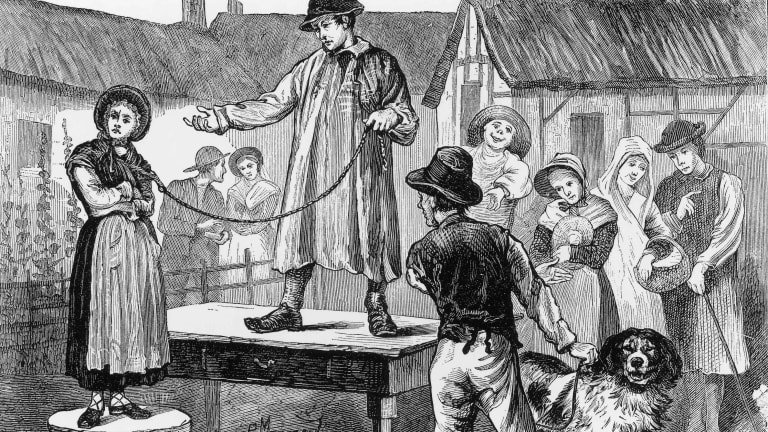
If your marriage broke up in the 1750s, you had to obtain a private Act of Parliament—essentially, an exception to Britain’s draconian divorce law—to formally divorce. The process was expensive and time-consuming, so wife-selling arose as a form of faux divorce.

Until the 1857 Matrimonial Causes Act, it was essentially impossible to obtain a divorce in the U.S., no matter how bad the marriage or how cruel one’s husband. A couple could only be divorced by the passage of a private act through Parliament, a remedy available only to the very wealthy.

If you wanted a divorce in the early 1900s, you had to prove your significant other had committed adultery, abused, or abandoned you. By 1916, the U.S. led the world in number of divorces and in 1942, the U.S. Supreme Court ruled in Williams v. North Carolina that other states had to recognize divorces, under the “full faith and credit” clause of the U.S. Constitution. It wasn’t even until the late 1960s that Americans were allowed no-fault divorces.

If there was divorce in your own family history, like mine, the family was usually quite secretive about it. And as we all know, secrecy usually equals shame in our culture. In my family, who were basically Southern Baptist farmers in the Kansas City area in the early 1900s, I can think of three family secrets that my Mom had to really dig for when she decided to do our full genealogical history: divorce, marrying someone of the Jewish faith and severe mental illness.

My own 2001 Colorado divorce was quite quick and painless. We never had to show up in court because the filing was uncontested, meaning we were not fighting over assets and we had no children. We just filled out some forms, paid $99 and we were done. No muss no fuss, except for a few hurt feelings and the various biases and criticisms I experienced from others afterwards. One great side effect for me, my TMJ went away never to return!

Did you know that more than one quarter of Americans getting divorced in the United States today are over age 50, and most of those divorces happen after 20 years of marriage? Pew Research found that the rate of divorce among those over 50 nearly doubled from 1990 to 2015, and the attitudes of those Americans have shifted to feeling much more supportive of divorce.

Here’s my own conclusion a few years after my own divorce:

“Perhaps it’s mainly women who get stigmatized by divorce: “What’s the matter—couldn’t keep your man?” The assumption being that any man is better than no man at all. Come on—we can do better than this, people! Few marriages are matches made in heaven, and sometimes they truly need to end. Mismatched is no match at all. It’s only fair that after a mistake, each of us can try again to find happiness before it’s too late.”


My experiences with aging, disability and my own mental health

I’ve been thinking a lot about aging and mental health lately, so I looked up the topic. According to an article from our National Institutes of Health:

“The most common mental disorders in older people include depression, anxiety, and substance abuse. Mental disorders are associated with increased healthcare costs, mortality and suicide, along with interference with daily living, and a reduction in quality of life.”

From my own experiences, this makes perfect sense. As our health declines, so does our ability to feel good about our lives, and then there are those predictable thoughts about how we’ve lived our lives and what it must feel like to die. One thing I experience is the daily differences in how I feel about my life, but I’m not certain how much of that is caused by my head injuries. Some days I feel almost like I used to, happy and ready to get out and try new things. Other times I can barely get out of bed and face the day. The problem is I cannot predict what will happen each day, so it’s difficult to plan ahead.

Mike has observed this unpredictability and also wondered what causes it. Now I believe part of it is a natural response to losses later in life. Some days I see little future for myself and so I feel depressed. I do not want to drag him down, because there is no need for both of us to suffer. Other days I feel that old optimism and then I can’t believe I was so low yesterday.

What could be more natural than our ability to confront our own aging and disabilities better on some days than others? Also it takes time to adjust to such major changes in health and abilities…

Realistically my ability to travel very far or go anywhere I want to is limited. But also my desire to travel has become less with age and with so many fantastic travel videos to be enjoyed on Youtube. The place Mike and I most want to visit now is Patagonia. There’s a very good chance I won’t ever get there, but I love watching travel videos and dreaming… Now that’s something previous generations did not have! We really are very lucky, even in our old age. I appreciate that everyday!

“Even in seemingly dormant times, we are in transition. Losses and gains are in constant play. We are the change-agent, and we are changed. Even without toil, we transform. So, wisdom advises us to open our hearts to transition; to honor fully what is passing, to learn from all that unfolds, and to welcome what arrives at our door each day with courage and curiosity.”

How my brain is healing from serious concussion

Although I have other experiences with brain injuries and healing, this most recent concussion a little over a year ago has been quite different. This was the first time I experienced auditory and visual hallucinations after I fell and knocked myself out on a stone floor.

From the first I had lots of balance problems, especially because I so fear anymore falls. But what was different for me was the constant feeling of the world spinning around me, much like the whirlies when you’re drunk. Especially when I turned my head either way or put it back very far I felt so dizzy. This went on for months afterwards and between my bad lungs and my whirling brain, I worried about my balance quite a bit.

What I find most curious about me is that I go through periods of symptoms like the twirlies, and then they go away for a while, maybe a month or so, and then they come back again. When they are bad, I don’t trust myself to walk alone without support of some kind. I have felt like this for the past few days and then this morning I felt fine again.

I know that brain cells can repair themselves, I guess it’s a bit like re-wiring. I experienced that after my TBI in May of 2008. It took lots of rest and a couple years, but I did get almost back to ‘normal’ for me. These kind of personal experiences teach us new appreciation for the incredible resilience of our brains. Perhaps that is what is happening to me now. I get better for a while and then I flash back to that old dizziness for a few days, just to fully appreciate when my balance comes back again.

Let’s hear it for the process of neuroplasticity!

Still codependent but working on it at age 67!

As a lifelong co-dependent and apparent sucker for abuse, it took me FOREVER to arrive at this simple answer to all who have taken advantage of my kindness and understanding:

Don’t be afraid to lose someone who is not grateful to have you.

As I head towards 70 years old I find that I have taken abuse from far too many in my life, first from a supremely judgmental family and then just about everyone else I met along the way. From the beginning, when I felt like I must take care of my mother’s emotional needs, I tried to comfort, mediate with and please others instead of standing up for my own needs. In fact, I hadn’t the slightest idea what my own needs were. After years of counseling, I still sometimes struggle with that…

The main sign of codependency is consistently elevating the needs of others above your own. Other signs include controlling behaviors, self-sacrifice, and fear of rejection.

Yes, gigantic fears of rejection and abandonment! And I was certain that if I was honest and truly myself, no one would want to be around me. I learned this behavior from my mother, who worshipped my father, but was also super angry at him most of the time. She thought having her own opinion or interests would be far too selfish, so she took on my father’s interests instead for most of her life, doing things she has no real interest in to please and be with him. After my father’s death she seemed lost. She had lost her leader.

What a shame and a waste of her unique personality and charm. Years of counseling and reading have helped me wake up to my own personality and charm, but also I find now I have a very low tolerance for abusive people. A number of people who used to be in my life are no longer welcome, because I have such a low tolerance for abuse and nastiness. But why should I fear losing them if they were never grateful to have me in their life?

I know it seems late in life to come to these conclusions, but at least I finally got it.

Mid-June Colorado Foothills Garden Notes

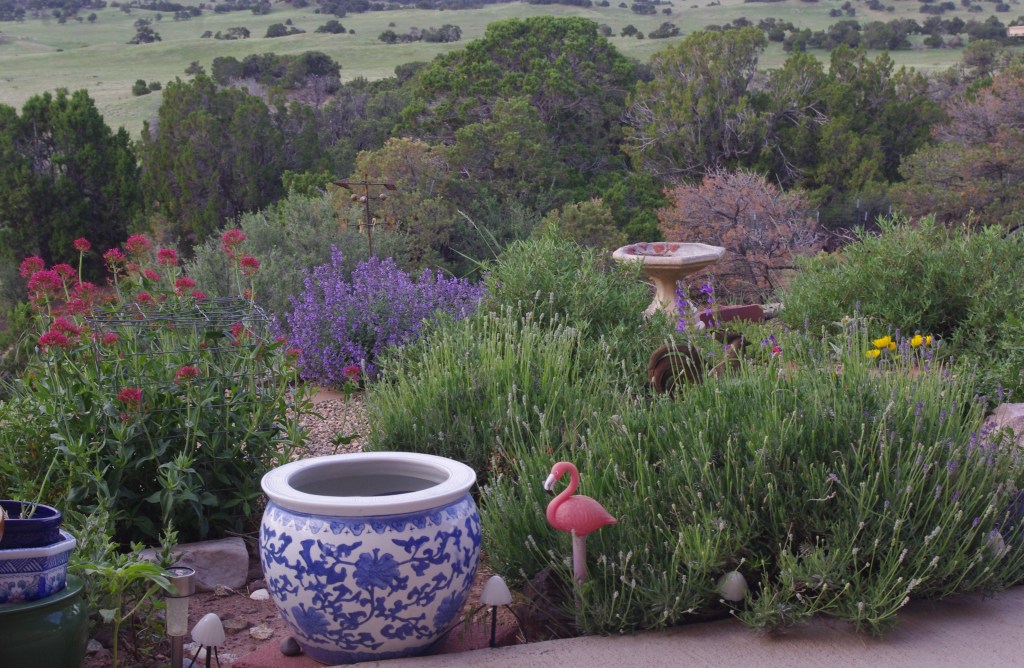
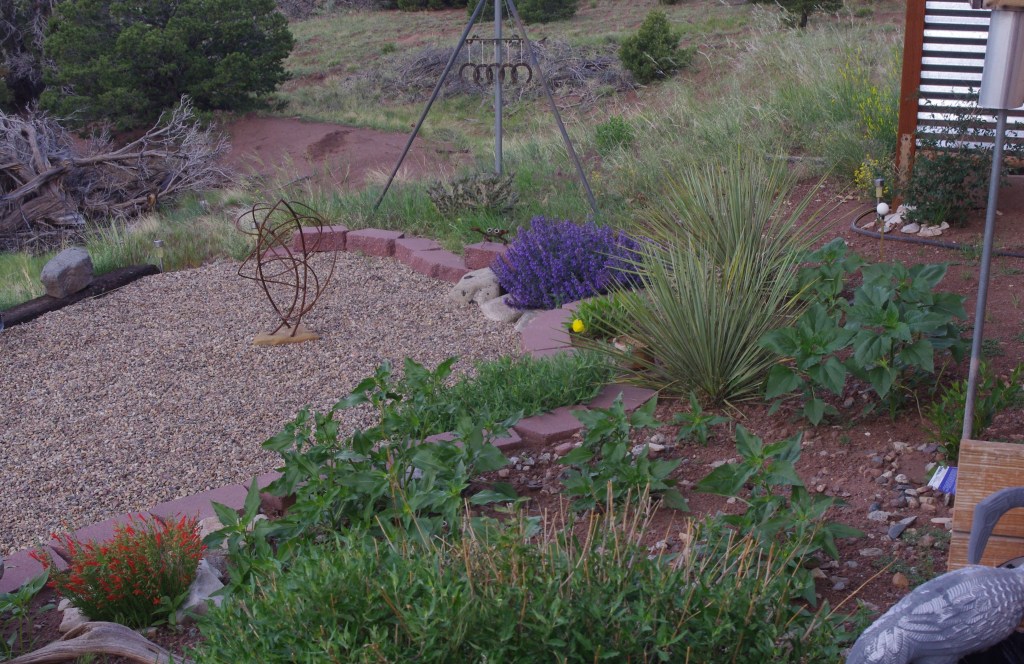
WOW, it was plenty HOT here yesterday! We got over 90 degrees, which almost never happens up here at 7,000 feet. My new plants were not pleased, but those that have been here for the past few years were fine. Here’s a photo summary of what is happening in my garden.

First of all, this is what my “sky garden” looked like in June 2019. We had just completed the hardscaping at this point!

These day in the far east end I am nursing a new plant, an Icelandic Poppy, and so far so good in spite of all the wind we’ve had lately. My Jupiter’s Beard at the end is struggling but still hanging in.

Lavender absolutely loves it up here! And that large Jupiter’s Beard on the left is thriving too.

I forget the name of these cute little yellow flowers, but they sure are tough! Then I have a couple of different penstemons in this grouping near one of my lavender plants. The Blue-mist Spirea bushes with start blooming in July.

This is a view of mid-garden with the steps. Yarrow dominates this area. It seems to be pleased with itself. My native Four-O’Clock is slowly creeping out from under Buddha and that big Catmint plant. It got hit hard by the big snow we had the end of May, that almost froze all the flower heads off! My green shamrock is in the foreground. Thanks Mike!

My west end is mostly new or native plants. So excited to see that yellow Evening Primrose start to bloom this morning! The native sunflowers are everywhere over there and I just planted a “Little Kim Lilac” bush over there. Sure hope it survives the wind! Check out a few of Mike’s creations, the metal sculpture and his horseshoe wind chime under the Bluebird’s box.

I should also include this central square of flowers, the first place I planted anything about four years ago. Can you find my metal coil dog? That’s one of Mike’s more recent creations.

Happy to be home!

After just two days up in the northern Colorado cities, Mike and I are always so happy to come home! Speaking as someone with a brain injury, cities increase my stress level immediately, even as we drive north through Pueblo, Colorado Springs and Denver. In summary, being there exhausts my brain energy so quickly. There is also the stress of staying in a different house with different people. All I know is that I need to sleep a lot after I get home to “catch up” on my mental comfort level and health. Of course, psychologists have known for years that:

“City living can chip away at your psychological immune system, which can be precarious for those with a family history of mental illness. According to psychologists , this environmental stress can increase their risk of developing a psychiatric condition, such as anxiety, depression, or bipolar disorder.”

As we drive south out of the metro parts of Colorado, we both breathe a gigantic sigh of relief. We love to return to the life that we love in one of the least populated and developed counties in Colorado. We find slow, quiet, and peaceful is great for our sanity! Our passive solar home always stays cool for free while we’re gone. I miss my garden and Mike misses his cat Rosie when we go on trips.

This is our reward for moving down here eight years ago now… Try to beat that view from your back porch! When I first met Mike he said he wasn’t moving again unless it was to somewhere where he wasn’t looking at the house across the street. Success at last!

I immediately go outside and check on my plants. Luckily nobody got eaten while we were gone 🙂

And yes, I do have some native plants coming up too, like this yucca, a transplanted Cholla cactus and some evening primrose. I sure hope the Cholla decides to bloom this July! It’s flowers are a bright magenta color.

Postscript: The funniest thing I witnessed on our drive through Denver was a trucking company named: “Follow me to Jesus, Inc.” No shit!