rural living
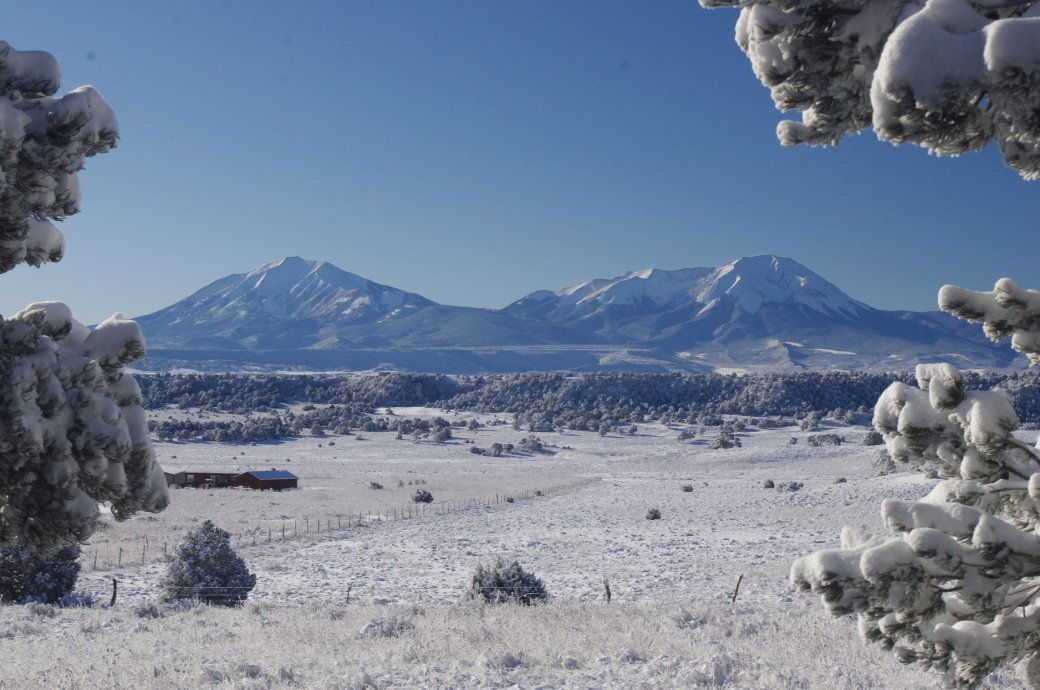
Capulin Volcano in Northern New Mexico

On a stunningly beautiful March day, with temperatures in the 70s, we decided to take a short drive down to Raton and points east yesterday.

Twenty miles east of Raton you will find Capulin Volcano National Monument. This volcano erupted into existence 60,000 years ago. Capulin’s conical form rises 1,300 feet above the plains and reaches 8,180 feet above sea level. A curvy paved road takes you up to the top where you can look down into a caldera or volcanic crater.

The best part? The incredible views looking west! If you look carefully you will see the Sangre de Cristo mountain range in the distance. Those are the mountains we see from our patio west of Walsenburg.

Check out Mount Capulin sometime and learn more about how volcanos form.
Why we decided to stay in Colorado for retirement
Another short entry from my Memoir of Retirement: From Suburbia to Solar in Southern Colorado.

Amazing sunrise from our new passive solar rural home in southern Colorado
I wrote this on May 7th 2014:
Many of you may be like us, making some big decisions about where and when to retire. We just signed a contract yesterday to sell our home in Fort Collins, and move south in the next month or so.
When we started thinking about this major change, we chose to remain in Colorado for a number of reasons.
We were looking for inexpensive land to build a solar home with great views and a cleaner, quieter, calmer existence. We found that in the rural southern part of our state.
Then I just found out this week that in terms of medical care and finances we made a very good choice!
First of all, Colorado ranks in the top quartile in healthcare systems nationally, beating out all other western states. Then I saw a new Bankrate.com financial survey announcing the best states to retire to. Colorado ranks number two, only after South Dakota.
Here’s a quote from that article: “Colorado gets above-average marks for cost of living, crime rate, health care quality and taxes. The Gallup-Healthways survey finds that the well-being of Colorado residents ranks among the highest in the nation.”
The first thing you need to know about Colorado is how different parts of the state really are. Most Coloradans live in what we call “the front range” cities like Fort Collins, Boulder, Denver and Colorado Springs. Then there are the mountains which are beautiful, but cold, snowy and generally an expensive place to live.
I have spent most of my life living in Colorado Springs, Boulder and Fort Collins, and to my mind, a city is a city in terms of their ever increasing cost of living, overcrowding, traffic, pollution and quality of life. After living the past nineteen years in the Fort Collins area, I can say these are our worst problems, and they are not going to get any better ever.

Mike is ecstatic to move out of the city and have this view everyday!
The rest of the state is rural and quite different than “the front range.” The eastern plains are mainly small farming communities and the mountains have few good job opportunities. We have chosen to put down new roots in a rural area west of Interstate 25. We have found the perfect perch for our custom, passive solar home.
Postscript: I would only add that the average household income for some place like Fort Collins is near $60,000 now, while the average down here in Huerfano County is around $33,000. Colorado exhibits quite a wide range of income levels. You don’t need to be rich to live here, only in the big cities like Denver, Fort Collins, etc.
The hidden purpose of my new memoir: Convincing your pardner to love rural!
I decided to write a memoir of the process Mike and I went through around age 60, as we were going through it. I thought, we can’t be the only ones thinking about leaving city life behind for retirement, hoping to find a quiet, peaceful sustainable life in some beautiful rural area.

Horsetooth Reservoir up above Fort Collins, Colorado!
As we put this plan into action and bought three acres west of Walsenburg to build our passive solar home at the beginning of 2014, I discovered that Mike was MUCH MORE CERTAIN than I was about this whole plan! He felt certain that he wanted to leave the city behind regardless of our old friendships back in Fort Collins, and the services and predictability of city life. This plan was suddenly coming together far faster than I could assimilate! I knew I loved visiting down south, but was I ready to give up everything I knew to move there?

Walsenburg rental we lived in while building our home west of here
After we moved into our rental for the building process, I learned that many wives felt the same way initially about pulling up their roots and going completely rural. The men seemed to know what they wanted, but the women were more careful or hesitant to move to a rural area. Much like I felt at first that our new homestead was rather “isolated” other women I met felt the same. Luckily I totally trusted Mike’s sense of place and his unique abilities to make this home the best of my entire life.
But I just realized yesterday that my memoir is especially suited for wives or partners who want to move somewhere wild and rural, to show them the process I went through. I certainly changed my mind as the building went on…
At first I was so scared and uncertain of this choice we were making, mainly because we needed to sell our suburban home to afford the construction of our new solar home. There was really no way to go back on this deal if I ended up not liking it! It did feel really risky to me, but not to Mike.

Our new home at sunrise!
I found that very quickly after we moved into our new home about one year after moving to Walsenburg, I loved it here. The silence, the natural beauty, the amazing sunrises and the big sky feeling… what’s not to love about that?
It just took me a while to adjust my vision and expectations and QUIT WORRYING SO MUCH ABOUT EVERYTHING!
So, for any of you who want to convince your pardner to move to a more rural part of the country. This book might really help!
Why we moved to the country to retire
For some reason this spring I keep flashing back to four years ago when we were still living in suburbia in Fort Collins and preparing to move down here to build our solar home…
Here’s an excerpt from my Memoir of Retirement:
I saw a stupid retirement TV commercial last night that really got me thinking. The question was:
Can you keep your lifestyle in retirement?
Say what? It suddenly struck me that this may be the most important difference between those of us facing retirement in the next few years. I for one have NO intention of keeping this lifestyle. If we did, what would be the point of retirement?
My dream retirement involves escaping this lifestyle! I feel that I have become ‘metro-fied,’ and I’m now more than ready for a peaceful escape from my present lifestyle.
I have lived in metropolitan areas for most of my adult life, for access to good jobs. What I have observed is ever increasing crowding, pollution, traffic and aggressive behavior.

Construction begins on our new solar home facing the Spanish Peaks!
What I now long for is a quieter more peaceful existence with just a few people per square mile, where we can enjoy a friendly, caring sense of community; a place where we can make new friends through our daily lives.
We know and accept that this will involve a major lifestyle change, and we are ready for that. No traffic sounds great to us in exchange for less shopping convenience. Valuing and having time for new relationships is what we seek, not more of the same overcrowding, air pollution and road rage.
As I sit in the constant traffic in Fort Collins or Denver these days, I can only think, “This is never going to get better!” People will continue moving here and traffic will keep increasing every year, and I do not want to spend one more precious moment of my life sitting in traffic.
We want out of this lifestyle, the sooner the better!
Postscript four years later: I WAS SO RIGHT ABOUT THIS!
Cannabis in Colorado History & Boomers’ Cannabis Use Patterns
 Colorado is the home of legal medical and recreational cannabis, and come to find out, we have history with this stuff. When Colorado became a state back in 1876, both hemp and cannabis could be grown legally, and they stayed that way for decades. By the late 1800s, cannabis oil was a common ingredient in medical tinctures. Asian-style hashish dens were common in larger cities like New York and San Francisco. Increasing popularity led to concerns that hashish would lead to mass addiction, and in 1906 the federal government imposed the first regulation on cannabis intended for consumption: A product simply had to be labeled if it contained the herb.
Between 1915 and 1917, Wyoming, Utah and Nevada all banned cannabis, and in March 1917, Colorado legislators made the use and cultivation of cannabis a misdemeanor. Those who broke the law were subject to a fine up to $10 and a month in jail, part of the growing national temperance movement that led to Prohibition in 1920.
On November 7, 2000, 54% of Colorado voters to approve the use of marijuana in the state for patients with written medical consent. Under this law, patients could possess up to 2 ounces of medical marijuana and cultivate no more than six plants.
Conditions recognized for medical use include: cachexia; cancer; chronic pain; chronic nervous system disorders; epilepsy and other disorders characterized by seizures; glaucoma; HIV or AIDS; multiple sclerosis and other disorders characterized by muscle spasticity; and nausea. Patients could not use cannabis in public places, or in any manner which might endanger others including operating a vehicle or machinery after medicating.
Since the enactment of Colorado Amendment 64 in November 2012, adults aged 21 or older can grow up to six marijuana plants privately in a locked space and legally possess all marijuana from the plants they grow, and possess up to one ounce of marijuana while traveling,
Since 2012, Colorado sales of cannabis have been staggering! Since legalization, Cannabis sales have topped 13 billion, with 4.5 billion just in 2017. Tax data shows close to 22 million collected just in 2017.
Boomers and Cannabis Use
 If you remember the 60s you weren’t there…
According to the most recent iteration of the 40-year-long “Monitoring the Future” study from the University of Michigan, 85 percent of Americans 50 plus have used illegal drugs, including marijuana, in their lifetimes.
Since 2006, marijuana use has increased significantly among adult Americans age 50 plus. A decade ago, roughly 4.5 percent of people ages 50 to 64, and 0.4 percent of seniors above age 65 had used marijuana in the past year. By 2013, those numbers had increased to 7.1 percent and 1.4 percent, respectively. In percentage terms, marijuana use among 50- to 64-year-olds increased by 57.8 percent, while among seniors ages 65 and up, it ballooned by 250 percent.
This study, based on over 45,000 responses to the National Survey on Drug Use and Health, isn’t the first to note that marijuana use is increasing rapidly among older adults. But it digs more deeply into the demographics of older Americans’ marijuana use, uncovering some interesting findings. For example European-Americans and African-Americans are much more likely to indulge in cannabis than Latinos. Low-income and married Americans are more likely to partake than separated or divorced, but single or widowed Americans use cannabis the most.
Many 50+ Americans are using cannabis to deal with mental health issues. Among those 50 and older, people who have suffered with depression or anxiety in the past year are much more likely to use cannabis medically. A number of studies have shown a link between marijuana use and mental disorders. Given the widespread prevalence of medical marijuana laws, some seniors may be turning to cannabis as an alternative treatment for the ailments of old age.
One study found that Medicare reimbursements for a number of common prescription medications dropped sharply after the introduction of medical marijuana laws.
 Adventures of the NEW??? Old Farts