A Study of Vigilance in Rural Colorado

Vigilance: the action or state of keeping careful watch for possible danger or difficulties. Synonyms: alertness, attentiveness, watchfulness

As a psychologist, my natural tendency is to observe changes in my own and others’ behavior. By living in cities for most of my life, and then moving outside of even the smallest town recently, I have had a marvelous opportunity to observe how my consciousness has changed. One area I find particularly interesting is my level of vigilance.

This is a state which most are not conscious of, because it can often be barely felt on a conscious level. Simple thoughts like “Are my doors locked?” “Do I feel safe now?” and “Am I safe?” can come up constantly. I became much more aware of these feelings after moving away from cities. In this way I discovered that we all experience varying degrees of safety in any environment.

I see now that while living in cities I felt the need to be constantly vigilant. Especially living as a single woman there, I was always quite aware of locking my doors, noticing strange sounds or things going on around my home, etc. Cities offer such a tight concentration of people everywhere, with traffic, lines at the store, etc. They seem to require a heightened level of vigilance at all times.

Sunflowers on a county road

MY COMMUTE TO TOWN

However, I didn’t become aware of my city-inspired heighten state of vigilance until I tried living away from others. When I first moved out into the country I felt isolated and concerned about that sense of isolation. How would I make new friends? What about emergencies?

But in less than a year or so those fears turned into a new sense of security and safety. We live among others who have three to six acres of land, and most keep completely to themselves. In this new setting I found that I needed to train myself how to mellow out. I was still hyper-vigilant, a trait that no longer served me.

Each year I live here, my level of deep security and relaxation increases along with my level of introversion. Some might see this as a bad thing, but I must say it feels really good to feel truly safe for the first time in decades, both in my home and in my life.

Should a seeker not find a companion who is better or equal, let him resolutely pursue a solitary path. There is no companionship with a fool.  – The Dhammapada


The Handmaid’s Tale Revisited

The Handmaids TaleIt was with apprehension and trepidation that I decided to watch the new Hulu version of Margaret Atwood’s novel “The Handmaid’s Tale” this week. I read this book decades ago so I had some idea of what to expect. This is a story about a frightening future USA society where women are only valued for their breeding potential, or as accessories for male entertainment.  This dystopia is called Gilead:  “In Gilead, the bodies of fertile women are politicized and controlled. The North American population is falling as more men and women become infertile (though in Gilead, legally, it is only women who can be the cause of infertility). Gilead’s treatment of women is based upon a narrow, fundamentalist interpretation of the Bible, meaning that women are the property of and subordinate to their husband, father, or head of household. They are not allowed to do anything that would grant them any power independent of this system. They are not allowed to vote, hold a job, read, possess money, or own anything, among many other restrictions.”  – Wikipedia

OK, so most would say that could never happen, but then I also never thought I would see an American president respect and defend neo-Nazis like he did last year. I never thought I would see a president’s wife whose only claim to fame is a modeling career. Women are most definitely accessories for male arrogance and pleasure in Trump’s “pussy-grabbing” World.

The methods of mind-control are what fascinate me most in this version of Ms. Atwood’s story.  I have been exploring the psychology of mind-control for decades in my studies of Chinese history, in situations like the Jim Jones mass suicide in 1978 in Guyana, and in my own extremely disturbing Outward Bound-like experience back in the 1980s when a team leader nazied-out on me…

Trust me, you do not know what you would do when all of your power to determine your own fate is taken away. Group shaming is one of the most powerful tools in the arsenal of the terrorist.

I never forgot the part of Ms. Atwood’s novel where all women suddenly had no money and therefore no power. They all lost their jobs at once and their money was given over to the men in their life, only the beginning in the police state of Gilead.

handmaids

This story really does symbolize one of my worst case scenarios for our culture. Like something from a terrible dream, I fear my own neighbors would some day take away everything, because I do not believe or see the world the way they do.

State sponsored religion or beliefs of any kind are so dangerous.

Postscript: My thoughts days after watching this series. Although this series portrays life in a dystopic future, it also is an excellent portrayal of the life of most women in our past. Historically women were generally seen as either good workers and breeders, or simply entertainment for men.

How do we get “good with money?”

When I recently saw the headline: “Money Habits Established by Age 7” on PBS, I was astounded! Could we really be that set in our ways by seven? But then I thought back to my earliest saving habits and I could pretty much believe this. While my older brother could never hold on to money for any length of time, and my big sister also struggled with high finance, I was a born saver from way back.

I can even prove it:

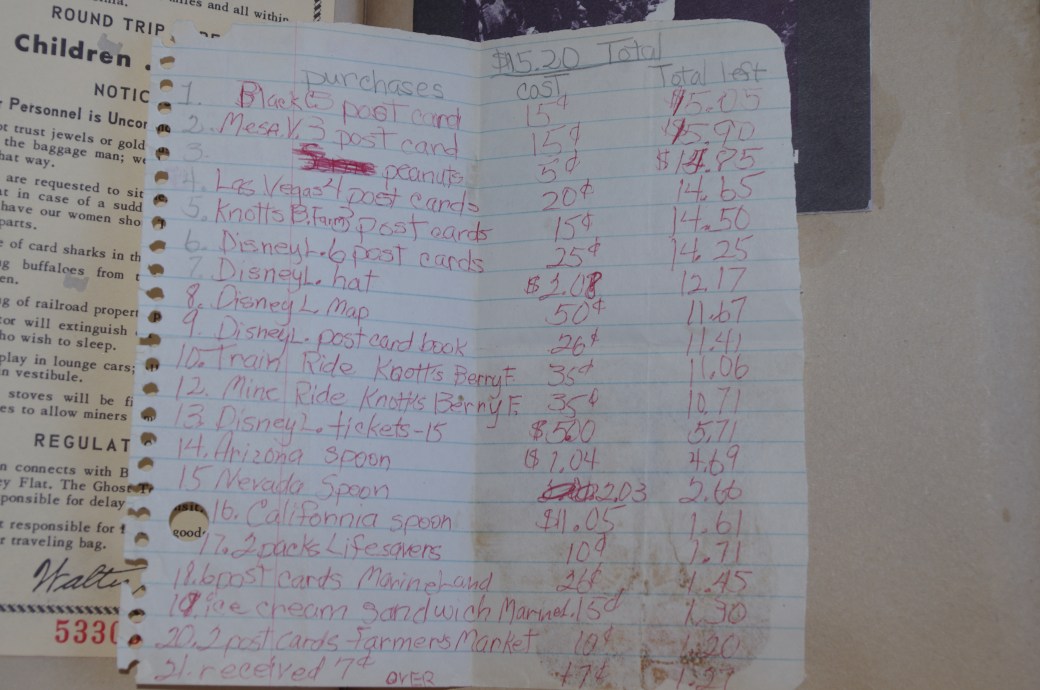
1967 budget for trip to Disney Land California

We took a family trip to Disneyland the summer of 1967 and wouldn’t you know, I documented every penny I spent on that trip. I was twelve years old! I started out with a little over $15.00 which sounds like nothing, but this was back when postcards were a nickel and rides at Knott’s Berry Farm were 35 cents. I ended up with a dollar left. I also had a savings account by then. I loved to watch my money grow, while my siblings didn’t. I’ve always wondered why.

kid counting coinsI read an article yesterday that predicted that the oldest sibling would be best at finances and the youngest fairly bad at saving. Nope, that’s not how it worked in our family. How about yours? Where does the desire to save money come from? Why do so many boomers have nothing extra saved for retirement, while some of us saved like crazy starting at age 20? That is a mystery to me!

Earth Day in the USA: Love Your Mother

earth day

On January 28, 1969, a well drilled by Union Oil Platform A off the coast of Santa Barbara, California, blew out. More than three million gallons of oil spewed, killing over 10,000 seabirds, dolphins, seals, and sea lions. As a reaction to this natural disaster, activists were mobilized to create environmental regulation, environmental education, and Earth Day. Among the proponents of Earth Day were the people in the front lines of fighting this disaster, Selma Rubin, Marc McGinnes, and Bud Bottoms, founder of Get Oil Out.

Earth Day 1970

The first Earth Day celebrations took place in 1970 at two thousand colleges and universities, roughly ten thousand primary and secondary schools, and hundreds of communities across the United States. It also brought 20 million Americans out into the spring sunshine for peaceful demonstrations in favor of environmental reform. It now is observed in 192 countries, and coordinated by the nonprofit Earth Day Network, chaired by the first Earth Day 1970 organizer Denis Hayes, according to whom Earth Day is now “the largest secular holiday in the world, celebrated by more than a billion people every year.” Environmental groups seek to make Earth Day into a day of action to change human behavior and provoke policy changes.

Why Earth Day Today?

Because the earth needs us now more than ever! And since we’re fresh out of other planets to live on, now is as good a time as ever to do everything we can to preserve the miracle of this green and blue planet. Go solar! Use wind power. Change old habits that hurt the earth. You could probably name ten things today that would benefit Mother Earth immediately. Do it instead of just thinking about it!

big earth

What does the future hold? It’s all up to us!


Breathe: A Surprisingly Refreshing Movie!

When I read the description of the 2017 film Breathe, I wasn’t so sure whether to borrow it from my local library. It sounded very sad and perhaps overly sentimental, but as it turns out, I LOVED IT!

First of all, nobody remembers how devastating polio was just a few years before I was born (1955). This is the true story of how Robin Cavendish  became paralyzed from the neck down by polio in Africa in 1958 at age 28.

How common was this in the 1950s?

In the United States, the 1952 polio epidemic became the worst outbreak in the nation’s history. Of the nearly 58,000 cases reported that year, 3,145 died and 21,269 were left with mild to disabling paralysis.  -Wikipedia

Robin Cavendish and son

Robin and his son Jonathan in 1961

The love between Robin and his wife is so inspirational! The uplifting part of this film is the way Robin and his wife Diana Blacker refuse to allow Robin to be confined to a hospital bed, imprisoned by the limits of his respirator. In England Robin Cavendish became one of the first paralyzed polio victims to defy expectations, leave the hospital, and with the help of a special wheelchair, live life to its fullest despite his polio-induced paralysis.

After a year in hospital he insisted on being able to leave, against the advice of his doctors. So excited about his new-found freedom, Cavendish decided to help others experience the same. He sought the help of Teddy Hall, an Oxford scientist and engineer, who developed a wheelchair with a portable respirator so he could become ever more mobile. Cavendish and Hall raised money from benefactors across the country and also persuaded the government to help fund the manufacture of these special wheelchairs.

Breathe film

Robin died by assisted suicide (euthanasia) in 1994 when his lungs stopped functioning at age 64, defying doctors’ predictions that his life would be meaningless and cut short outside of a hospital. His son Jonathan, conceived months before his paralysis, grew up to become a film producer. His production company Imaginarium Studios, is behind this film.

I highly recommend this well-made film about real life challenges and how the human brain and spirit often rises to overcome them. Yes it is definitely a tear-jerker, but in such a meaningful and  positive way!

Rediscovering your heart

“Who knows why you start rediscovering your heart you just do it again and again…”    – Jimmy Buffet

Midlife is such a marvelous time to rediscover yourself and your earliest dreams and goals. It is the time to look back and see how well you have achieved those goals you treasured as a child, and what else needs to be done to make your life complete.

Here’s a short essay from my book Find Your Reason To Be Here: The Search for Meaning in Midlife, about how this process might proceed:

pretty purple rocks

What Defines You? Rediscover Your Heart 

Your first step in this new action plan will be to let go of your previous reality, which was built on unrealistic goals, rules, expectations, and perceptions. This will require that you first find a way to believe it is possible for you to change your life.

How will you do this? First you must rediscover your heart, your inner wisdom, and your belief in your power to change perhaps everything in your life. Do you remember your child’s-mind and heart at age seven or eight? When you were that kid you had a pretty good idea of what you loved to do and what you were naturally good at. Back then you were still listening to your inner wisdom and paying more attention to its truths. That was before authority figures began sharing their truths with you, convincing you that your own truth was silly, unrealistic, and not worth listening to.

Now is the time to check inside again and excavate that child’s wisdom from the decades of outside advice and beliefs you have accumulated in your head and heart. Yes, there were many practical concerns that drove you to choose the major you pursued in college, the career you have dedicated your life to up until now, and even the love partner you may have spent the past 20 or 30 years with.

No need to judge the choices you have made up to now. Know that you have always done your best to survive and thrive, but also respect your present need for a mid-course adjustment. Constantly racing towards some sense of security is quite human, but not realistic. Find new respect for your changing self and the many new perceptions you will gather as you attempt to turn off the safety-seeking, security-oriented feedback loop in your brain. Security can only take you so far, but to grow and evolve you must take new risks. Your overall goal is to have no regrets as you look back over your life from the age of 70 or 80.

Change in midlife requires that, like never before in your life, you begin to believe in yourself and your power to change. This exercise will require that you develop your highest levels of self-love, self-respect, and self-compassion.

As you begin to recall your past interests and dreams, think about what happened to them. Did they hold any validity? Do you miss those dreams or have reasons to believe that you would still like to pursue them? Were they vestiges of your authentic self, which you have tried to delete or ignore for decades? Would this be a good time to allow them back into your heart, if only for a bit of new consideration?

Midlife is the best time to question again why you are here and become crystal clear about what needs to happen in your life before you die.

Laura and Rasta the view 2014

Open to your vast spontaneous creativity, give yourself the freedom to try new things, let go of your innate fear of failure, and finally feel free to experiment, perhaps for the first time in decades!