Freedom in Retirement: We are all prisoners of our own experience…

make the world with our thoughts BuddhaSilly me. For the longest time I thought there was some connection between age and higher levels of consciousness. I mean, as we age it seemed likely that we would also evolve in essential psychic ways. But now I know age has nothing to do with it. Our varied levels of consciousness depend more on how much we limit our thoughts, experience and options. I’m speaking from 60+ years of experience…

My upbringing demanded a certain way of thought, and a phenomenally large set of rules about how I should live. Think a mild case of German authoritarianism with “my way or the highway” thrown in. We were raised to expect to be, to quote my first boyfriend, “something at least semi-great.” When I became interested in China back in my teens, I immediately jumped to the realistic goal of becoming the first US Ambassador to China. Such a happy mix of egotism and narcissism, with tons of PRESSURE on top!

After I studied librarianship at the graduate level to get a job, and Asian History, I then turned to Transpersonal Counseling Psychology at the Naropa Institute in Boulder. There I felt quite at home with what I was learning.

Besides the standard counseling psychology curriculum, we studied the interplay between psychology and spiritual development, the benefits of a contemplative practice, and moment-to-moment awareness, with ample opportunities to develop a compassion practice. There I met Ken Wilber, an American philosopher and author of a number of books on transpersonal psychology. Ken taught me to see consciousness as a wide spectrum of thought, with ordinary awareness at one end, and more profound levels at the other. The natural human progression is from lower consciousness, to personal, and then altered states of consciousness or spiritual experience. Some call these transpersonal levels.

I experienced excellent instruction in limited thinking as I grew up. Even as my father said he encouraged an open mind, the rules were clear and I generally followed them well. It was only much later, after I realized that the rules I was raised with weren’t working for me, that I started my midlife do-over, my personal revolution. I felt drawn to questioning just about everything in my past, especially all the rules in my head. There I found such a cruel mix of self-deprecation and criticism.

It is only in the past few years that I have made a quantum leap in self-compassion and consciousness. I no longer tolerate negativity and craziness around me, and have gained many new insights into the voices in my head… 🙂   Please, don’t believe your “negative committee” any longer. Question the way you approach every decision you make. Are you doing things the way your parents would for unknown reasons, or moving on to higher levels of thought and experience?

Question what you think you’ve known forever. Is it true or just some rule you’ve been following mindlessly for decades? Embrace your freedom to think the way you choose now, not the way previous generations did.

Don’t just save up your bucks for retirement, prepare your mind for a whole new level of freedom. The older I get, the clearer my moment-to-moment choices become. It can be so freeing to stop your brain autopilot in its tracks, and begin to live a new life!

To learn more about how midlife questioning helped to create a new lifestyle for us in an amazing passive solar home in the Colorado outback, go check out: A Memoir of Retirement: From Suburbia to Solar in Southern Colorado

Teach kids how to connect with Mother Earth!

“A garden symbolizes what a faith community is, connections, caring for the planet and caring for life in urban areas where people don’t have the opportunity to grow food or be in nature.”      — Claire Baglien

The Benefits of Starting a School Garden Program 

By Abby Quillen

“A garden is a grand teacher,” horticulturist Gertrude Jekyll wrote. School administrators obviously agree because the nation is in the midst of a school gardening boom. The number of school gardens nearly doubled between 2013 and 2015. More than 7,000 American schools now have a garden.

Most teachers start a school garden program in elementary schools, and grow flowers or veggies. Some include unique features, such as chickens, orchards, and aquaponics systems (where students raise fish and use the fishes’ waste to feed plants). Teachers use gardening activities to teach nearly every discipline, including health, nutrition, science, math, environmental studies, language arts, art, and social studies. Students in one California school sow native plants to learn what the state looked like prior to European settlement. In other schools, kids test soil composition, learn about food chains and ecosystems, measure plants as they grow, calculate the perimeter and area of garden beds, and keep gardening journals.

Researchers examining how gardening impacts students have found that school gardens–sometimes called “living classrooms”–cultivate more than just plants. Students who participate in school gardens are on average more engaged in what they’re learning, boast higher science test scores, and eat more fruits and vegetables than their non-gardening peers.

school-gardens-grow-strong-students

Cultivating Young Minds

Teachers who integrate gardening into lessons say it is a powerful, hands-on learning tool that engages kids better than typical classroom instruction. Quantitative data supports these observations. Middle schoolers who took part in the Edible Schoolyard Project at a large urban California school improved both their overall GPAs and their math and science grades.

In a review of 12 studies, students who gardened performed better on standardized science tests than their non-gardening peers in all 12 studies. Fifth-grade gardeners in one study scored nearly 15 percent higher on the standardized science test than a control group. REAL School Gardens, an organization that builds gardens for low-income schools, says students at their partner schools improve 12 to 15 percent on standardized tests after gardening is integrated into school curricula.

Fertilizing Social and Emotional Development

Caring for plants together and waiting for them to grow also teaches kids about cooperation, responsibility, patience, and delayed gratification. In a study of a year-long garden program for third, fourth, and fifth graders, students improved teamwork skills and markers of self-understanding, a term used to describe a person’s ability to comprehend his or her own actions. Nature-based activities, including gardening, also help kids relieve stress, improve attention spans, and ease symptoms of ADHD.

Most kids love learning in the garden. In an evaluation of seven qualitative school garden studies, the majority of kids in every study said they enjoyed gardening at school. Elementary–aged students in one survey reported feeling “happy, relaxed, calm, and safe” while working in their school garden. And it’s not just students who benefit emotionally and socially from school gardens; teachers who are trained to do garden activities with their students report higher morale and job satisfaction.

Planting Healthy Lifestyles and Environmental Consciousness

Learning to garden as a kid can shape life-long habits. School gardens can improve children’s eating habits, at least in the short term. In an analysis of studies on the subject, researchers concluded “gardening increased vegetable consumption in children, whereas the impacts of nutrition education programs were marginal or nonsignificant.” Advocates hope the healthier food preferences inspired by school gardens will last into adulthood and help curb the current obesity trends. In the past three decades, childhood obesity has more than doubled, and 42 percent of Americans are expected to be obese by 2030.

Gardening may also inspire an increasingly urban population–81.5 percent of American kids live in urban areas–to take care of the environment. Many kids put their hands in dirt and relate with the natural world for the first time in school gardens. A number of studies show kids who participate in nature-based activities in elementary school are more likely to have an affinity for nature as adults.

“In the end, we will conserve only what we love, we will love only what we understand, we will understand only what we are taught.”  — Baba Dioum 

Conclusion

Not all school gardens flourish. They require time, support, and hard work. And they have the most impact when teachers are extensively trained in gardening curricula. That said, research suggests the effort is worthwhile. When school gardens thrive, they have the potential to nourish academic learning, social skills, healthy lifestyles, and environmental consciousness.

IMGP6501

BEAUTY is the GARDEN where HOPE GROWS!

Back to reality, strange as it is…

everyone seems normal until youThis is your brain on drugs, prescription drugs… After a few days of very strange brain sensations and a few wild hallucinations (both visual and auditory!), I’m finally starting to feel ‘normal.’ I’ve been struggling with the extreme brain craziness of withdrawal from Paxil, which I really cannot recommend to anyone!

Interesting how doctors don’t tell you about this ahead of time. I couldn’t have imaged anything like this from simply stopping a pill…Post Script: 30 days later feeling much better, but I had to fire my doctor over this one.

IMGP6501

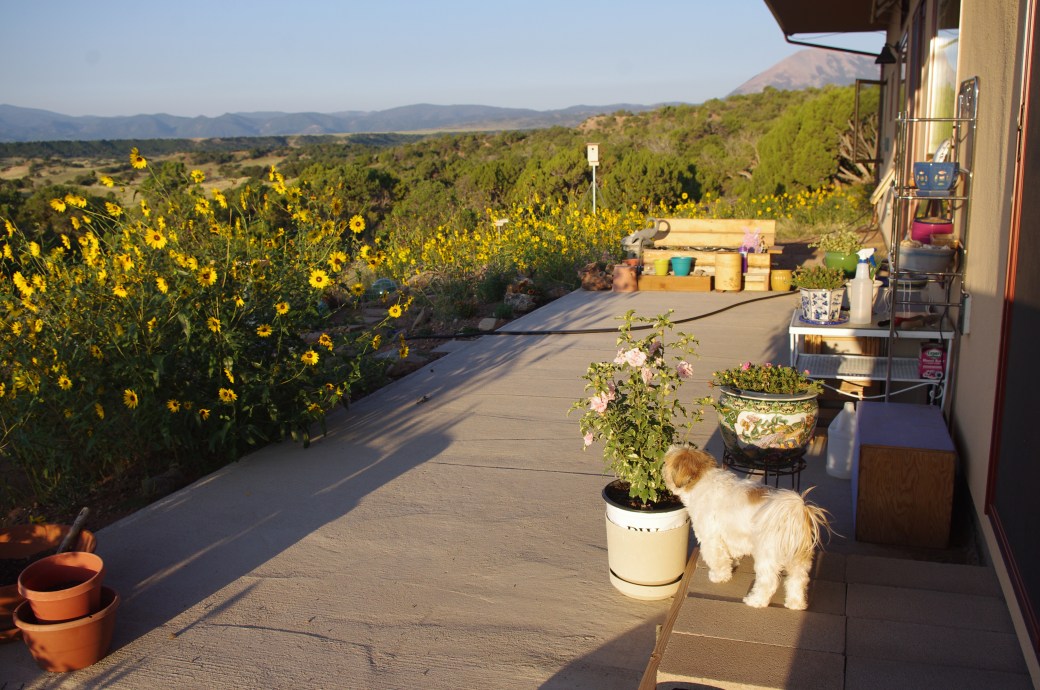
Then yesterday I went out into my garden and found the stupid deer or rabbits had chomped off two of the plants I’ve been carefully nurturing all summer. GRRRR… but my garden has mostly just been taken over by SUNFLOWERS EVERYWHERE! Funny how the deer don’t like them…

IMGP6505

We are experiencing the total invasion of three foot sunflowers everywhere here at the Navajo Ranch in southern Colorado!

Poppy field in Oz

Sometimes it feels just like that scene from ‘The Wizard of Oz’ where they find themselves surrounded by poppies!

I had so much FUN meeting a few new women at a friend’s party yesterday. Most of them live in La Veta, so I got an earful of stories and anecdotes about living there. I love La Veta, and I’m so glad it is nearby, but I have never wished that I live there.

IMGP6502

I figure if we came this far to get away from the noise, traffic, pollution, and problems of other people, why move in right next to them?

A Network of Grateful Living: Healing for all

IMGP6485

I hope the rest of you are familiar with “A Network for Grateful Living.” I discovered them through their wonderfully healing short video A Good Day, which offered me a whole new perspective on what a good day can be. I started watching this video ten years ago. This video has changed my life.

Here’s a short statement of how they see their present work:

“These are moments that call on us to harness the greatest courage and conviction that our hearts can muster. Holding fast to our connectedness, faith, creativity, values-clarity, and our tenacity to love more deeply than ever – this is the work of our times. 

Our work is to offer a wellspring of nourishment, support, and inspiration for you and this community; that we might collectively move through the moments of our days, and the days of our lives, uplifting and helping to heal ourselves, one another, and the world. Thank you for drinking from this well…”

IMGP6121

I personally cannot summarize my own work any better than that…

The pros and cons of antidepressants

paxil tabsA few months into our move here in 2014, I became very stressed. The uncertainty of this major adventure had overwhelmed me, so I started taking a low dose of Paxil. Surprisingly, my doctor told me nothing about the side effects and long-term problems that might occur. It took a new friend to finally inform me how detrimental that 10 mgs could be to my health. She said it can cause problems with weight gain and decreased libido.

Come to find out, it can do a LOT MORE!

paxil side effectsHere’s a list of possible side effects from Paxil: Weakness, Drowsiness, Dizziness, Nausea, Anxiety or nervousness, Dry mouth, Insomnia, Constipation or diarrhea, Increased sweating, Decreased libido, orgasmic inability or delay, Agitation or irritability, Restlessness, Impulsiveness, tremors, hyperactivity, Memory problems, Allergic reactions, Problems with balance or coordination, Confusion or Hallucinations and Racing or abnormal heart rate.

This did not include additional problems because of my history of brain injury.

Now I’m no idiot. I knew there would be side effects, but gaining back the weight I worked so hard to lose back in 2011, I wasn’t expecting.

I am now in the process of cutting my dose in half. I want out of SSRI dependency. But, of course, this isn’t simple either. It turns out Paxil is one of the most difficult SSRIs to get off of without major problems. Apparently this can effect my brain’s acetylcholine production. I have learned that I need to supplement my levels of choline, lecithin and other B vitamins to lessen the effects of Paxil withdrawal.

Luckily there are dietary changes that help:

“Lecithin and choline can be found in a wide variety of foods, but many of the richest sources are foods also high in cholesterol and fat. Egg yolks are one of the best dietary sources of lecithin/choline. Other excellent sources of dietary choline are beef steak, liver, organ meat, spinach, soybeans, cauliflower, wheat germ, peanuts, and brewer’s yeast.”

I’ll let you know how this process goes for me, but in the meantime, please give some thought to the prescription drugs you are presently taking. Are they helping enough to be worth their side effects? Inform yourself about what other problems they can cause.