My sister and I have been dealing with this question for the past few years, as our father died and then our mother and brother’s health continued to fail. In addition, we have both lost companion animals this past year. Is it better to share with others your inner feelings which are dominating your time and energy, or is it best to keep quiet?
In a world where most feelings are now allowed to be shared with those around you, those who supposedly care about you, when someone asks how you are, is it OK to say:
“Well my mom is despondent since she broke her hip and had to be moved to a nursing home, my brother just entered hospice care, and my husband suffers greatly from the major surgery he had this month. Did I mention that my dog died in my arms in July?”
Mostly my sister and I cry together on the phone and then go on. She tells me about how it breaks her heart to watch our Mom’s health and will to live fail. I tell her about our brother’s lonely, sad existence as his lungs and brain fail him. Throw in nearly a month at a hospital two hours north of here for Mike’s surgery, and you will see the sum total of our pain and grief.
Our family Christmas 2021
I know most will say, at least you still have your sister to talk to, and that is such a blessing, but Diane and I can’t help but feel that others don’t want to be brought down by our family’s grief. So many people just cannot handle the pain and grief of others. I have witnessed this personally. Everyone will have their own time of great grief, no matter how hard they try to deny it.
Having someone special to share your grief really does help…
For as long as I can remember, I have always loved words. Even before I learned English, I made up my own language to communicate with my cat and doll. Words meant so much to me. They seemed like magic. With the right words you might get others to understand your most important and secret feelings. With words you could begin to understand other peoples’ worlds. They were the key to everything!
As I grew I kept loving them more and more. Even though, or perhaps because, I was a book worm at heart, words were my own kind of magic. So I read everything I could, especially about other women’s lives. I wondered how they made it through the difficult world I saw outside my door. Words were my key to understanding my world. Then I learned how words could resolve misunderstandings and bring people closer together, another form of word magic. I always wanted to learn more.
Eventually I became a librarian with a whole building full of words. So many stories from all over the world, explaining why we do the things we do. I wanted to learn everything in those books! I began to wonder if I might write a book someday, but then I would find a book that expressed my ideas or feelings better than I could and say, “See, I hasn’t meant to be a writer.”
My own version of a midlife crisis at age 49 changed my mind. I felt like I had to write to understand and explain to others what I was experiencing. This phenomenal transition was too important for others to miss out on. That is when I became a writer. I started a blog that took off, with thousands of followers who seemed to understand what I was talking about. Words helped me to expand my world, all around the world! I had friends in Europe, Asia and Australia who understood the exceptional opportunity of changing everything in midlife.
Since then much has changed in my life. A traumatic brain injury in 2008 began to stand in the way of my wonderful relationship with words. I did get back to writing and still loved it, but then I learned, through a few concussions, that I needed to live on oxygen fulltime. And the concussions took their toll. Now I can only properly handle fewer and fewer words. A conversation with another can only go on for an hour or so before my brain gets tired and needs some silence to rest up for more time with others. Some days I have trouble remember the most basic words, like yesterday I had a hard time remembering the word for “dimples.”
For all of these reasons I will not be writing here much longer. My joy in writing is diminishing slowly. The concentration required seems to hurt my mind, especially being on the computer so long. After writing something like this I have to stare off into space for a while to recuperate.
But I do still love words and will continue that relationship for as long as I live. And I will also continue to admire when other writers get it so right. I believe this writer got it right in describing my favorite vision of life after death:
“There is a moment when your dreams and memories merge together to form a perfect world. That is heaven. Each heaven is unique. This is the world of you. The land is filled with all you hold dear, and the sky is your imagination.” – From the end of the movie “1883” written by Taylor Sheridan
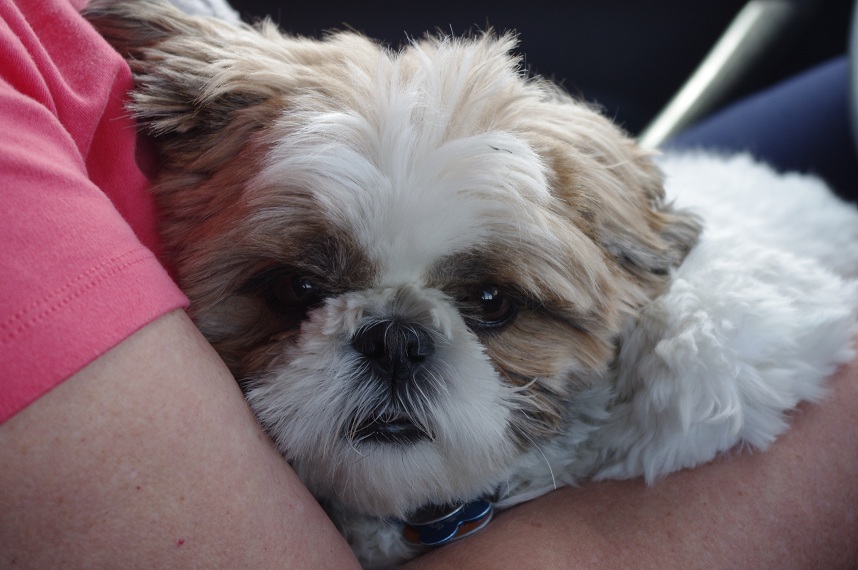
Rasta was my Christmas present in 2008…what a cutie pup!
We lost our precious Rasta pup this week. After a couple of weeks of trying to avoid reality, we found we had to accept that his quality of life had taken a brutal turn for the worse, with the loss of his other eye to glaucoma and a stroke. He was 14 and a half and had one of the best lives a pet could have. He was loved and appreciated his whole life.
“The cutest puppy in the history of the world!” to quote our friendRad
I have not had much direct experience with death in my life. Yes, I have avoided it, I must admit. Mike didn’t have that luxury as his beloved mother died at an early age. There has been a touch of non-reality to death in my life, even though I have lost pets before. Unfortunately, Mike had to deal with the actual physical body for us. Our vet comes out to your car and puts your pet to sleep in your arms. I will never forget the shot to his heart. Then Mike prepared him for burial and buried him on our land, in a place that is not physically accessible for me.
Here are a few personal observations about loss and grieving from my perspective:
There is a certain non-reality to death. They were here and now they’re just gone.
I feel extreme sadness and yet I know that Rasta is better off not suffering anymore.
We removed the obvious reminders of his life around us and yet I still look for him constantly, miss his greeting when I come into our home, save delicious leftovers for him, and talk to him. I can’t get out much anymore. He was my constant companion.
There are so many TV commercials for pet food, etc. making it abundantly clear that pets have become our new version of children…
We should not make any comparisons about how we each suffer loss and grieve. Everyone feels pain and loss differently and it can bring up difficult previous memories of loss and pain. We all grieve in our own way.
This kind of pain leaves me searching for any type of escape or distraction from the loss. Just to forget this loss temporarily feels like a blessing.
Goodbye Rasta. Rest in Peace. We loved you so very much!
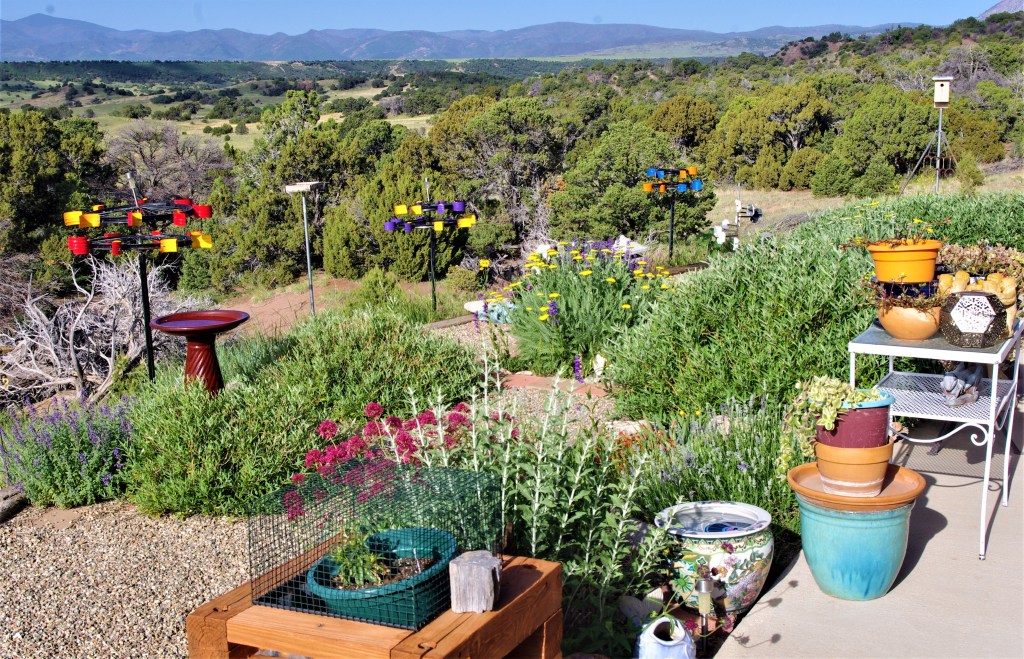
I haven’t been out to my garden lately because of a painful hip and various illnesses in our family. But this morning was glorious, with temperatures in the 60s and great light, so I took a walk around and this is what I found.
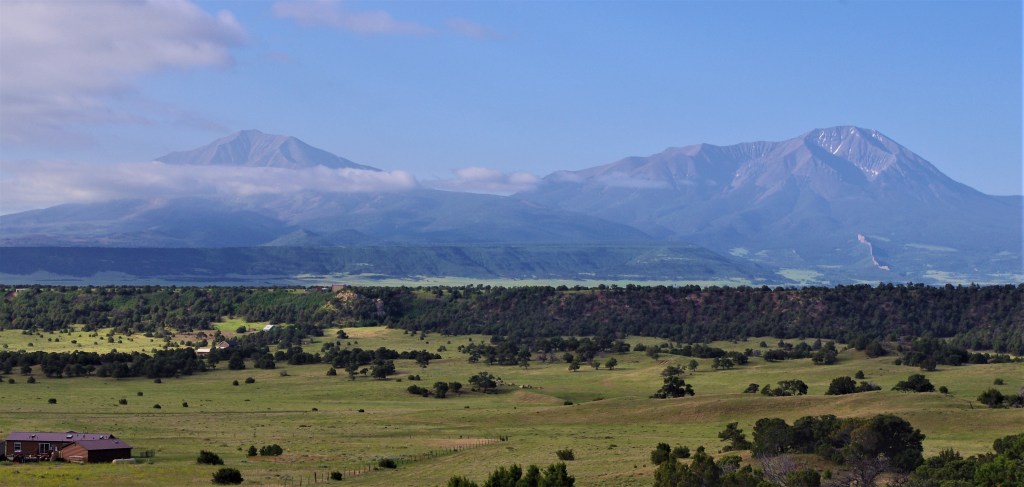
First I noticed the loveliness of the East Spanish Peak, with a sash of wispy clouds around it.
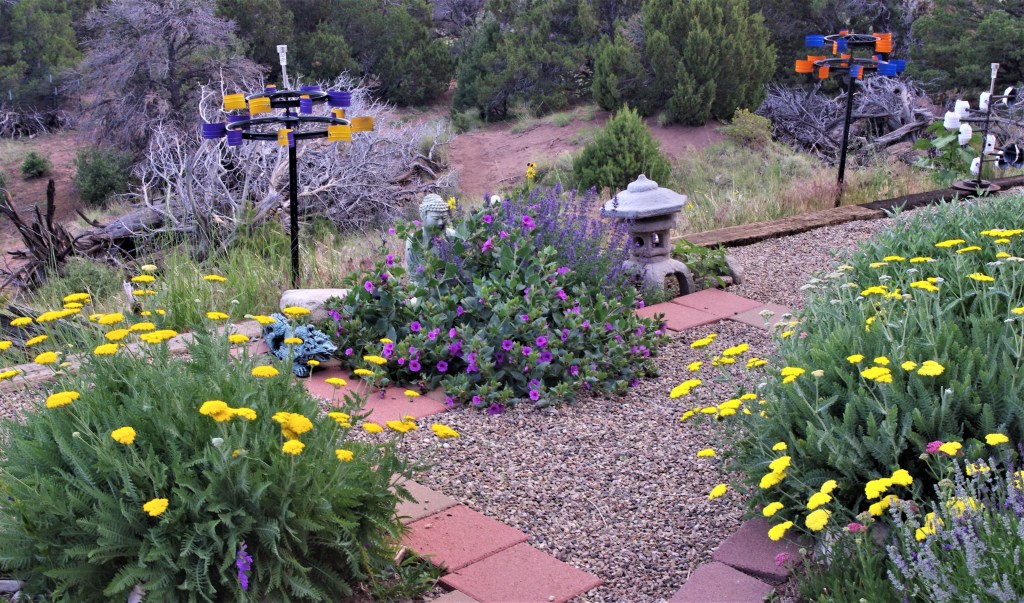
Then I was drawn to my center piece of golden yarrow and those Rocky Mountain Penstemon who survived the deer that ate most of them in early spring.
Behind and to the right is my Buddha decorated with native Showy Four O’Clocks and Catmint. I still have a yellow Coreopsis that should be coming in soon to the left of Buddha, if the others leave enough room!
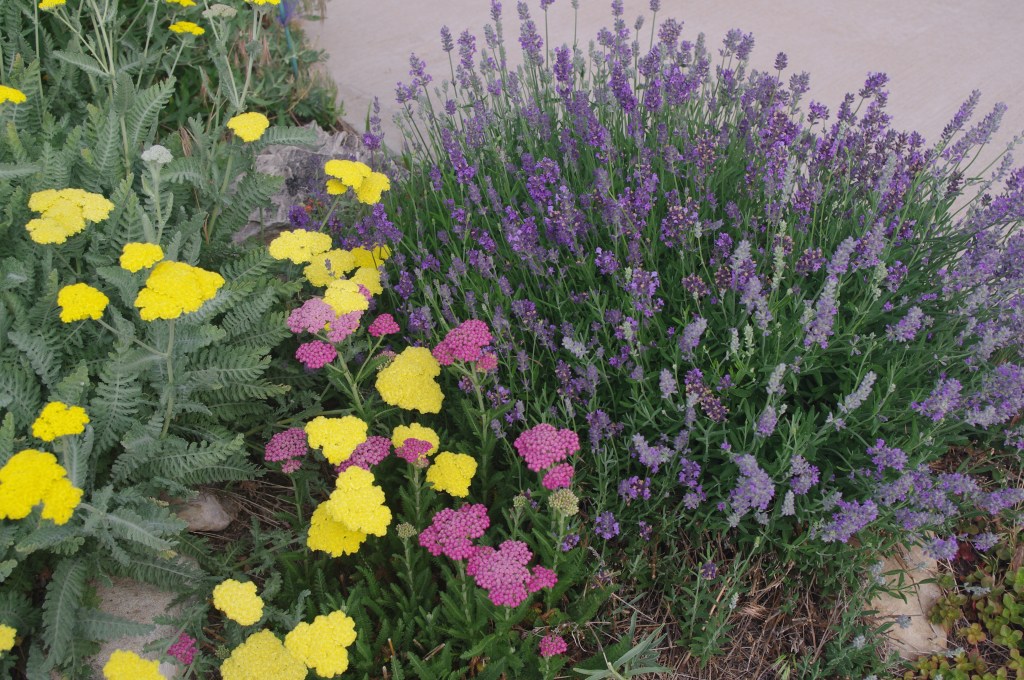
My yarrow and lavender plants are coming along well…
My yellow Columbine is almost finished blooming. Now it’s spreading its seed for next year…
My favorite time of year in my garden!
We had a quiet time celebrating the solstice this June. Our loving pup Rasta is now almost completely blind. Glaucoma just took his other eyethis week 😦
I was reorganizing my retirement funds recently and that got me thinking: How are other retired Baby Boomers doing? In that process I learned about why we have fewer and fewer workers for highly skilled jobs…
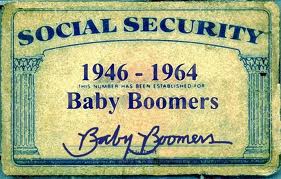
Baby Boomers, born between 1946 and 1964, make up 28% of the United States population, making them one of the largest living adult generations, second to millennials. In 2011, the first round of Baby Boomers—those Americans born between 1946 and 1964—turned 65.
From now until 2030,10,000 Baby Boomers will be retiring every single day!
The COVID pandemic, shall we say, encouragedearly retirement. According to the Pew Research Center, the rate of retirement for Boomers accelerated with COVID-19, with nearly29 million Boomers retired in 2020, three million more than in 2019.
Seventy-five million Boomers are expected to retire by 2030, paving the way for what is now being called “The Great Retirement,” as opposed to the “Great Resignation.”
Retirement Savings
“The Great Retirement” is an unprecedented flood of retirees exiting the workforce earlier than planned, triggered by the pandemic which heavily affected those 60 and older. Whether it was to enjoy life, health concerns, or a changing work environment, this part of the workforce has seen an uptick in retirement. In spite of these numbers, many Boomers find it hard to retire. Why? Many baby boomers are worried about their finances. Nearly two-thirds expressed concern about not having enough savings to quit their job. Shockingly, at least to me, the median retirement savings of Baby Boomers today is just $144,000 to $202,000.
Health & Death Rate Among Boomers
The largest generation in American history, Boomers are likely to remain that way for the foreseeable future. What wasn’t foreseen was how long Baby Boomers would live. When the first Boomers were born, the average life expectancy was 63 years old. Among Boomers recently that was79 years, but that is falling.
Unfortunately we, as a generation, are not as healthy as our parents were at our age. Why? One culprit is obesity-associated chronic diseases caused by a gigantic dietary shift. Beginning in the 1950s we were introduced to fast, convenient, processed foods with plenty of additives and preservatives. Today we have increased deaths from chronic liver disease, suicide, cirrhosis of the liver, along with poisonings all caused by addiction. I’m sure you have heard about recent death spikes related to opioid abuse, alcohol abuse, and heroin abuse. The implications of this epidemic are massive.
As we all know, addiction is a symptom of bigger issues—the underlying causes of addiction need to be treated. Our generation, known for questioning authority and seeking equality, has lived through significant family changes brought on from two-parent working households, increased divorce rates, increased career mobility, increased technological advancement, and increased psychological awareness. How have these factors impacted our long-term well-being?
My thoughts
As someone who lives in a poor, rural county in southern Colorado, whose average age is 55, I can say I have known many more people who have died here in the past 9 years than I have ever known before. It seems a fairly regular event to hear of another person’s death. Some move here to retire and find the higher elevation too much of a challenge (kind of like me). Many came here to die and do. We certainly have our share of addiction problems and depression. I now see retirement as more of a quality of life challenge. It isn’t about money, addiction or even how long I live, but more about spending my last years in appreciation for what I have right here before me everyday.
I have been thinking about trauma in my own history these past few weeks and I now see I have suffered a number of traumatic experiences that I did not originally recognize as such. I think this can be attributed to two personal factors. One is that I have always been a “highly sensitive person” and the second is my numerous head injuries in the past 15 years.
I assume most of you have heard of the term highly sensitive, but these are the traits I relate to personally:
Overly sensitive to emotional and physical violence
Naturally experiencing the emotions of those around me
Often feel overstimulated
Often need to withdraw because of overstimulation
Startle very easily
Enjoy a rich inner life
Feel deeply moved by beauty
Deeply emotional and compassionate
Unable to deal with even moderate amounts of criticism
Usually feel different and alone
Easily overthink and worry way too much
Very intuitive
Often feel tired and emotionally overwhelmed
I guess you can see why someone like me can be more easily traumatized. Then when I experienced a traumatic brain injury in 2008, my ability to deal with others, especially when they are angry or even just mean to me was multiplied by one hundred percent. And with this most recent serious concussion I find I am so easily drained after simple exchanges with others, and I can only socialize for an hour or two with anyone.
Luckily I found a life partner who is also quite sensitive and therefore understands exactly how much I can take from others. And yet, even with him I need to withdraw regularly into my quiet little world where nobody can reach me. I simply feel safest alone in very quiet places. I guess I am a true introvert now.









 Adventures of the NEW??? Old Farts